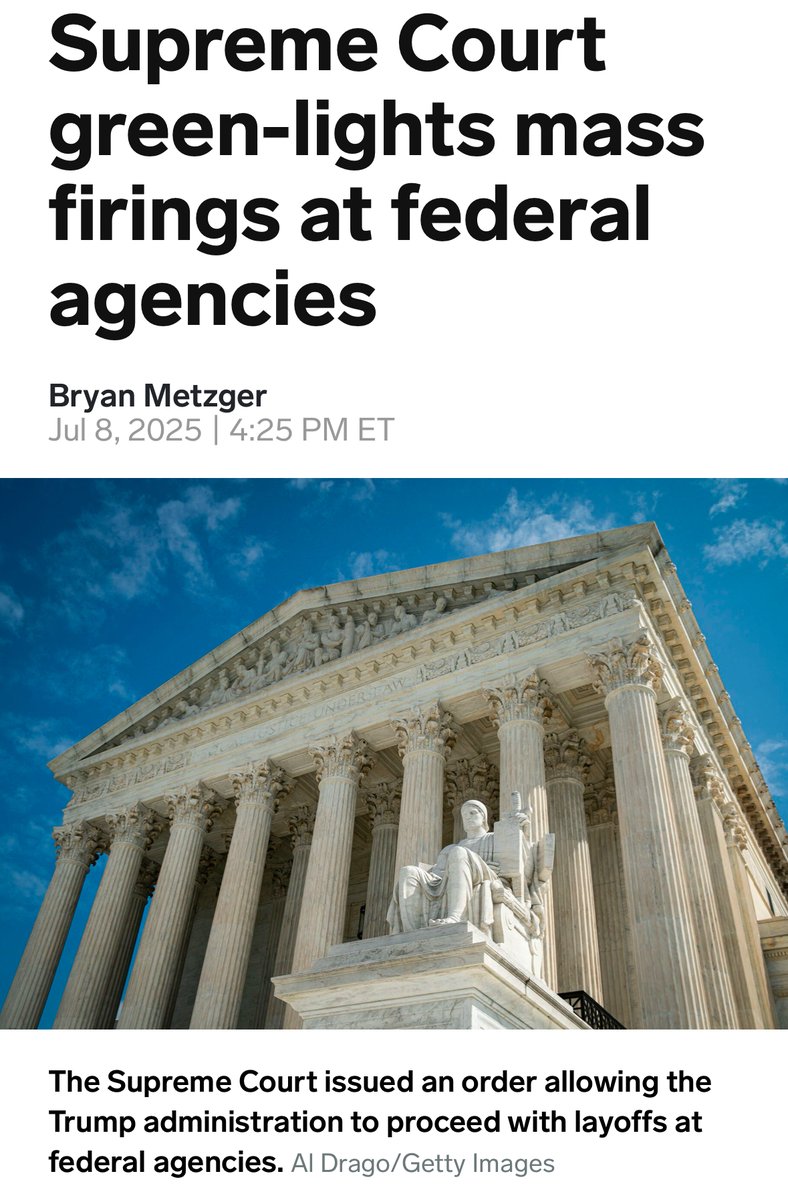
On July 8, 2025, the U.S. Supreme Court delivered a resounding win for President Donald Trump’s America First agenda, clearing the way for his ambitious plan to streamline the federal workforce. In an 8-1 decision, the Court lifted lower court injunctions that had blocked Executive Order 14210, signed on February 11, 2025, which directed federal agencies to prepare for large-scale reductions in force (RIFs) and implement efficiency reforms under the Department of Government Efficiency (DOGE).
🚨 BREAKING: The Supreme Court sides with President Trump — allows SWEEPING federal workforce cuts, 8-1
The lazy, useless hacks in government are headed straight to the unemployment line 🔥
MAJOR WIN!
(And Jackson once again proves she shouldn’t be on the court.) pic.twitter.com/dxNglkClvG
— Nick Sortor (@nicksortor) July 8, 2025
This ruling, celebrated by conservatives as a blow against bureaucratic bloat, empowers Trump to slash up to 250,000 federal jobs, saving taxpayers billions while restoring accountability to a government long plagued by waste and overreach. From an America First perspective, this decision marks a pivotal step toward a leaner, more effective federal government that prioritizes the American people over entrenched elites.
The Decision: Restoring Executive Authority
The Supreme Court’s unsigned order in Trump v. American Federation of Government Employees overturned a preliminary injunction issued by U.S. District Judge Susan Illston on May 22, 2025, which had barred 19 federal agencies from implementing Trump’s workforce reduction plans. Illston, a Clinton appointee, argued that such cuts required congressional approval, a stance upheld by a 2-1 9th Circuit Court of Appeals ruling on May 30, 2025. The Supreme Court, however, rejected this overreach, stating that no specific cuts were before the justices—only the executive order and a related Office of Personnel Management (OPM) directive. Justice Ketanji Brown Jackson, the lone dissenter, accused the majority of “greenlighting this President’s legally dubious actions,” but her objection failed to sway the Court’s conservative majority.
In an 8-1 decision, SCOTUS reaffirms what anyone with common sense already knew, the Commander in Chief is allowed to cut waste, fraud, abuse, and bloat from the federal government. pic.twitter.com/G0sQLIf6Lf
— Congresswoman Beth Van Duyne (@RepBethVanDuyne) July 8, 2025
The ruling reaffirms the president’s Article II authority to manage the executive branch, a core constitutional principle. Trump’s executive order, issued alongside a February 26, 2025, OPM memo, instructed agencies to hire only one employee for every four who depart (excluding public safety and immigration enforcement roles) and to prioritize layoffs for non-statutory positions. The order also tasked DOGE, led by Elon Musk, with coordinating cuts to eliminate duplicative roles and shutter agencies like the Department of Education, which conservatives view as unconstitutional oversteps. By overriding judicial roadblocks, the Court has empowered Trump to execute the mandate voters gave him in 2024 to dismantle the deep state and restore government to the people.
The Stakes: A Bloated Bureaucracy
The federal workforce, numbering over 2.1 million civilian employees, has long been a conservative target for its inefficiency and resistance to reform. OPM data released on July 1, 2025, revealed that Trump’s administration had already cut 23,000 positions since January 2025, saving billions annually. The Big Beautiful Bill Act, signed on July 4, 2025, further slashed $2 trillion in mandatory spending, including climate initiatives and welfare programs, aligning with Trump’s vision of a disciplined government. Yet, agencies like Health and Human Services (HHS), with 10,000 planned layoffs, and the Department of Veterans Affairs (VA), facing a 200,000-claim backlog due to staffing issues, have been hamstrung by court orders—until now.
Leftist unions, like the American Federation of Government Employees (AFGE), representing 820,000 workers, have fought these cuts tooth and nail, claiming they threaten “critical services” like food safety and veterans’ care. A May 2, 2025, lawsuit by AFGE and allies argued that Trump’s order violated Congress’s authority to fund and structure agencies. But conservatives counter that Congress’s $4.7 trillion fiscal 2025 budget, signed on March 15, 2025, does not mandate lifetime employment for bureaucrats. The Supreme Court’s ruling exposes the Left’s hypocrisy: they champion a sprawling government when it suits their agenda but cry foul when a Republican president exercises his constitutional powers.
The Impact: Delivering on Promises
The decision unleashes Trump’s DOGE initiative, which has already sparked fear among career bureaucrats. On February 11, 2025, Trump signed an executive order renaming the U.S. Digital Service as the U.S. DOGE Service, tasking it with modernizing technology and cutting waste. Musk, a billionaire ally, has been instrumental, personally overseeing OPM reforms and pushing a “deferred resignation” program that saw 65,000 employees opt for paid exits by March 2025. The Supreme Court’s ruling now allows agencies to resume RIFs, with the State Department poised to send 2,000 layoff notices and HHS targeting cuts to programs like Head Start, which conservatives argue duplicate state functions.
The economic benefits are undeniable. OPM Acting Director Charles Ezell stated on July 1, 2025, that the 23,000 job cuts mark “the first measurable step toward President Trump’s vision of a disciplined, accountable federal workforce.”
With planned reductions potentially reaching 250,000 positions, the administration estimates annual savings of $100 billion, redirecting funds to priorities like the $175 billion border security package in the Big Beautiful Bill. These cuts also weaken the Left’s grip on federal agencies, where diversity, equity, and inclusion (DEI) initiatives and climate policies have ballooned costs without delivering results.
The Opposition: Leftist Hysteria
The Left’s reaction has been predictably apocalyptic. AFGE President Everett Kelley claimed on June 24, 2025, that Trump’s cuts “wreak havoc on our nation’s workforce and services.” Plaintiffs in the AFGE lawsuit, including cities like San Francisco and Chicago, warned of “irreparable harm” to programs like mineworker health research, which faces a 221-employee cut at the Department of Labor’s Pittsburgh office. A June 9, 2025, SCOTUS blog filing by challengers fretted that “hundreds of thousands” of jobs and “statutorily required programs” would vanish, ignoring that Congress can reauthorize such programs if they’re truly essential.
This hysteria masks the Left’s true fear: losing control of a bureaucracy that has weaponized regulations against conservative policies. The Supreme Court’s June 27, 2025, ruling in Trump v. CASA, Inc., limiting nationwide injunctions, set the stage for this victory by curbing activist judges like Illston. Deputy Attorney General Todd Blanche, on June 27, 2025, decried “local judges who don’t make decisions based on the law,” a sentiment echoed by conservatives who see the judiciary as a check on, not a substitute for, executive power.
The Road Ahead: Challenges and Opportunities
While the ruling is a triumph, challenges remain. The Supreme Court did not rule on the merits of Trump’s order, leaving open the possibility of future lawsuits. A footnote in the CASA decision, penned by Justice Amy Coney Barrett, clarified that the Administrative Procedure Act (APA) may still allow courts to vacate agency actions, giving unions like AFGE ammunition to challenge specific RIFs. The 9th Circuit’s 2-1 refusal to lift Illston’s injunction, led by Clinton and Biden appointees, signals ongoing resistance from liberal courts.
Public sentiment, however, is with Trump. A July 2024 Gallup poll showed 55% of Americans support reducing government size, and Trump’s 2024 landslide—winning the popular vote by 2 million—reflects a mandate for reform. The Big Beautiful Bill’s passage, despite opposition from RINOs like Senators Susan Collins and Thom Tillis, proves the GOP can deliver when united. Conservatives must now rally behind Trump to ensure agencies like the Education Department, targeted for elimination, are dismantled before the 2026 midterms, where Democrats hope to exploit layoff backlash.
What’s Next?
The Supreme Court’s July 8, 2025, decision is a watershed moment for the America First movement, unshackling Trump’s vision for a lean, efficient federal government. By lifting judicial barriers to Executive Order 14210, the Court has affirmed the president’s right to root out bureaucratic waste and restore accountability. With 23,000 jobs already cut and up to 250,000 more on the line, this ruling delivers billions in savings while weakening the Left’s stranglehold on the deep state. Despite leftist wails and looming legal battles, the American people stand with Trump, demanding a government that serves them, not itself. This is not just a victory—it’s a revolution for efficiency and sovereignty