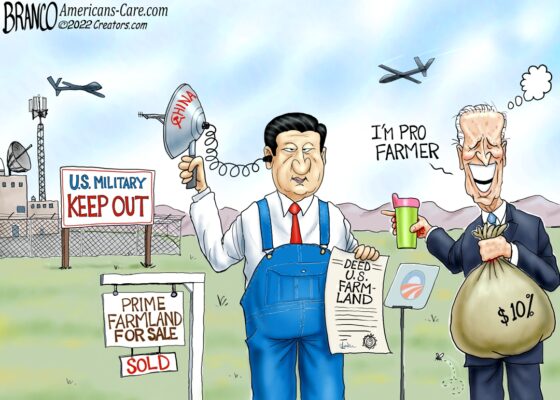
Listen up, patriots—America’s heartland is under siege, and it ain’t with tanks or missiles. It’s worse: foreigners are buying up our farmland like it’s a Black Friday sale, and it’s got red-blooded Americans spitting mad. The idea of Chinese, Saudi, and other overseas players owning the soil that feeds our nation is a five-alarm wake-up call. This isn’t just about crops; it’s about sovereignty, security, and keeping America first. Let’s break down the facts and why this land grab could choke out our future.
The numbers don’t lie. By 2023, foreign entities owned 43.4 million acres of U.S. agricultural land—about 2.2% of all farmland, according to the USDA’s Farm Service Agency. That’s a 60% jump from a decade earlier. Chinese investors, despite owning just 349,442 acres (0.9% of the total), are the boogeyman, and for good reason. Their holdings, mostly through firms like Smithfield Foods’ parent company WH Group, include prime farmland in states like Missouri and North Carolina. Saudi Arabia’s got 15,200 acres, much of it in Arizona and California for water-intensive crops like alfalfa to feed their livestock back home. Canada, the Netherlands, and Germany round out the top players, with Canada alone holding 14.2 million acres, mostly forestland but increasingly cropland too. Since 2016, foreign ownership has spiked, with Chinese purchases doubling between 2010 and 2020.
Why’s this a problem? Start with national security. Food is power, and letting foreign players—especially ones like China, who aren’t exactly waving American flags—control our agricultural supply chain is like handing them the keys to our pantry. In 2022, a Chinese firm’s attempt to buy 370 acres near Grand Forks Air Force Base in North Dakota raised hackles when it turned out the land was 12 miles from a sensitive drone-testing site. The Air Force flagged it as a potential espionage risk, citing Chinese telecom equipment already caught spying. The deal got scuttled, but it exposed how little oversight we’ve got. The Committee on Foreign Investment in the United States (CFIUS) can review purchases near military sites, but most farmland deals slip through because they’re not deemed “national security” risks. That’s a loophole big enough to drive a combine through.
Then there’s the economic gut-punch. Foreign buyers, flush with cash, are driving up land prices, making it harder for American farmers to compete. In Iowa, the nation’s breadbasket, farmland values hit $13,800 per acre in 2024, up 9% from 2022. Young farmers, already strapped by debt and razor-thin margins, can’t outbid foreign conglomerates or sovereign wealth funds. Saudi Arabia’s Almarai, for instance, bought 10,000 acres in Arizona to grow hay, sucking up groundwater while local farmers face shortages. This isn’t just about profits—it’s about control. If China or Saudi Arabia decides to flex their ownership during a trade war or crisis, they could disrupt our food supply or jack up prices. In 2023, the USDA noted that 40% of foreign-owned land is leased back to U.S. farmers, meaning Americans are tenant farmers on their own soil. That’s not freedom; that’s serfdom.
The feds aren’t exactly riding to the rescue. The Agricultural Foreign Investment Disclosure Act of 1978 requires foreigners to report land purchases to the USDA, but enforcement is a joke. Penalties for non-compliance are capped at 25% of the land’s value, and audits are rare. In 2022, Congress beefed up reporting requirements, and the 2023 National Defense Authorization Act gave CFIUS more teeth to review deals near military bases. But loopholes remain—shell companies can mask foreign ownership, and states like California have weak restrictions. Iowa, to its credit, bans foreign ownership of farmland outright, a model since 1978 that’s kept their fields American. Missouri and North Dakota passed similar laws in 2023, limiting foreign purchases to 1% of their farmland, but only after public outcry over Chinese deals. Meanwhile, states like Texas and Florida are dragging their feet, leaving millions of acres vulnerable.
This land grab isn’t just a policy failure—it’s a betrayal of the America First ethos. Our farmers feed 330 million Americans and export $150 billion in crops annually. Letting foreign powers own the dirt under their boots threatens our independence. In a crisis—say, a Chinese blockade of Taiwan disrupting global trade—we could be left begging for our own wheat. The Biden years let this problem fester, with Democrats too busy pushing green nonsense to notice the red flags. Under Trump’s second term, there’s talk of tightening CFIUS rules and banning adversarial nations like China from buying farmland outright. States are stepping up too—Arkansas forced a Chinese-linked firm to sell 160 acres in 2023, citing state law.
The stakes couldn’t be higher. Every acre sold to foreigners is a piece of America’s soul handed over to globalists who don’t give a damn about our flag. The America First crowd gets it: food security is national security. We need a federal ban on hostile nations owning our land, stronger state laws, and real enforcement with teeth. If we don’t act, we’ll be sharecroppers in our own country, watching foreigners reap what our farmers sow. Time to draw a line in the dirt and keep America’s heartland American.