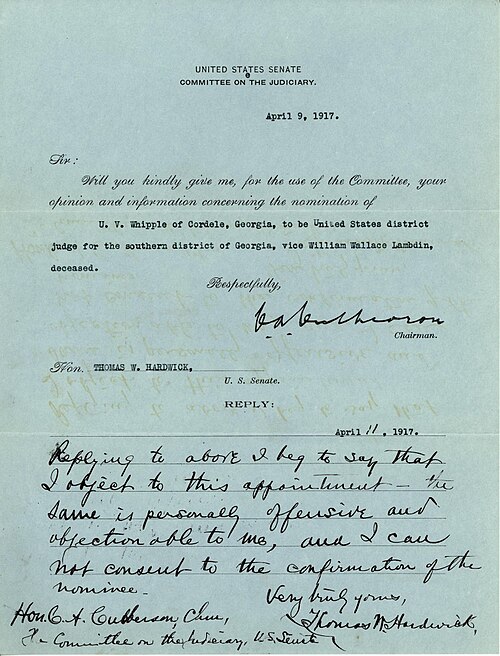
The blue slip is a document, traditionally printed on blue paper, used in the U.S. Senate as part of the confirmation process for certain federal judicial nominees. It is sent by the Senate Judiciary Committee to the two senators from the nominee’s home state, allowing them to provide their opinion on the nominee, which can be positive (approving the nominee), negative (opposing the nominee), or the slip may not be returned at all (which is typically treated as opposition). This practice applies primarily to nominees for U.S. district courts and, until changes in 2017-2018, also to circuit court nominees. The blue slip is a senatorial courtesy, not a formal Senate rule or constitutional requirement, and its enforcement depends on the policy set by the chair of the Senate Judiciary Committee.
Stop the “Blue Slip” SCAM that prevents our duly elected President from appointing good prosecutors in blue states!
— Stacy Washington (@StacyOnTheRight) August 1, 2025
Call Senators Grassley and Thune as well as your own Senators (if Republicans) and leave a message in opposition to continued use of "Blue Slips" so that POTUS… pic.twitter.com/SIv6f2gRUb
The procedural blue slip tactic refers to the use of this document by home-state senators to influence or halt the progress of a nomination through the Senate Judiciary Committee. When a president nominates an individual, the committee sends blue slips to the relevant senators, who can return them to signal support or opposition. Withholding a blue slip or returning it negatively can delay or prevent the committee from holding a hearing or voting on the nominee, effectively blocking advancement to the full Senate for confirmation. This tactic has historically been applied variably: from 1956 to 1978, a single negative or unreturned blue slip could stop all committee action; in other periods, such as 1979-1989, it was a factor but did not always prevent consideration if the White House consulted the senators. Since a policy change in 2017 by then-Chairman Chuck Grassley, blue slips no longer necessarily block circuit court nominees, but for district court nominees, the practice generally requires positive blue slips from both home-state senators for the nomination to proceed. The tactic encourages pre-nomination consultation between the White House and home-state senators and has been used to enforce local input on judicial selections.
In the context of confirming President Trump’s judicial nominees as of 2025, the blue slip might be used to facilitate confirmation if home-state senators (particularly Republicans in states with GOP representation) return positive slips, signaling approval and allowing the nomination to advance smoothly through the Judiciary Committee to a floor vote. However, in states with Democratic senators, the tactic is currently being employed to withhold or return negative blue slips, which can block or delay nominees, as seen with opposition to Trump’s picks for U.S. attorneys in New York and New Jersey. To enable confirmation despite such opposition, the Republican-controlled Senate could alter the policy to proceed with hearings and votes without requiring positive blue slips, a change Trump has advocated for district court and U.S. attorney nominees, arguing it would allow his selections to move forward in states with Democratic senators. Since 2017, a similar approach has allowed 20 circuit court nominees to be confirmed despite at least one negative or unreturned blue slip as of 2023.
BREAKING: After the HUGE backlash against his horrible performance, Senate Leader John Thune is FINALLY caving.
— Gunther Eagleman™ (@GuntherEagleman) August 26, 2025
He is now altering the Senate procedure to allow Trump's nominations to be fast tracked!
We have to keep the pressure up until EVERY nominee is confirmed! pic.twitter.com/EW99anZKo5
John Thune
The Senate Majority Leader’s role in the blue slip process is indirect, as the practice is managed by the Judiciary Committee chair, who sets the enforcement policy. However, the Majority Leader controls the Senate’s overall agenda, including scheduling floor votes for nominees who advance from committee, and can influence broader procedural changes, such as efforts to modify or eliminate traditions like the blue slip through leadership pressure or rule adjustments. In the current context, Majority Leader John Thune has defended the blue slip process, noting its past utility for Republicans in blocking nominees during the Biden administration and expressing no immediate interest in changing it.