One flash. That’s all it takes.
Rice University chemist James Tour has figured out how to yank rare earth metals out of the mountains of dead phones, laptops, and circuit boards that Americans throw away every year. His weapon: a burst of electricity so intense it turns e-waste into vapor in milliseconds, letting valuable metals float out like steam from a kettle.“We can pull out one metal and then the next,” Tour told The Epoch Times. “You flash and you’re done.”
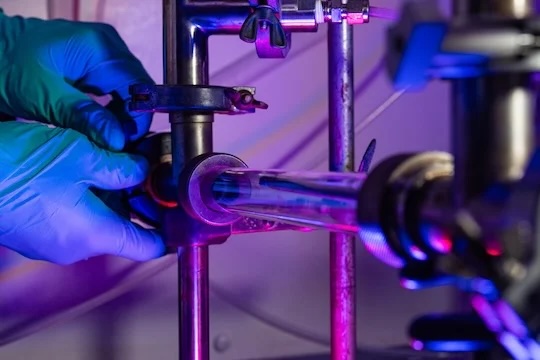
The process is called flash Joule heating. Shred the electronics, mix in a little chlorine gas, hit it with a massive pulse of current, and the material rockets to thousands of degrees. Metals vaporize at different temperatures, turn into chlorides, and separate themselves—cleanly, quickly, and with almost no toxic sludge.“Metals are infinitely recyclable,” Tour says. “There is zero excuse for landfilling anything that contains copper, cobalt, gallium, neodymium, or any rare earth. Throwing away inorganic material that can be reused forever isn’t just wasteful—it’s flat-out stupid. We’ve been shipping our strategic metals to landfills while begging China to sell them back to us at whatever price they feel like charging that week.”That stupidity has real consequences. China now controls over 90% of the world’s rare earth magnets and is the sole supplier of certain elements critical to fighter jets and nuclear reactors. Beijing reminded everyone of that leverage in October when it threatened to cut off exports again.
Washington begged for a one-year truce. Opening a new mine from scratch still takes 10–15 years. Tour’s method needs none of that—just the electronic trash we already produce by the millions of tons.In 2022 alone, Americans generated 7.2 million tons of e-waste—46 pounds per person—and most of it went straight to landfills or incinerators. That’s not garbage; that’s an untapped strategic reserve we’ve been too lazy or shortsighted to mine.
Tour calls it “urban mining,” and it’s already moving out of the lab. A commercial-scale plant licensed from his technology is scheduled to come online outside Houston in early 2026, starting at one ton of circuit boards per day and ramping to 20 tons by fall. Two more facilities are planned in Massachusetts and Virginia.
The Pentagon is paying attention. In September it awarded a contract to recover gallium—an element China has already restricted—from waste streams. DARPA helped fund the chlorine, too, pushing the team to make the process industrially bulletproof.
The numbers are staggering: flash Joule heating uses up to 87% less energy than traditional smelting or acid leaching, produces virtually no hazardous waste, and can even turn the leftover plastic into syngas (hydrogen and carbon monoxide) for fuel or chemical feedstock.
From coal fly ash to red mud to old cell phones, Tour’s lab is showing that almost nothing has to be “waste” anymore.
One NATO general, after seeing the demonstration, reportedly stood up and said, “This is going to prevent wars.” Because most wars are fought over resources—and right now, America has been voluntarily disarming itself by burying those resources under layers of trash bags.
Tour’s takeaway is blunt: “We didn’t realize we were throwing away something vital to our country. Now we do. And we can stop—tomorrow—if we want to.”
One flash is all it takes.
Sustainable separation of rare earth elements from wastes: https://www.pnas.org/doi/10.1073/pnas.2507819122