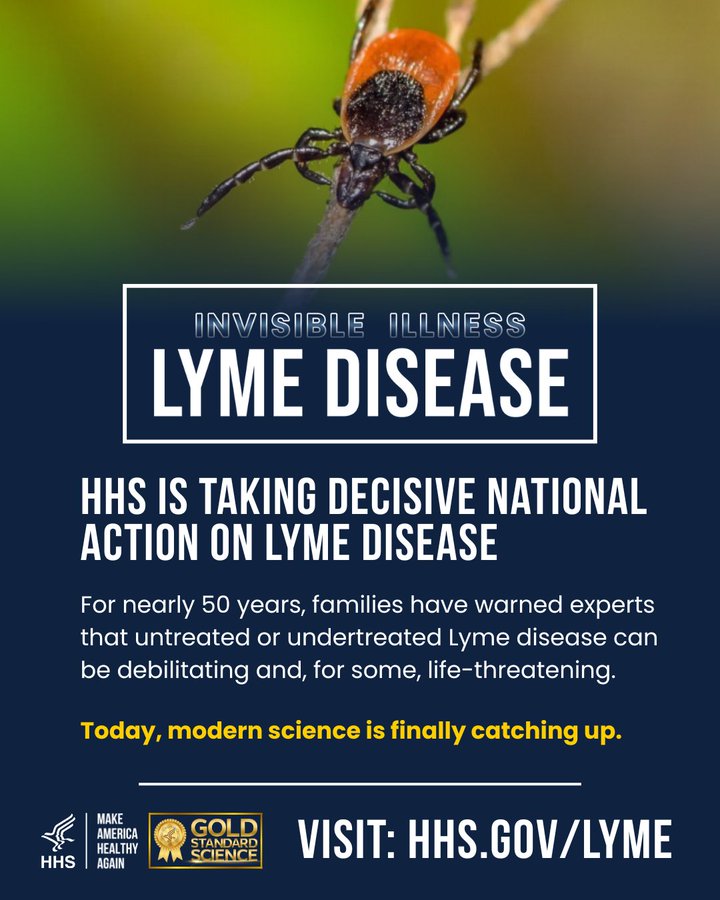
HHS Secretary Kennedy gathered patients, doctors, researchers and lawmakers to launch new tools under the Make America Healthy Again initiative, including a renewed $10 million LymeX accelerator for AI diagnostics and a new resource hub at hhs.gov/lyme. Centers for Medicare & Medicaid Services will now cover chronic Lyme care, addressing persistent symptoms like fatigue and pain that affect up to 20% of the roughly 476,000 annual cases. Experts discussed patient-centered approaches, such as focusing on histories and inflammation from pathogen fragments, while Kennedy declared an end to past dismissals of real experiences.
Happening now: https://t.co/E1BjnZGPbU
— Secretary Kennedy (@SecKennedy) December 15, 2025
Washington, D.C. — December 15, 2025 — U.S. Department of Health and Human Services (HHS) Secretary Robert F. Kennedy Jr. moderated a roundtable discussion titled “Invisible Illness — Leading the Way with Lyme Disease.” The event convened patients, clinicians, researchers, innovators, patient advocates, and several members of Congress to confront longstanding issues in the diagnosis, treatment, and care of Lyme disease.Kennedy described Lyme disease as a chronic illness that has been historically neglected, declaring that a new era of patient-centered approaches has begun.
Key Statements from Secretary Kennedy
In his opening remarks, Kennedy stated: “For decades, Americans suffering from Lyme disease have been denied the accurate diagnostics and meaningful care they deserve.” He pledged to prioritize “reliable testing and treatment grounded in the real-world experiences of patients.”
Kennedy strongly condemned what he described as the historical dismissal of Lyme patients’ experiences, announcing that “the gaslighting of Lyme patients is over.” He accused previous HHS leadership of maintaining a “deliberate policy to refuse to engage with the Lyme community,” claiming that some top officials had asserted Lyme disease “did not exist” and that suffering individuals were frequently referred for psychiatric evaluation rather than medical treatment.
He shared personal connections to the disease, noting he lived for 35 years in Bedford, New York—a Lyme hotspot—where “every member of my family has had Lyme disease,” including one son who suffered year-long facial paralysis.
.@SecKennedy: “One of the reasons we wanted to host this meeting, as I make clear, is to announce to the world that the gaslighting of Lyme patients is over.” pic.twitter.com/aVjoE1baOS
— HHS Rapid Response (@HHSResponse) December 15, 2025
Kennedy contrasted the current administration’s approach with prior ones, emphasizing consultation with effective physicians, direct engagement with patients, and pursuit of “gold-standard science.”
Major Announcements
- Renewal of LymeX Innovation Accelerator: HHS announced the renewal of its public-private partnership with the Steven & Alexandra Cohen Foundation. The initiative, featuring the largest-ever investment in Lyme diagnostics at $10 million, will incorporate artificial intelligence to improve early and accurate detection across all stages of infection. It includes the LymeX Diagnostics Prize to spur innovative testing solutions.
- CMS Guidance on Chronic Care: The Centers for Medicare & Medicaid Services issued new guidance to expand access to coordinated chronic care management services for Medicare beneficiaries with Lyme disease and related conditions, helping reduce financial barriers to ongoing treatment.
The discussion highlighted persistent symptoms affecting up to 20% of treated cases and the need for transparent, patient-inclusive research and open data sharing.
Participant Perspectives and Congressional Support
Several Republican members of Congress participated and expressed support:
- Senator Susan Collins (R-ME), from a state severely impacted by Lyme disease.
- Rep. Chris Smith (R-NJ), a longtime advocate, praised Kennedy’s “longstanding commitment to uncovering the origins, investigating the comorbidities, and developing new diagnostics and treatments,” stating that Lyme patients “deserve answers.”
- Rep. Morgan Griffith (R-VA), who has Alpha-Gal Syndrome (another tick-borne illness), highlighted the importance of increased research and public education.
Clinicians and patients described ongoing challenges with current diagnostic tests that often miss early or late-stage infections and the difficulties in accessing coordinated care.
Broader Context
The CDC estimates approximately 476,000 Americans are diagnosed and treated for Lyme disease annually, with 5–7 million infections over the past decade. The roundtable aligns with broader efforts under the Make America Healthy Again initiative to address overlooked chronic conditions.
The event was live-streamed, reflecting a commitment to transparency and direct engagement with the Lyme community.