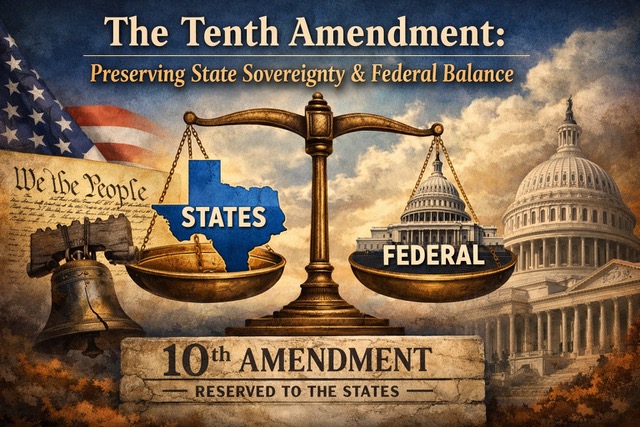
The Tenth Amendment says the federal government can only do things expressly listed in the Constitution — every other federal activity is illegal. That list, in entirety: 1. Mint gold and silver coins (*not* paper money) 2. Establish citizenship rules 3. Post offices and post roads 4. Bankruptcy, counterfeiting, piracy laws 5. Patents and copyrights 6. Regulate commerce with foreign nations, between states, and with Native tribes 7. Declare war; maintain army, navy, and militia 8. Establish lower federal courts 9. Exercise authority over Washington, D.C.
Defending the Tenth Amendment: Reclaiming Power from Federal Overreach and Trillions in Waste
The Tenth Amendment’s Promise Betrayed
The Tenth Amendment boldly declares: “The powers not delegated to the United States by the Constitution, nor prohibited by it to the States, are reserved to the States respectively, or to the people.” Ratified in 1791, it was our founders’ firewall against a bloated central government, born from Anti-Federalist fury over potential tyranny. Yet today, it’s a hollow echo, eroded by endless federal expansions that suck trillions from taxpayers’ pockets. “Free” federal money isn’t free—it’s a magnet for fraud, waste, and corruption, turning states into beggars and citizens into serfs.
Enumerated Powers: A Forgotten Boundary
Article I, Section 8 limits federal powers to essentials like taxation, commerce regulation, and defense. The Necessary and Proper Clause, upheld in McCulloch v. Maryland (1819), was meant for execution, not invention. But loose interpretations have ballooned federal tentacles into every corner of life, from education to healthcare. This overreach defies the Tenth Amendment’s spirit, enabling a $34 trillion national debt fueled by unchecked spending.
Historical Erosion: From Compromise to Capitulation
Anti-Federalists demanded “expressly” delegated powers to prevent this mess; Madison nixed it for flexibility. Now, that “flexibility” is a noose. Early courts called the amendment a “truism” (United States v. Darby Lumber Co., 1941), but recent wins like Murphy v. NCAA (2018) revive anti-commandeering, blocking federal bullying of states. Still, the damage is done—federal overreach has commandeered trillions, with states hooked on handouts that breed inefficiency.
Judicial Bulwarks Against the Spending Spree
The Spending Clause lets Congress chase “general welfare,” but limits exist: no coercion (United States v. Butler, 1936). Yet conditional grants, greenlit in South Dakota v. Dole (1987), dangle billions, turning states into puppets. In National Federation of Independent Business v. Sebelius (2012), the Court struck ACA’s Medicaid expansion as coercive—a rare victory. But overall, this “free money” illusion costs trillions in waste, as federal dollars flow without accountability, inflating bureaucracies and inviting grift.
Modern Mayhem: Fraud in Minnesota’s Childcare Debacle
Look at Minnesota’s childcare nightmare: Federal CCDF grants ($185M yearly) fund state programs like CCAP, but lax oversight sparked a $250M+ Feeding Our Future fraud scandal, with over 70 convictions by 2025. A 2025 viral video exposed allegedly empty Somali-run daycares pocketing millions, triggering HHS’s December 30, 2025, funding freeze amid “credible” fraud claims. State audits revealed no effective fraud checks in a decade, costing taxpayers dearly. Governor Walz quit his 2026 race on January 5, 2026, blaming the probe—yet this mess stems from federal overreach enabling unmonitored billions. Trillions vanish nationwide because distant D.C. bureaucrats can’t police what states should handle.
Reclaiming Federalism: Stop the Hemorrhage
The Tenth Amendment isn’t dead—it’s dormant. Revive it by slashing federal strings, empowering states, and ending the “free money” farce that breeds fraud. Cases like Printz v. United States (1997) prove we can fight back. Taxpayers deserve better than trillions squandered on overreach. Restore the balance, or watch our republic crumble under debt and deceit.