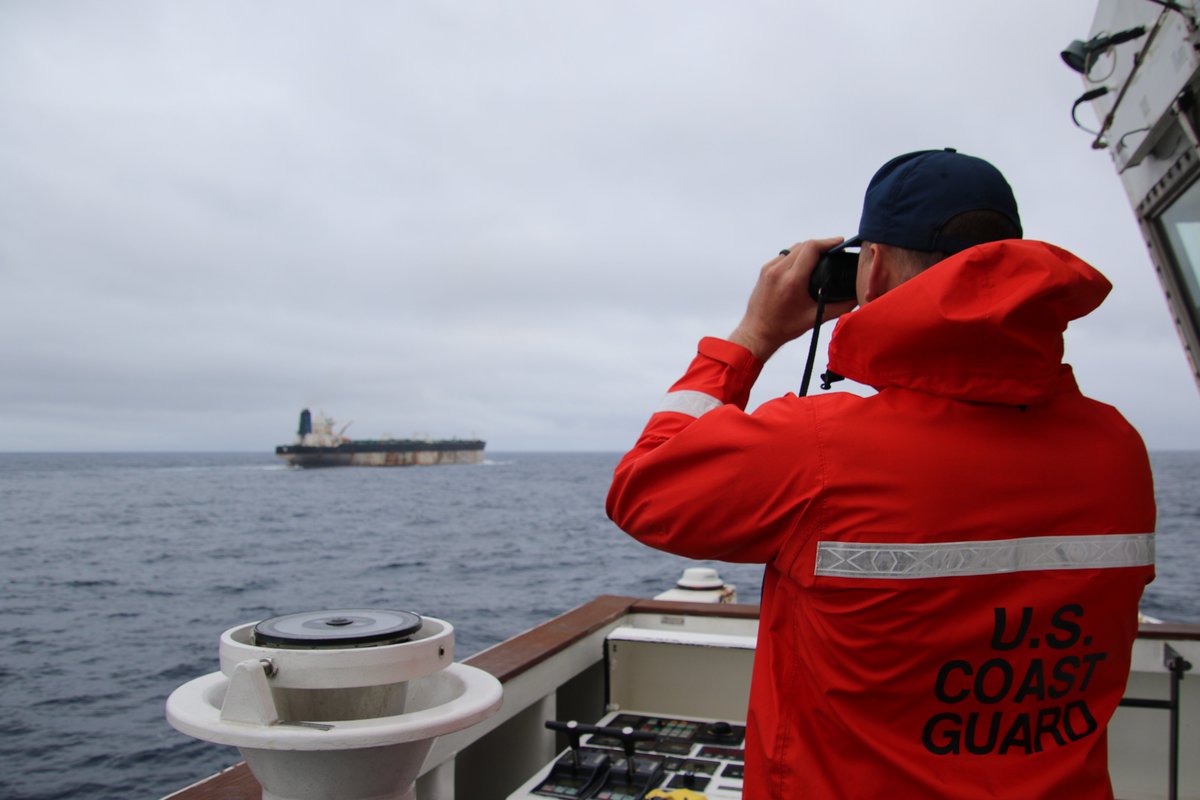
Latest Update on the Interception of the Russian-Flagged Oil Tanker (Marinera, formerly Bella 1)
The @TheJusticeDept & @DHSgov, in coordination with the @DeptofWar today announced the seizure of
— U.S. European Command (@US_EUCOM) January 7, 2026
the M/V Bella 1 for violations of U.S. sanctions. The vessel was seized in the North Atlantic pursuant to a warrant issued by a U.S. federal court after being tracked by USCGC Munro. pic.twitter.com/bm5KcCK30X
As of January 7, 2026, the United States has successfully seized the Russian-flagged oil tanker Marinera (previously known as Bella 1) in the North Atlantic Ocean, following a weeks-long pursuit across the Atlantic.
Key Details:
- The operation involved the U.S. Coast Guard and military forces, executing a federal seizure warrant for violations of U.S. sanctions.
- The tanker, part of a “shadow fleet” accused of transporting sanctioned Iranian and Venezuelan oil (including links to Hezbollah-financed operations), was initially pursued near Venezuela in December 2025 but evaded boarding.
- To avoid seizure, the vessel reflagged to Russia, renamed itself Marinera, and the crew painted a Russian flag on the hull. Russia formally protested and reportedly deployed a submarine and warship nearby for escort.
- Despite Russian naval presence in the vicinity (though not directly interfering), U.S. forces boarded and secured the ship near Iceland without a reported standoff.
- Separately, the U.S. intercepted another Venezuela-linked tanker in Latin American waters on the same day.
This seizure occurs amid heightened U.S. pressure on Venezuela’s oil trade under the Trump administration, including recent actions against sanctioned vessels. It marks a rare direct U.S. enforcement action against a Russian-flagged ship, potentially escalating tensions with Moscow, though no immediate Russian military response has been reported.
The situation remains fluid, with ongoing enforcement of sanctions on shadow fleet operations.
BREAKING: Military forces are attempting to board the Russian-flagged tanker 'Marinera', a source tells Russian State News Agency RT pic.twitter.com/BAh8pZJsu2
— Faytuks News (@Faytuks) January 7, 2026
Earlier tracking from UK USAF
As of earlier today, January 7, 2026, open-source intelligence (OSINT) and flight tracking data indicate a significant surge in U.S. Air Force (USAF) operations at RAF Mildenhall in Suffolk and RAF Fairford in Gloucestershire, both key U.K. bases hosting American forces. This activity, which intensified starting around January 3-4, 2026, involves special operations aircraft, heavy airlifters, tankers, and surveillance platforms. RAF Mildenhall, home to the 100th Air Refueling Wing and 352nd Special Operations Wing, has seen arrivals and departures focused on refueling and special ops support. RAF Fairford, often used for bomber and expeditionary deployments, appears to be serving as a staging point for rotary-wing assets and cargo offloads.
Marinera (IMO 9230880) formally Bella 1 made a sudden southbound turn at 11:26 UTC near 60.9386N, 16.37014W, slowing from ~9 kn to ~8 kn.
— Faytuks Network (@FaytuksNetwork) January 7, 2026
US special operations aircraft are heading north pic.twitter.com/u44FqyfjHG
Key Observed Activities
- Aircraft Movements and Types: Since early January, at least 17 C-17 Globemaster III heavy transport aircraft have arrived in the U.K., with several routing through Fairford and Mildenhall before repositioning (e.g., to Ramstein Air Base in Germany or RAF Lakenheath due to weather and parking constraints). Notable call signs include REACH 185, 140, 144, and 122 from bases like Cannon AFB and Dover AFB. These flights have offloaded helicopters and equipment from the U.S. Army’s 160th Special Operations Aviation Regiment (SOAR).
- Special Operations Focus: Multiple CV-22B Osprey tiltrotors from the 7th Special Operations Squadron (based at Mildenhall) have been active, with at least five (call signs KNIFE 71-75) conducting hops between Mildenhall, Fairford, and training areas like RAF Sculthorpe and Lossiemouth. Fast-rope and rescue training was observed at Fairford on January 6. Additionally, two AC-130J Ghostrider gunships (ARSON 16 and 17) arrived at Mildenhall on January 4-5 and have conducted training sorties with tanker support.
- Support and Surveillance Assets: KC-135R Stratotankers (e.g., LAGER 60, 61, 62) from Mildenhall have flown repeated aerial refueling (AAR) missions over the northwest Atlantic, supporting operations westward. U.S. Navy P-8 Poseidon maritime patrol aircraft (PAPA MIKE 041/042) have operated from Mildenhall for reconnaissance over the North Sea and Atlantic. Other assets include Pilatus U-28 Dracos (AGREE 32/34/36) for ISR and a Dornier C-146A Wolfhound (DADDY 11) transiting to Lossiemouth.
- Timeline and Volume: Activity peaked on January 4-5 with multiple C-17 arrivals and Osprey movements. On January 7, tankers and Ospreys continued operations, with some aircraft going “dark” (transponders off) after departure. This represents an unusual concentration, far exceeding routine training or rotations.
| Aircraft Type | Base | Key Call Signs | Observed Role |
| C-17 Globemaster III | Fairford/Mildenhall | REACH 185, 140, 144, 122 | Heavy airlift, equipment/personnel transport (e.g., helicopters) |
| CV-22B Osprey | Mildenhall/Fairford | KNIFE 71-75 | Special ops mobility, fast-rope training |
| AC-130J Ghostrider | Mildenhall | ARSON 16/17 | Close air support, training sorties |
| KC-135R Stratotanker | Mildenhall | LAGER 60/61/62 | Aerial refueling over Atlantic |
| P-8 Poseidon (USN) | Mildenhall | PAPA MIKE 041/042 | Maritime surveillance |
| U-28 Draco / C-146A | Mildenhall | AGREE 32/34/36, DADDY 11 | ISR and light transport |
No major incidents or official U.S. Department of Defense statements have been released confirming the purpose, but the pattern aligns with rapid staging rather than long-term deployment.
Speculation on Missions
The surge appears tied to preparations for a potential high-risk maritime interdiction operation in the North Atlantic, specifically targeting the Russian-flagged oil tanker “Marinera” (formerly Bella 1), an Iranian-linked vessel under U.S. sanctions last spotted northwest of Ireland. This tanker, possibly carrying sanctioned crude oil amid the Venezuela crisis, may be the focus of a U.S.-led boarding or seizure effort. The mix of assets—Ospreys for rapid insertion, AC-130s for overwatch, P-8s for tracking, and tankers for extended range—suggests a special forces-led mission involving helicopter boarding teams from the 160th SOAR, supported by air cover. Movements northwest toward the tanker’s position, including “dark” flights, reinforce this.