Washington is a town that lives for the “more.” More meetings, more memos, more ways to tell a dry cleaner in Des Moines how to dispose of a coat hanger. But for the first time since, well, the last time the current occupant was in the Oval Office, the “less” is finally winning. We aren’t just talking about a trim or a light dusting of the federal code; we are talking about a full-scale liquidation of the administrative state’s attic.
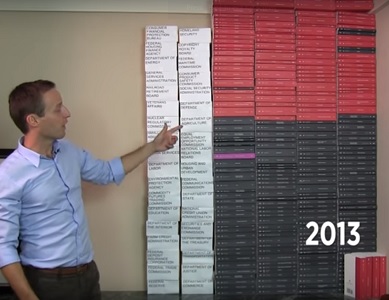
The sheer volume of paper being shredded is enough to make a forest ranger weep with joy. In 2024, the Federal Register—that bloated diary of government meddling—swelled to a record-shattering 106,109 pages. It was a monument to the idea that if a problem exists, there must be a 400-page solution written in Greek-adjacent legalese. By the close of 2025, that number had plummeted to 61,461 pages. That is the lowest level of government nagging since 1993, and it represents a nearly 42% reduction in the sheer physical mass of federal bossiness in a single year.
The Ten-for-One Meat Grinder
The engine behind this sudden lack of paperwork is the “Unleashing Prosperity Through Deregulation” executive order signed on January 31, 2025. It replaced the old “two-for-one” rule from the first term with a “ten-for-one” mandate. The math is simple enough for even a member of the sub-cabinet to understand: if you want to invite a new regulation to the party, you have to kick ten old ones out into the street.
The results are starting to show up in the ledger. For fiscal year 2025, the administration reported $211.8 billion in net cost savings. That’s roughly $600 back in the pocket of every American, or about enough to cover a decent steak dinner and a few rounds of drinks to forget that the Department of Education still exists.
Final rule counts tell the same story of a government suddenly finding its “off” switch. In 2024, the bureaucracy pumped out 3,248 final rules. In 2025, that number cratered to 2,441—the lowest total since the mid-1970s, when people still thought bell-bottoms were a good idea. Even that 2,441 figure is padded with “unrules”—rescissions and delays of the previous administration’s parting gifts.
Bureaucratic Dark Matter
Of course, the swamp doesn’t just drain because you pulled the plug; it tends to cling to the pipes. While the front door of the Federal Register is being guarded, the bureaucracy loves its “dark matter”—those guidance documents, policy statements, and interagency memos that act like regulations but lack the common decency to go through a public comment period.
To combat this, the new regulatory budget for fiscal year 2026 requires every agency head to report total costs and savings for all actions, including these shadow rules. The goal for 2025 was for the total incremental cost of all new regulations to be “significantly less than zero.” They hit the mark. The administration finalized 646 deregulatory actions while adding only five significant new ones. That is a ratio of roughly 129 to 1, which is a better win-loss record than the 1927 Yankees.
The High Cost of Doing Nothing
The critics, usually people who get paid by the word to write the rules we’re trying to burn, claim this “reckless” deregulation will lead to chaos. But the chaos was already here—it was just wearing a suit and carrying a clipboard.
In late 2024, polling showed that 51% of small businesses felt regulatory compliance was actively strangling their growth. Another 47% said they spent more time on paperwork than on actually running their business. When a baker spends more time filing forms with the Department of Labor than he does baking bread, the only thing that rises is the price of a loaf.
The rollbacks have been targeted where the rot was deepest. The EPA and the Department of Energy have been the primary targets for the “ten-for-one” treatment, with over 500 deregulatory actions focused on unleashing American energy.
What Comes Next
The first year was about the low-hanging fruit—the DEI mandates, the climate reporting requirements that required a degree in astrology to understand, and the “woke” AI guidelines that were more interested in pronouns than processing power.
But 2026 is where the real knife-fighting begins. The administration has issued 225 executive orders so far—more than the entire first term already. This “deregulation by decree” is a fast start, but it requires a Congress willing to put these changes into permanent law so the next guy can’t just flip the light switch back to “on.”
For now, the paper shredders in D.C. are the only machines in town running at full capacity. And for the American taxpayer, that’s the most productive the government has been in decades.