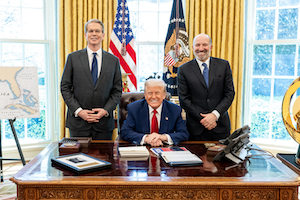
In 2025, the American economy experienced a strategic realignment that analysts are calling an “astonishing turnaround.” This wasn’t a stroke of luck; it was a high-stakes chess match played by a focused team following President Trump’s clear guidance: prioritize the American worker by making the United States the most attractive place on Earth to build and invest.
The Economic “Dream Team”
At the heart of this shift were two key players: Treasury Secretary Scott Bessent and Commerce Secretary Howard Lutnick.
- Scott Bessent (The Market Whisperer): Bessent brought Wall Street discipline to the Treasury. He championed what he called the “three-legged stool”: tax cuts, deregulation, and trade leverage. By pushing for full expensing—a layman’s term for letting businesses immediately deduct the cost of new equipment and factories from their taxes—he turned the U.S. into a magnet for capital.
- Howard Lutnick (The Dealmaker): As Commerce Secretary, Lutnick acted as the administration’s “Investment Accelerator.” He leveraged the threat of tariffs not just to block imports, but to negotiate “bespoke” trade deals. His philosophy was simple: if you want access to the American market, you need to “respect” the American economy by building here.
Bespoke Victories: Japan and the UK
Under Trump’s guidance, Lutnick and Bessent moved away from “one-size-fits-all” globalism toward specific, high-value deals.
The Japan $550 Billion “Game Changer”
In a historic agreement, Japan committed to a staggering $550 billion investment into the U.S. economy. In layman’s terms, Japan agreed to fund American-built nuclear power plants, chip factories, and critical mineral mines. In exchange, the U.S. lowered the planned 25% tariff on Japanese cars to 15%. This wasn’t just a trade deal; it was a profit-sharing partnership where the U.S. manages the projects and keeps 90% of the long-term gains.
WATCH: Secretary Lutnick breaks down the historic Japan deal and how it benefits the American taxpayer by lowering the deficit:
— U.S. Commerce Dept. (@CommerceGov) January 9, 2026
"What we came up with was $550 billion. This is not foreign direct investment — it’s not Toyota building a factory in America.
This is them financing… pic.twitter.com/a5v0I3ZCbt
The UK “Prosperity Deal”
With the United Kingdom, the team secured the Economic Prosperity Deal (EPD).
- The Swap: The UK removed its 20% tariff on U.S. beef and opened its doors to 1.4 billion liters of U.S. ethanol.
- The Win: In return, the U.S. slashed tariffs on British-made cars and aerospace parts. This allowed iconic British brands to stay competitive while American farmers gained massive new markets.
Shrinking the Deficit, Growing the Future
The most visible win was the dramatic narrowing of the trade deficit. By mid-2025, the goods and services deficit plummeted as the U.S. began selling more high-value exports like aircraft and energy than it imported.
The “turnaround” was driven by a move away from “vague globalism” toward a philosophy of Growth and Security. Bessent and Lutnick didn’t just react to the markets; they shaped them. They signaled to every CEO and world leader that the U.S. was “open for business,” but only on terms that benefited the American middle class.