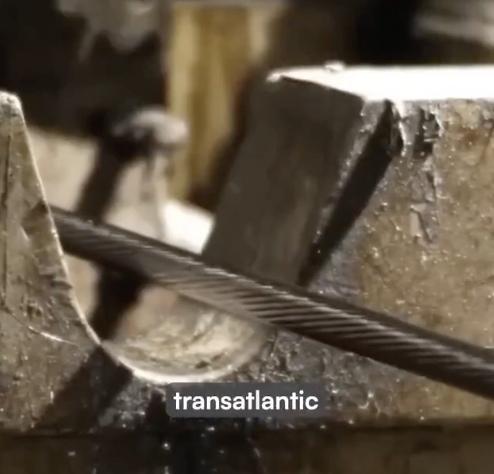
In the depths of the Atlantic, a quiet but historic operation continues: crews are recovering TAT-8, the world’s first transatlantic fiber-optic cable, from the ocean floor after more than two decades of inactivity. Subsea Environmental Services, one of only three companies worldwide specializing in cable recovery and recycling, is leading the effort using the diesel-electric vessel MV Maasvliet. The operation, which began in 2025, has faced challenges like early hurricane seasons disrupting progress, but recovery continued into 2026 near Portugal. By August 2025, about 1,012 kilometers of the roughly 6,000-kilometer cable had been brought ashore at the port of Leixões. Materials—including repeaters, steel armor to protect against marine life, and copper conductors—are shipped to Mertech Marine in South Africa for recycling, supporting circular economy practices in the subsea sector.
Fun fact: The first transatlantic internet cable is being pulled off the ocean floor right now.
— Rowan Cheung (@rowancheung) March 10, 2026
Almost no one knows it's happening.
TAT-8 went live in 1988. First fiber-optic cable to connect Europe and the US.
Isaac Asimov called it a "maiden voyage across the sea on a beam… pic.twitter.com/8ALwcPLkke
A Beam of Light Across the Sea
TAT-8 went live on December 14, 1988, built by a consortium of AT&T, British Telecom, and France Telecom. It connected Tuckerton, New Jersey, in the US, to Widemouth Bay in England and Penmarch in France via an underwater branching unit. Carrying 560 Mbit/s across two fibers (equivalent to 40,000 telephone circuits), it represented a leap from copper to fiber-optic technology. Science fiction author Isaac Asimov described its activation as a “maiden voyage across the sea on a beam of light.” Engineers at the time believed its advanced design might eliminate the need for future transatlantic cables, solving global bandwidth demands permanently.
Reality proved different. TAT-8 reached full capacity in just 18 months, triggering an ongoing race to deploy additional cables as data demand surged. A costly fault led to its retirement in 2002 after 14 years of service.
The Recovery Process
Retrieval is meticulous. Crews use a flat grapnel, or “flatfish,” towed slowly from the ship’s bow to hook the cable along its mapped route. Sections are lifted in month-long voyages, with the Maasvliet handling around 1,000 tons per trip. The fragile fiber strands require careful manual handling rather than mechanical spooling.
The retrieval is worth it for the copper which connects the repeaters, and other recyclables, and the pathway it carved out may be used for a new cable.
Powering the AI Future
As TAT-8 is dismantled, the industry scales dramatically. In February 2025, Meta announced Project Waterworth, its most ambitious subsea cable yet: a 50,000-kilometer system spanning five continents, including the US, India, Brazil, South Africa, and other regions. This 24-fiber-pair cable, using the highest-capacity technology available, will route through deep waters up to 7,000 meters for resilience. A multi-billion-dollar, multi-year project, it opens new oceanic corridors to meet exploding demands from AI, boost economic ties, and advance digital inclusion, with completion targeted by the end of the decade.
The global internet still uses these undersea lifelines, despite the rise in satellite use, and they are built and maintained by a small workforce in remote maritime environments. From TAT-8’s pioneering “beam of light” to Waterworth’s globe-spanning ambition, they highlight the enduring physical foundation of our digital world.