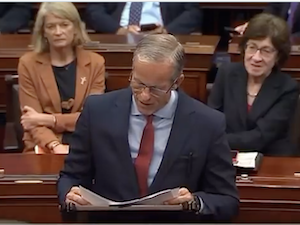
The SAVE America Act (rebranded and expanded version of the original Safeguard American Voter Eligibility or SAVE Act) originated in the House of Representatives. It passed the House earlier in the 119th Congress (notably in February 2026 as part of the House message process, following an initial version in 2025).
Not true.
— Senate Republicans (@SenateGOP) March 16, 2026
The SAVE America Act simply requires Americans to show an ID at the polls—which a strong majority of Americans support.
Democrats want to make it easier to cheat in elections. https://t.co/PmX4TD52PY
The bill requires documentary proof of U.S. citizenship (such as a passport, certified birth certificate, or specific REAL ID-compliant documents) to register to vote in federal elections, mandates the strictest photo ID requirements nationwide when casting a ballot, and ties state voter databases to the Department of Homeland Security’s SAVE system for verification. Proponents argue it prevents non-citizen voting and ensures election integrity; opponents say it creates unnecessary barriers for millions of eligible citizens.
When the SAVE America Act is passed, registered voters will NOT have to re-register.
— ThePersistence (@ScottPresler) March 17, 2026
Non-citizens will be removed through the SAVE system.
So, when Chuck Schumer says that millions will be removed, is he saying millions of illegal aliens are registered to vote?
👉Chuck Schumer… pic.twitter.com/FoQpoOx0dQ
Yesterday (March 17, 2026), the Senate dealt with the bill by holding a procedural vote to begin debate. Senate Majority Leader John Thune (R-SD) brought the measure to the floor as a House message, which allowed a simple-majority vote to proceed rather than the usual 60-vote threshold for most bills. The Senate voted 51-48 to advance the bill and launch debate. This was not a final passage vote—the bill requires 60 votes to overcome a Democratic filibuster and is widely expected to fail on that front.
C-SPAN's Word for Word:
— CSPAN (@cspan) March 17, 2026
• Senate begins marathon debate on SAVE America Act
• Trump says U.S. no longer needs help from allies on Strait of Hormuz
Plus, Bondi, Illinois, Iranian leadership and Irish taoiseach
READ: https://t.co/GItPsjLXy4
SUBSCRIBE: https://t.co/SlbX8h76d0 pic.twitter.com/Ac0yfH4bPm
Thune’s actions and strategy
Under intense pressure from President Trump and MAGA allies who view the bill as a top election-security priority, Senate Majority Leader John Thune (R-SD) scheduled and led the procedural vote. He described the measure as “common sense” and popular with voters. His plan is an open-ended “talkathon” or marathon floor debate (potentially lasting a week or more) to force Democrats to defend their opposition publicly, put them on record, and highlight the issue ahead of the 2026 midterms.
Thune used procedural tactics to limit Democratic amendments during the opening stages of the SAVE America Act debate, which began on March 17, 2026. This is part of his strategy for a controlled, extended “talkathon” debate rather than allowing an open-ended free-for-all that could let Democrats derail the process or force unwanted votes on their priorities.
How Thune Parried Democratic Amendments
- Filling the amendment tree: Shortly after the Senate voted 51-48 to begin debate on the bill (via the House message procedure), Thune “filled the amendment tree.” This Senate procedural maneuver involves the majority leader offering a series of placeholder amendments (often non-substantive or “tree-filling” ones) that occupy all available amendment slots under Senate rules.
- It prevents the minority (Democrats) from easily offering their own amendments for a vote, as the tree is full and the majority controls what gets considered next.
- This limits Democrats’ ability to propose poison-pill changes, unrelated riders (e.g., on Iran war powers, abortion, Obamacare subsidies, tariffs, or other Democratic priorities), or motions that could hijack the floor and shift focus away from the SAVE Act.
- Thune has used this to guide the debate toward Republican-favored amendments while blocking or delaying Democratic ones.
Thune has repeatedly stated he lacks the votes to change Senate filibuster rules (the “nuclear option”) or secure 60 votes for passage, calling himself the “clear-eyed realist” on the math. He rejected more aggressive tactics like forcing a continuous talking filibuster and is using the extended debate as a compromise to address Republican base concerns without upending Senate rules.
There is virtually no realistic chance the SAVE America Act (the current version of the SAVE Act) passes the Senate in its current form or becomes law anytime soon.
Here’s the current status as of March 18, 2026 (mid-morning EDT), based on the latest reporting:
- The Senate vote yesterday (March 17) to begin debate on the House-passed bill was a procedural step (advancing via a simple majority on the House message), not a vote on passage. Sen. Lisa Murkowski (R-Alaska) was the lone Republican “no,” and Sen. Thom Tillis (R-N.C.) didn’t vote. Debate kicked off as a “marathon” or “talkathon” session, expected to run for days or a week+ with extended floor time, overnight possibilities, and Republicans highlighting the issue for messaging ahead of 2026 midterms.
- Passage requires 60 votes to overcome a Democratic filibuster (cloture to end debate). Republicans hold only 53 seats, and Democrats are uniformly opposed, calling it voter suppression. No Democrats are crossing over.
- Senate Majority Leader John Thune (R-SD) has repeatedly stated he lacks the votes for:
- Changing Senate rules (the “nuclear option” to drop the threshold to 51 votes).
- Forcing a “talking filibuster” (requiring Democrats to hold the floor continuously, which could theoretically allow a simple majority to advance but needs near-unified GOP support to sustain quorum and votes—Thune says the math isn’t there).
Who voted against proceeding (the 48 “no” votes) and why:
- All Democrats voted no. Senate Minority Leader Chuck Schumer and others called the bill a “voter suppression” measure and “dagger to democracy,” arguing it is designed to make voting harder for eligible citizens while doing little to address actual non-citizen voting (which they describe as rare and already illegal). Patronizing leftist critics are claming it could disenfranchise tens of millions of Americans—especially women (due to name changes after marriage), young people, low-income voters, rural residents, seniors, and minorities—who lack ready access to passports or certified birth certificates.
.@SenSchumer on SAVE Act: "If MAGA want to bog down the Senate over a debate on voter suppression, Democrats are ready. We're ready to be here all day, all night, as long as it takes." pic.twitter.com/cPwj7I9z4b
— CSPAN (@cspan) March 17, 2026
Additional provisions (nationwide photo ID and federal database mandates) are seen as creating new barriers, disrupting mail/online registration, and amounting to federal overreach on state election administration. Democrats have vowed to filibuster and delay as needed.
SAVE ACT: Senator Fetterman spent a month basking in glory expressing support for the Save America Act, promising to vote for it. He was lying. pic.twitter.com/flPQCCDE4Q
— @amuse (@amuse) March 12, 2026
- Sen. Lisa Murkowski (R-Alaska) was the sole Republican to vote no. She has long supported voter ID and citizenship verification in principle but opposes this bill. Her reasons center on federal overreach (the Constitution leaves election rules primarily to states) and practical harms to Alaskans, particularly in remote/rural areas.
🚨 BREAKING: Sen. Lisa Murkowski (R-AK) has voted NO on the procedural vote on the SAVE America Act
— Nick Sortor (@nicksortor) March 17, 2026
That’s probably because Murkowski would NEVER be re-elected without rigging
Just days ago, Murkowski basically said Alaskans were TOO STUPID to get IDs
Remember that, Alaskans!… pic.twitter.com/jJXdbqJScF
- Sen. Thom Tillis (R-North Carolina) did not vote, nor even turn up. He had expressed reservations about the strategy and timing, viewing the prolonged debate as potentially wasteful.
🚨#BREAKING: North Carolina Senator, Thom Tillis COMPLETELY MISSED THE VOTE on the motion to move forward the SAVE Act.
— Matt Van Swol (@mattvanswol) March 17, 2026
He didn’t show up.
Absolutely unbelievable. pic.twitter.com/5nIgK15JXI
Current status: Debate on the bill is now underway on the Senate floor and is expected to continue for days or longer. Passage remains highly unlikely without 60 votes, and no final vote is imminent. Republicans are using the process for messaging; Democrats are using it to highlight opposition. The bill has not advanced beyond this procedural stage.