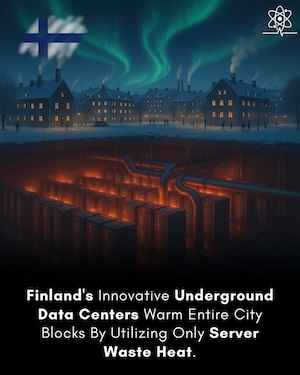
Repurposing waste heat from the data centers we’re building offers a scalable, low-cost path to sustainable heating for local towns and industrial parks. Servers generate immense thermal energy—often 40-50% of a data center’s electricity input becomes heat. Capturing and redistributing this “waste” via district heating networks can displace fossil fuels, cut emissions, and deliver near-free heat to communities.
Finland demonstrates the model at scale. In Helsinki, a subterranean data center under Uspenski Cathedral channels server heat into the municipal grid, warming ~500 large homes year-round. Espoo and Hamina host similar systems:
Google’s Hamina facility recovers heat equivalent to 80% of a nearby neighborhood’s annual demand, supplying it gratis to the local utility. Underground siting leverages natural insulation, reduces noise, and frees surface land for parks or housing.
To replicate this:
- Site strategically: Place new data centers near towns or industrial parks with existing or planned district heating loops. Retrofitting costs ~€1-2M per MW of recovered heat—far below new boiler plants.
- Engineer heat capture: Install heat exchangers on server cooling loops (air- or liquid-cooled). Raise coolant temperatures to 60-70°C for direct district integration; higher-grade heat (via heat pumps) serves industrial processes needing 100°C+.
- Pipe it out: Extend insulated pipelines 1-5 km to endpoints. Helsinki’s network proves loops can span cities without significant loss.
- Monetize or gift: Operators offset capex by selling heat at 20-40% below gas rates or donate it for PR and tax credits, as Google does.
Benefits compound: each MW of data center power yields ~0.8 MW thermal, decarbonizing ~1,000 homes per 10 MW facility. Industrial parks gain process heat for drying, distillation, or greenhouses. Grid operators stabilize loads via demand-response cooling.
U.S. pilots—Microsoft in Virginia, Meta in Nebraska—already test this. With AI driving data center growth, routing waste heat locally turns an energy liability into a public asset, slashing municipal heating bills and emissions in one infrastructure play.