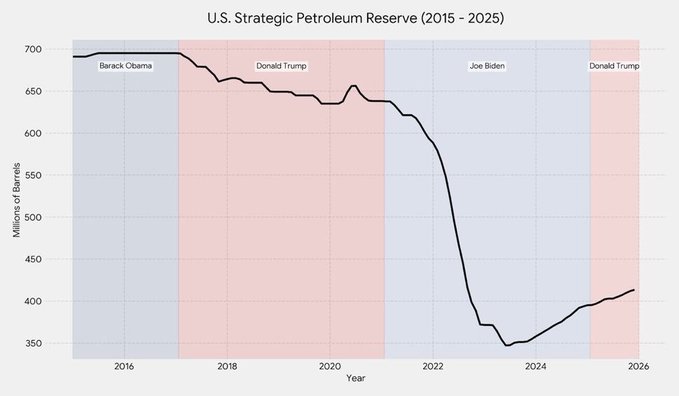
While the lefty elites were busy virtue-signaling about green dreams and handing out cash to their cronies, Joe Biden decided to play fast and loose with America’s emergency oil stash like it was his personal ATM. The Strategic Petroleum Reserve—our nation’s underground bunker of black gold—was built to shield us from real crises, not to juice midterm polls. But Biden yanked out hundreds of millions of barrels in a desperate bid to shave a few cents off gas prices, and in the process, he wrecked the very salt caverns that keep the whole thing humming. Now, with repairs eating up taxpayer dollars and the reserve still limping along half-empty, we’re staring down the barrel of vulnerability in a world that’s anything but stable. America First means treating our security seriously, not raiding it for votes. Here’s the no-BS breakdown on how we got here and what’s coming next.
The SPR’s Rock-Solid Origins: Built for Battles, Not Bailouts
Back in the bad old days of the 1970s, when Arab oil barons decided to choke off supplies during the 1973-1974 embargo, America got a wake-up call. Gas lines stretched for blocks, prices skyrocketed, and our economy took a gut punch. President Gerald Ford didn’t whine about it—he signed the Energy Policy and Conservation Act on December 22, 1975, creating the Strategic Petroleum Reserve as a fortress against future shocks. The idea was simple: Stockpile enough crude to replace imports for months if the bad guys cut us off again.
This isn’t some fancy above-ground tank farm; we’re talking massive underground vaults carved out of ancient salt domes along the Gulf Coast in Texas and Louisiana. Sites like Bryan Mound, Big Hill, West Hackberry, and Bayou Choctaw hold up to 714 million barrels total—that’s the authorized capacity, though it was originally eyed for a billion. These caverns are engineering marvels: Workers pump in fresh water to dissolve the salt, creating huge chambers 2,000 to 4,000 feet deep. The leftover brine gets piped out, often miles offshore, leaving impermeable, self-sealing spaces that hug the oil tight. Geologic pressure seals any cracks, and the natural temperature gradient keeps the crude circulating for consistent quality. It’s cheap too—about $3.50 per barrel to build versus $15-$18 for surface tanks—and damn near leak-proof. This setup was designed to buy time in a real emergency, like a war or blockade, not to play politics with pump prices.
Biden’s Big Drawdown: Draining the Tank for Democrat Dreams
Fast-forward to 2022, and Biden’s crew spots trouble: Russia’s invasion of Ukraine sends global oil markets into a tailspin, with U.S. gas hitting over $5 a gallon in June. Instead of unleashing American drillers, Biden goes for the quick fix—tapping the SPR like it’s an endless keg. On March 31, 2022, he authorizes the release of up to 180 million barrels over six months, at a rate of about a million a day. That’s the biggest emergency drawdown in history, dwarfing past ones like the 30.6 million in 2011 for Libya disruptions or 21 million in 1991 for Desert Storm.
But let’s call it what it was: a blatant election ploy. With midterms looming and Dems sweating voter backlash over inflation, Biden floods the market to knock prices down by up to 40 cents a gallon, per estimates at the time. Total pull under his watch? A staggering 291 million barrels by mid-2023, slashing the reserve to 347 million—the lowest since 1983. That’s a 46% gutting, leaving us with barely enough to cover 56 days of imports at 2022 levels. Sure, it calmed markets short-term, but at what cost? We traded long-term security for a temporary poll bump, and now the bill’s due.
🚨Strategic Petroleum Reserve FACT CHECK.
For all the fake Know-it-alls – especially you in the media – who want to blame Trump for the depleted condition of the #SPR, the facts are illustrated below.
Joe Biden – Reduced it by a net 240 million barrels of oil, and damaged some… pic.twitter.com/KrwXRZphRg
— ⚡️David Blackmon⚡️ (@EnergyAbsurdity) March 7, 2026
Salt Cavern Sabotage: How Rapid Raids Wreck the Rocks
Here’s where Biden’s haste bites back. Those salt caverns aren’t indestructible; they’re living rock that reacts to what we do. To extract oil, you inject brine to push it out—simple physics. But pump too fast, and that water starts dissolving the cavern walls, warping shapes, reducing volumes, and risking structural integrity. Each cycle of fill and draw stresses the system: Compression like concrete under overburden, but with plastic-like flow that can deform if abused.
Biden’s 2022 blitz—180 million barrels in months—sparked alarms. By November 2022, concerns bubbled up that the “rapid depletion” had hammered pipelines and caverns, potentially compromising the whole setup. Sure, the admin brushed it off in April 2023, claiming no damage. But fast-forward to 2025 under clearer eyes, and the truth emerges: The quick drain did indeed cause structural hits, with repairs pegged at over $100 million. As of April 2025, only two of the four major sites could even be refilled due to ongoing fixes. We’re talking well remediation, cavern stabilization, pipeline swaps—the works. These aren’t cosmetic; rapid cycling erodes the salt’s self-healing magic, turning our secure vaults into potential liabilities. By June 2025, reports confirmed aging caverns were hobbling refill efforts, with maintenance woes spotlighted in hearings. This isn’t just wear and tear; it’s the fallout from treating a strategic asset like a slush fund.
🚨 BREAKING: THIS IS INFURATING. It just came out that the Trump admin must run $100 MILLION in repairs because of when the Biden admin DRAINED the Strategic Petroleum Reserve to help Democrats in the midterms.
They got very short-term gas prices a little lower… and damaged… pic.twitter.com/BdK9E8BYbA
— Eric Daugherty (@EricLDaugh) May 9, 2025
The Road to Recovery: Repairs, Refills, and Real Risks
So, what’s next in this mess? As of December 2025, the SPR sits at 411 million barrels—about 57.6% full—after some buybacks. The previous crew secured 200 million barrels at an average $74.75 each, using $16.95 billion from 2022 sales (minus $2.05 billion clawed back for deficits). They bought 32.3 million since 2023, canceled 140 million mandated sales, and accelerated 5 million in exchanges. But that’s peanuts; we need 303 million more to hit 714 million.
Repairs are grinding on into 2026, with $100 million-plus sunk into fixing Biden’s damage. The push is for $20 billion more to speed refill, aiming for full capacity by 2028. Trump’s team isn’t messing around—seeking $660.5 million for buys and $218 million for maintenance in recent proposals. But with only half the sites operational for filling, it’s a slog. Multi-year timeline means we’re exposed: A real crisis now—like another Gulf shutdown or Mideast flare-up—could leave us scrambling with private stocks (424 million as of early October 2023) as backup.
The kicker? This vulnerability hands leverage to adversaries. China and Russia love seeing us weak-kneed on energy. America First demands we drill more, export smart, and rebuild the SPR without excuses. No more Dem raids for votes; fix the caverns, fill the tanks, and keep our edge sharp. Biden’s legacy? A damaged fortress and higher risks. Time to make energy security great again—no apologies, just action.