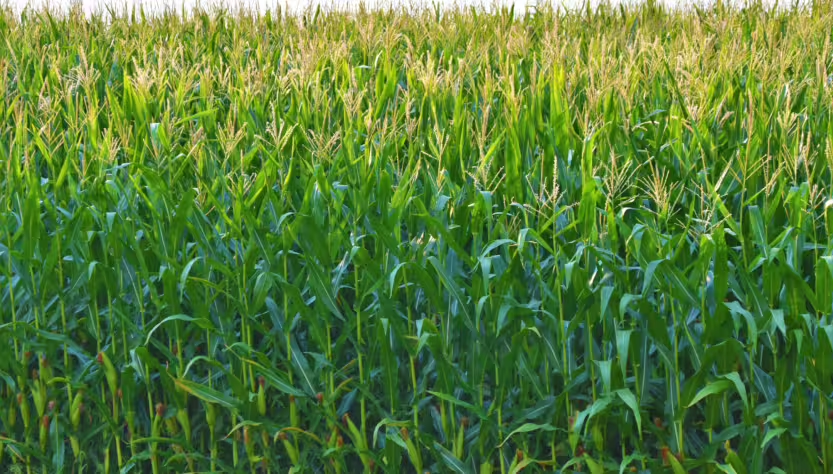
Listen up, folks – we’ve got a classic case of Washington meddling turning gold into garbage. The claim floating around is that America’s hooked on importing food because we’re wasting prime farmland on growing corn for biofuel instead of actual grub. Sounds like another eco-warrior fever dream, but let’s dig in with an America First lens. We’re talking about putting our farmers, our economy, and our sovereignty first, not chasing unicorn fantasies that end up hurting the heartland. After a deep dive into the numbers – and yeah, I checked ’em twice because bureaucrats love to fudge facts – here’s the unvarnished truth. Spoiler: It’s not as simple as the tree-huggers say, but it’s still a mess courtesy of bad policy.
The Corn-for-Fuel Hustle: Is It Robbing Our Dinner Tables?
First off, is the claim true? Sort of, but not in the way the alarmists spin it. America churns out about 15 billion bushels of corn a year, and roughly 36 to 40 percent of that – around 5.5 billion bushels – gets turned into ethanol for biofuel. That’s a whopping chunk of our farmland, over 30 million acres tied up in this boondoggle. Ethanol production hit a record 16.2 billion gallons in 2024, and it’s still climbing despite the headaches.
Now, does this mean we’re importing burgers and beans because all that corn could be feeding folks instead? Not exactly. The U.S. is still a beast in domestic food production – we grow plenty of grains, meats, and staples right here. But our food imports have exploded to $213 billion in 2024, creating a $37 billion trade deficit that’s ballooned over the last decade. Projections for 2025 put it even higher, maybe pushing $47 billion. That’s real money leaving our shores, folks, and it’s not because we’re short on corn chowder.
The reality? We’re importing stuff we can’t or don’t grow efficiently at home – think tropical fruits like bananas and avocados, coffee, cocoa, and off-season veggies. In 2024, fruits and nuts alone racked up $20 billion in imports, with beverages at $42 billion and seafood over $12 billion. Sure, some farmland locked into ethanol corn means less flexibility for other crops, but the big driver is consumer demand for variety and year-round supply. We’re not “feeding America on imported food” wholesale – domestic output covers most basics like wheat, soy, and beef. But yeah, that ethanol mandate is crowding out potential for more diverse farming, and it’s jacking up costs everywhere.
Green Pipe Dream: Ethanol’s Dirty Little Secrets
If you’re thinking this corn-for-fuel gig is saving the planet, think again. The environmental toll is a nightmare straight out of a bad sci-fi flick. Growing all that corn requires massive fertilizer dumps – nitrogen that’s breaking down into nitrous oxide, a gas 300 times worse than CO2 for warming the planet. Agriculture already spews over 10 percent of U.S. greenhouse gases, and corn ethanol is the kingpin, guzzling two-thirds of our nitrogen fertilizer.
Studies crunching the numbers show ethanol’s carbon footprint is at least 24 percent higher than gasoline when you factor in land grabs, fertilizer runoff, and processing. We’re talking expanded corn acres – up 8.7 percent from 2008 to 2016 alone – plowing over pastures and conservation land. That leads to 3 to 8 percent more fertilizer use nationwide, spiking water pollution by 3 to 5 percent. The Gulf of Mexico’s dead zone? Blame nutrient runoff from these mega-farms, creating an oxygen-sucking wasteland bigger than some states.
And get this: Monocropping corn year after year strips the soil, kills biodiversity, and turns fertile ground into dust bowls waiting to happen. The Renewable Fuel Standard – that bloated 2007 law forcing ethanol into our tanks – promised climate wins, but it’s delivered a net loss. We’re subsidizing pollution while pretending it’s progress. America First means real energy independence, not this subsidized scam that’s eroding our topsoil and choking our rivers.
Economic Gut Punch: Who Pays the Price?
The economic disruptions from this biofuel binge are hitting where it hurts: American wallets and farms. Corn prices jump 2 to 3 percent for every billion gallons of ethanol we crank out, thanks to the RFS mandates. That ripples through the food chain – higher feed costs for livestock mean pricier beef, pork, and chicken at the store. Taxpayers? We’re on the hook for billions in subsidies that prop up this industry, with ethanol plants raking it in while family farms scrape by.
Remember the ethanol boom from 2004 to 2011? Production quadrupled, but it wasn’t just the RFS – the MTBE ban on gasoline additives lit the fuse. Still, policies like these distort markets, inflating corn demand and squeezing out other crops. We’ve seen food costs climb $4.9 to $6.8 billion extra in recent years just from biofuel tweaks. And with imports surging – up 6 percent annually from 2014 to 2024 – our trade deficit is bleeding jobs and cash overseas.
Rural economies get a short-term boost from ethanol plants, sure, but the long game? Higher input costs, volatile prices, and dependency on government handouts. We’re talking fertilizer spikes, water scarcity in corn-heavy states, and farmers locked into a cycle that favors Big Ag over the little guy. America First demands we ditch these disruptions and let markets work – not force-feed ethanol that costs more than it saves.
What We’re Really Importing: Exotic Treats or Everyday Essentials?
So, are we only importing food that’s “difficult to grow here,” or is foreign chow taking over our plates? Mostly the former, but the lines are blurring. Top imports in 2023 and 2024: Fruits like avocados ($2.5 billion from Mexico), bananas, berries; veggies for off-season salads; seafood ($1.4 billion, mostly from Chile and Norway); coffee and cocoa we can’t produce domestically.
Domestic production dominates staples – we export $176 billion in ag products like soy, corn, and meat. But imports now make up over half our fruit and nut consumption, a third of veggies, and most seafood. Grain milling products? 57 percent imported. Even Fourth of July classics like watermelon, tomatoes, and beer have deficits. It’s not that we’re starving without imports; it’s about variety and convenience. Consumers want guac in January, and that means relying on Mexico for 80 percent of our avocados.
But here’s the rub: As biofuel corn hogs more land, we’re less agile in ramping up domestic alternatives. Imports grew to $213 billion in 2024 because we’re specializing in grains while outsourcing the rest. That’s not strength – it’s vulnerability. Trade wars or supply chain hiccups, and suddenly your smoothie costs double.
Time to Ditch the Ethanol Albatross
Bottom line: The corn-for-biofuel push is a policy trainwreck that’s inflating prices, trashing the environment, and making us more dependent on imports for the good stuff. We’re not “importing food instead of growing it here” across the board – we’re smartly focusing on what we do best while bringing in the exotics. But ethanol’s land grab is a drag on flexibility, and the economic hits are real.
America First means scrapping these green mandates that benefit lobbyists over farmers. Let markets decide, boost domestic diversity, and keep our food secure. We’ve got the best land and growers in the world – time to unleash ’em without the ethanol anchor. If we don’t, we’ll keep watching billions flow overseas while our farms pay the price. Wake up, Washington – before it’s too late.