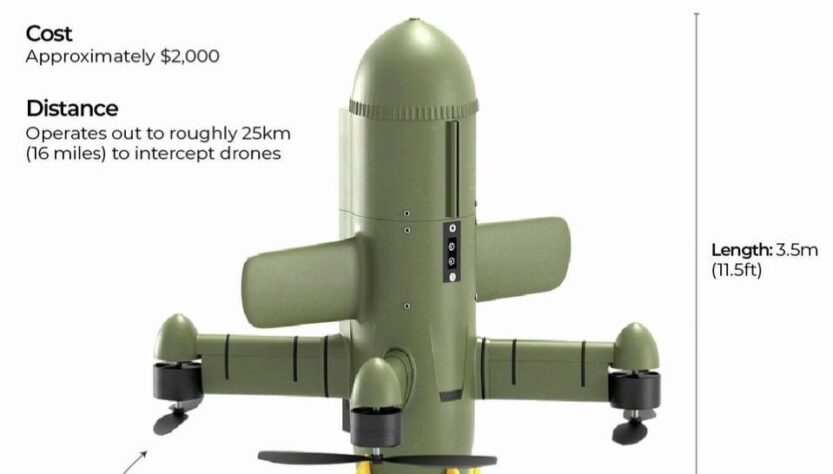
The STING (Ukrainian: Стінг) is a Ukrainian-developed interceptor drone, a specialized anti-drone weapon that’s proven highly effective in countering low-cost Russian/Iranian loitering munitions like the Shahed/Geran series.
Produced by the Wild Hornets volunteer-turned-miltech group, the Sting addresses the asymmetry where expensive air defenses (e.g., Patriot missiles costing millions) are used against cheap Shahed drones (~$20,000–$50,000 each). By late 2025 and into 2026, it has become a key part of Ukraine’s scalable, affordable counter-drone strategy.
Design and Construction
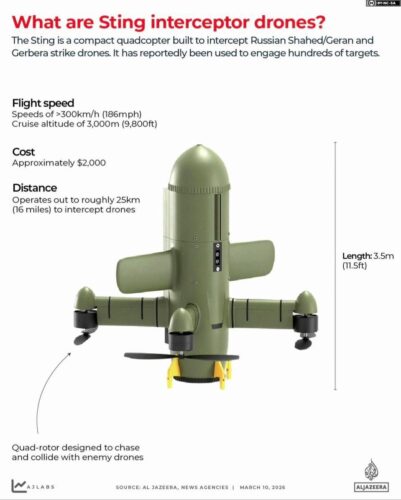
The Sting features a distinctive bullet-shaped, aerodynamic frame that’s largely 3D printed, enabling rapid, low-cost, decentralized production. It’s a quadcopter with four rotors for vertical takeoff and high maneuverability. The compact design (about the size of a large thermos) includes a domed head housing a thermal imaging camera, sensors, AI-assisted targeting, and an explosive payload for kinetic kills (ramming the target). It fits in a duffel bag and deploys from any flat surface—no catapult required.
Key Specifications and Performance
- Top speed: Up to 343 km/h (213 mph), with consistent reports around 315–320 km/h (195–200 mph)—fast enough to chase down Shaheds cruising at ~185 km/h or even faster jet-powered variants like Geran-3.
- Altitude: Operational up to 3,000 m (10,000 ft).
- Engagement range: Up to 25 km (some sources note effective intercepts around 15 miles/24 km).
- Control: FPV via VR-style goggles, with AI-assisted terminal guidance and thermal cameras for night/all-weather targeting.
- Deployment: Under 15 minutes; vertical launch, highly maneuverable, and can return to base if no target is found or it’s already downed.
- Payload/Method: Explosive warhead for direct collision (kinetic kill).
Cost and Production
Thanks to 3D printing and off-the-shelf components, the Sting costs roughly $2,000–$2,500 per unit (some reports mention as low as ~$1,000–$2,100 for variants). Wild Hornets scaled production dramatically, operating a large printer farm to output dozens to hundreds daily across their drone lineup. This has enabled mass deployment without relying on traditional defense contractors.
Operational Impact and Achievements
Introduced in combat around mid-2025, the Sting quickly became a leader in anti-drone warfare. By early 2026:
- Downed over 3,900 enemy drones (per Wild Hornets reports), including thousands of Shaheds/Gerans.
- Achieved first confirmed intercepts of jet-powered Geran-3 variants and even Shaheds modified with air-to-air missiles.
- Contributed to record monthly kills (e.g., interceptors accounting for ~70% of Shahed destructions in some periods).
- Demonstrated internationally, including successful tests against high-speed target drones.
It’s flipped the cost equation, making drone defense economically viable against swarms.
International Interest
The Sting’s success has drawn global attention amid rising Iranian drone threats. The U.S. Pentagon has expressed interest in acquiring similar low-cost interceptors (~$1,000–few thousand dollars). Gulf states like the UAE and Qatar are pursuing acquisitions or partnerships. Ukraine has shared expertise, with Zelenskyy confirming U.S. requests for help against Iranian drones. Even Russia has tested analogs inspired by the design.
This showcases how 3D printing and grassroots innovation are transforming modern air defense. If you’d like more on combat footage, comparisons to other interceptors, or updates on production/export deals, just say the word!