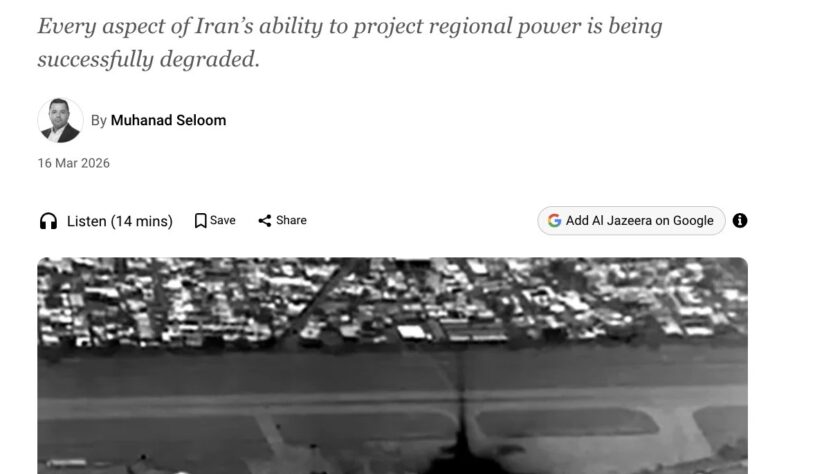
Every aspect of Iran’s ability to project regional power is being successfully degraded.
We turn to a rare anti-Iran article from Al-Jazeera, a move possibly reflecting anger at the Iranian ordinance falling on Qatar, https://www.aljazeera.com/opinions/2026/3/16/the-us-israeli-strategy-against-iran-is-working-here-is-why
Here’s the gist.
Challenging the Dominant Narrative
Two weeks into Operation Epic Fury, the prevailing view depicts the U.S.-Israeli campaign against Iran as an unplanned blunder: regional escalation, surging oil prices, Iranian retaliation, and warnings of a prolonged Middle Eastern quagmire. U.S. senators and cable news highlight mounting crises and human costs. Writing from Doha amid missile alerts and evacuations, Muhanad Seloom argues this narrative is fundamentally wrong—not because costs are imaginary, but because critics focus on immediate prices while ignoring the strategic ledger.
Systematic Degradation of Iranian Capabilities
Far from failure, the operation systematically dismantles Iran’s power-projection tools built over four decades. Ballistic missile launches plummeted over 90% (from ~350 on February 28 to ~25 by March 14), and drone launches fell from over 800 on Day 1 to ~75 by Day 15. Hundreds of launchers are inoperable, with reports indicating 80% of Iran’s capacity to strike Israel eliminated. Naval assets (fast-attack craft, midget submarines, mines) face liquidation, while air defenses are so suppressed that non-stealth U.S. B-1 bombers now operate over Iranian airspace with near-total confidence.
Phased Campaign Structure
The operation proceeds in clear phases. Phase 1 suppressed air defenses, decapitated command structures, and degraded missile/drone infrastructure, achieving local air superiority over western Iran and Tehran by March 2 without confirmed U.S. or Israeli aircraft losses. Phase 2 targets Iran’s defense industrial base—missile production facilities, dual-use research centers, and underground storage—to prevent reconstitution. This methodical approach forces Iran into a dilemma: firing remaining missiles exposes launchers to destruction; conserving them forfeits deterrence. Current salvos appear as rationed, politically timed gestures, signaling managed decline rather than strength.
Nuclear Program Setback
Pre-campaign, Iran held 440 kg of 60% enriched uranium—enough for ~10 nuclear weapons if further enriched—and neared breakout capacity for one bomb. Strikes damaged Natanz, rendered Fordow inoperable, and targeted related industrial sites. While strikes cannot erase knowledge or fully account for stockpiles, they impose major delays. Critics question whether diplomacy was exhausted, but continued restraint risked the very nuclear threshold now being pushed back.
Strait of Hormuz as a Wasting Asset
Closure of the Strait of Hormuz drives oil price spikes and global economic pain, yet this hurts Iran disproportionately: ~90% of its exports pass through it, alienating China and deepening isolation. Iran’s naval blockade tools are degrading rapidly, suggesting the disruption is temporary and the strait’s reopening a matter of when, not if.
Fragmenting Proxy Network
Regional proxy attacks (Hezbollah, Iraqi militias, Houthis) reflect desperation, not expansion. The assassination of Supreme Leader Ali Khamenei, IRGC decapitations, and disrupted authorization layers (legitimation, coordination, logistics, deniability) indicate a shattered command center. Attacks stem from pre-delegated authority, becoming uncoordinated and politically costly as regional states turn hostile.
A Visible Endgame
The operational logic points to “strategic disarmament”—permanent degradation of missiles, nuclear latency, and proxies—creating conditions for a durable post-conflict framework (verification, diplomacy, enforcement). While public rhetoric wavers and diplomacy lags, the military campaign advances toward this goal.
Costs vs. Inaction
The human and economic toll is undeniable—over 1,400 Iranian civilian deaths, U.S. service member losses, Gulf sirens—but inaction carried higher long-term risks: a nuclear-armed Iran with unchecked proxies dominating the region. The strategy, measured by capability degradation rather than news cycles, is working.
