May 5, 2026 – Fighting flared in the Persian Gulf on Monday as U.S. military helicopters sank six to seven Iranian small boats in the Strait of Hormuz. The clashes erupted on the first full day of President Donald Trump’s Project Freedom, aimed at escorting hundreds of stranded commercial ships through the blocked waterway.
Rather than launching a full-scale military escort operation, the U.S. had deployed ships and aircraft to the region to monitor threats, advise vessels, and respond if necessary.
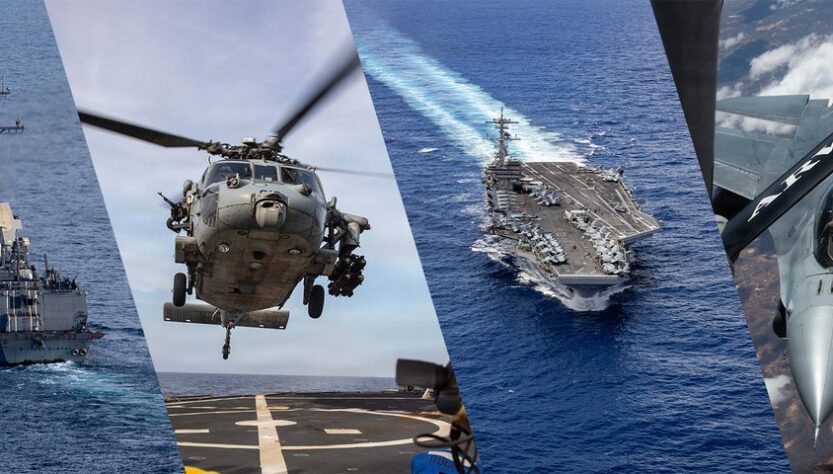
The Pentagon’s support for “Project Freedom” includes guided-missile destroyers, drones, more than 100 aircraft, and roughly 15,000 troops, signaling a significant show of force without crossing into open conflict.
Officials say the rules of engagement have also been updated, allowing U.S. forces to strike immediate threats, such as Iranian missile positions or fast-attack boats, if American or allied vessels are targeted.
The move comes after Trump rejected a more aggressive military option that would have sent U.S. naval forces directly through the strait to forcibly reopen it. (Newsmax)
South Korea Directly Affected
A South Korean-operated cargo ship, the Panama-flagged HMM Namu, was hit by an explosion and caught fire in waters near the United Arab Emirates inside the Strait of Hormuz. The vessel carried 24 crew members, including six South Korean nationals. The fire broke out in the engine room, prompting an emergency response. President Trump publicly stated that Iran fired at the ship and urged South Korea to join the U.S.-led mission to protect commercial shipping in the region. South Korea’s government is reviewing its position on participating.
Project Freedom Under Fire
Trump launched Project Freedom to guide neutral-flagged vessels trapped in the Persian Gulf since Iran effectively closed the strait in late February amid the broader conflict. Two U.S.-flagged merchant vessels successfully transited the strait under U.S. protection on Monday. However, Iran responded with cruise missiles, drones, and swarms of small boats targeting both naval and commercial traffic.
A United Arab Emirates-owned tanker was also struck by Iranian drones. U.S. forces intercepted multiple incoming threats while defending the operation.
USS George H.W. Bush (CVN 77) transits the Arabian Sea as U.S. forces enforce the naval blockade against Iran from the Gulf of Oman and support Project Freedom in the Strait of Hormuz. The carrier has more than 60 aircraft on board. pic.twitter.com/u7U9YyhBO8
— U.S. Central Command (@CENTCOM) May 5, 2026
Overview of the Strait of Hormuz
The Strait of Hormuz is one of the world’s most critical maritime chokepoints. It connects the Persian Gulf to the Gulf of Oman and the Indian Ocean, with Iran’s coastline running along its northern side. At its narrowest point, the navigable channels are only about two miles wide in each direction.
Before the 2026 crisis, roughly 20-25% of global seaborne oil trade and 20% of liquefied natural gas (LNG) passed through the strait daily — around 20 million barrels of oil per day. It serves as the primary export route for oil and gas from Saudi Arabia, UAE, Kuwait, Qatar, Iraq, and Iran. Disruptions here have already caused global fuel price spikes, supply shortages, and forced production cuts in several Gulf states. The narrow geography makes it highly vulnerable to mines, small boat swarms, missiles, and drones.
What Happens Next
Project Freedom operations are continuing into Tuesday with heavy U.S. naval and air presence. More escorted transits are expected in the coming days as the U.S. works to reopen safe passage for neutral shipping. Oil markets remain volatile, with fears of prolonged disruptions.
South Korea’s response to Trump’s call could bring additional allied support, potentially expanding the operation. The UAE has already shifted schools to remote learning through Friday due to Iranian drone threats and regional safety concerns.
Gulf States Ramp Up Support for U.S. Efforts While Pushing for Long-Term Strait Security
May 5, 2026 – As Project Freedom unfolds, Gulf Cooperation Council (GCC) countries are coordinating closely with the U.S. while taking independent steps to protect their economies and shipping lanes.
UAE: Leading the Charge with Direct ActionThe United Arab Emirates has been hit hardest by recent Iranian drone and missile strikes, including attacks on an oil tanker and facilities. In response:
- Schools nationwide shifted to remote learning through Friday for safety.
- The UAE is actively advocating for a multinational Hormuz security force and has signaled readiness to deploy its own navy assets to support safe passage.
- It strongly backs U.S. operations and has condemned Iranian attacks on commercial vessels.
Saudi Arabia: Diversifying Routes and Urging Strong U.S. Action
Saudi Arabia is maximizing bypass pipelines (East-West Crude Oil Pipeline to Yanbu on the Red Sea) to reduce reliance on the strait. It is pressing the U.S. not to stop short in neutralizing Iranian threats to long-term stability. Riyadh is coordinating with other GCC states on diplomatic and security measures while avoiding direct military involvement in the current clashes.Broader GCC Coordination
- Collective Stance: GCC nations have condemned Iranian attacks as “blatant” and “criminal,” declaring they are prepared to act in self-defense. They support the U.S. position that Iran cannot unilaterally control or toll the strait.
- Bahrain: Sponsored a UN resolution calling for defensive missions to keep the strait open, including coordinated escorts.
- Shared Measures: Many Gulf states are accelerating alternative trade corridors (e.g., new Saudi-UAE land/sea links bypassing Hormuz) and have declared force majeure on some oil exports due to disruptions.
- Longer-Term Push: Discussions are underway for a potential GCC-led maritime security task force, possibly involving Egypt and Jordan, to secure the strait beyond the current U.S. operation.
Outlook for Gulf States
Gulf states view Project Freedom as a welcome immediate step but are focused on a permanent solution — reopening the strait under international guarantees and reducing vulnerability through diversified routes and stronger regional defense cooperation. They are wary of any U.S.-Iran deal that leaves Tehran with leverage over Hormuz.This unified but cautious approach balances short-term survival with long-term economic security amid the ongoing crisis. The situation remains fluid as more transits are attempted today.
Iran continues to assert control over the strait and has disputed U.S. claims of success. U.S. officials describe the mission as purely defensive and humanitarian, focused on protecting civilian vessels running low on supplies. Further Iranian interference risks stronger U.S. retaliation, while successful escorts could ease the global energy crunch and pressure Iran toward negotiations.
The situation remains highly fluid, with both sides trading claims and the world watching closely for any escalation or breakthrough in this vital energy artery.
— U.S. Central Command (@CENTCOM) May 3, 2026