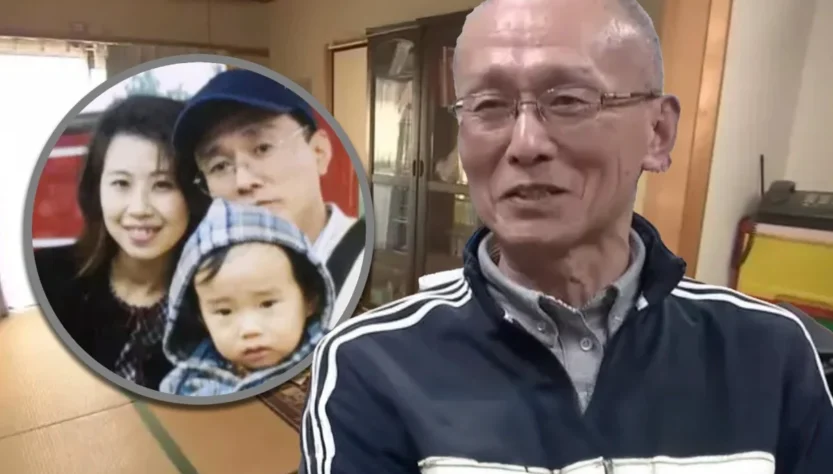
The Apartment That Stopped in Time
In Nagoya, Japan, a man kept paying rent on an apartment he never lived in. For 26 years, he sat on its floor twice a week, ate convenience store food, and waited.
On the morning of November 13, 1999, Satoru Takaba left for work as he always did. His wife Namiko, 32, stayed home with their two-year-old son, Kohei. She had recently told her husband she was the happiest she had ever been.
By the time Satoru returned that evening, Namiko was dead — stabbed repeatedly in the neck. Kohei was found unharmed beside her. The furniture was in disarray. There was blood on the floor. And somewhere in that apartment, without knowing it, a killer had left something behind.
The Investigation
More than 100,000 police officers were mobilized. Some 5,000 people were interviewed. The killer had posed as a delivery person to gain entry. The knife was her own. The attack was premeditated. And yet the case went cold — no fingerprints, no witnesses, no suspect.
By law at the time, Japan’s statute of limitations for murder was 15 years. If no arrest was made by 2014, the killer would walk free forever. Satoru Takaba was not willing to accept that.
The Decision
A year after the murder, Satoru and Kohei moved out. Satoru kept paying the rent.
50,000 yen a month — for an apartment no one lived in, no one cleaned, no one rearranged. The calendar on the wall still showed November 1999. The bloodstains on the floor were left exactly as they were. Satoru’s reasoning was clear: forensic science would advance. The apartment was not a shrine. It was a 26-year, $145,000 bet on the future of technology.
He visited twice a week. He would sit on the spot where Namiko had died, eat convenience store food, and work through the incident records he kept in a notebook. “If I cry and grieve,” he said, “that is just giving the killer what they want.”
The Science Catches Up
Three years after the killing, investigators made a quiet breakthrough: not all of the blood at the scene was Namiko’s. The killer had been wounded in the struggle. The blood was preserved — not enough to identify anyone in 1999, but enough to wait with.
In 2010, after years of public advocacy by Satoru and other victims’ families, Japan abolished the statute of limitations for murder entirely. The case could never expire.
Still, another fifteen years passed.
In October 2025, police visited a 69-year-old woman named Kumiko Yasufuku. She initially refused a DNA sample. Then, on October 30, she walked into a police station and hinted at her guilt. The sample matched the blood in the apartment — blood that had waited, untouched, for over a quarter century. She confessed: “I murdered a woman.” She was arrested the next day.
The Connection
The detail that hit Satoru hardest was not the arrest. It was who Yasufuku was.
His high school classmate. Same tennis club. She had harbored feelings for him in their youth — feelings he never knew about. About five months before the murder, they had met at a reunion. Satoru had seemed happy. Married. Content. Investigators believe that was enough to trigger everything.
Yasufuku had never met Namiko Takaba.
When Satoru learned who had killed his wife, his first word was simply: “Why?”
What Remained
On March 5, 2026, prosecutors announced Yasufuku would stand trial. On the 27th anniversary of the murder, Satoru said quietly: “I think Namiko will forgive me now that I’ve come this far.”
His son Kohei — two years old the day his mother was killed — said: “I think my father’s persistence over 26 years ultimately led to her arrest. I hope my mother can rest in peace.”
The motive remains under investigation. But the man who refused to let that moment be forgotten, who paid $145,000 and sat on a bloodstained floor and waited for science to catch up to justice — finally has an answer worth living with.
Kumiko Yasufuku was indicted in March 2026. Satoru Takaba’s advocacy helped abolish Japan’s murder statute of limitations in 2010.
In 1999, Namiko Takaba was stabbed to death in the couple’s apartment in Nagoya, Japan. Despite extensive investigations, the case went cold with no suspect identified. Devastated but determined, her husband Satoru Takaba made an extraordinary decision: he moved out but continued… pic.twitter.com/fIIW94QwIS
— Massimo (@Rainmaker1973) May 6, 2026