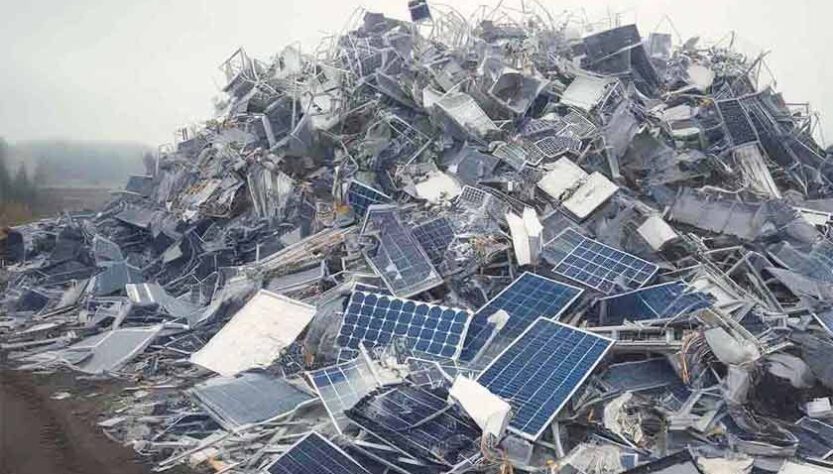
The Hidden Avalanche: The Growing Waste Crisis from “Renewable” Energy Technologies
Solar Panels: A Looming Toxic Avalanche
Millions of solar panels are hitting their end-of-life cycle, and the world is completely unprepared for the coming toxic avalanche. By 2050, projections estimate up to 78 million metric tons of solar e-waste globally. This isn’t just a pile of debris — it’s the future of green energy waste hidden in plain sight. While renewables promise a clean transition, their end-of-life realities reveal massive logistical, economic, and environmental challenges.
The Recycling Myth Versus Economic Reality
The industry often boasts that solar panels are “95% recyclable” in theory because of their glass, aluminum, and copper components. Yet economics consistently overrides technical feasibility. Proper disassembly and recycling of a single panel can cost $20 to $28 in places like Australia and the United States, while landfilling runs as low as $4. Without strong financial incentives or mandates, up to 90% of decommissioned panels end up in landfills rather than recycling streams.
The Industrial Sandwich That Resists Recovery
Each solar panel functions as an industrial “sandwich,” with layers tightly bound by heavy polymers and encapsulants. Extracting the microscopic amounts of silver and high-purity silicon requires energy-intensive chemical processes or thermal treatments that often exceed the value of the recovered materials. Newer, cheaper panels use less silver and thinner wafers, further eroding recycling economics and leaving valuable fractions locked away.
Leaching Hazards in Landfills
When panels fracture or are crushed in landfills, heavy metals like lead and cadmium can leach into soil and groundwater. This creates the prospect of multi-generational contamination from dispersed, unmanaged waste sites. The shift from “clean energy” to persistent hazardous legacies becomes real if proper management fails at scale.
This isn't just a pile of debris – it’s the future of green energy waste hidden in plain sight.
— Peter Clack (@PeterDClack) May 19, 2026
Millions of solar panels are hitting their end-of-life cycle, and the world is completely unprepared for the coming toxic avalanche. By 2050, the International Renewable Energy… pic.twitter.com/g7PG7CbBAb
Accelerated Replacement Cycles
The crisis accelerates faster than many models anticipated. Solar cells naturally degrade over 25-30 years, but economic pressures drive even earlier retirements. Newer, higher-efficiency or cheaper panels prompt solar farms and homeowners to replace functional systems a decade or more ahead of schedule. This compressed lifecycle shatters the narrative of durable, long-term green assets and fuels an endless loop of waste generation.
Wind Turbine Blades: Giant Non-Recyclable Composites
Wind turbines add another dimension to the problem, particularly their massive blades made of fiberglass and epoxy resins. These durable structures resist easy recycling due to cross-linked polymers that cannot be readily melted or reformed. By 2050, significant volumes of blade waste are expected, much of it destined for landfills where the non-biodegradable materials will occupy vast space for centuries. Transporting blades longer than 50-100 meters creates additional logistical nightmares.
Battery Waste from EVs and Grid Storage
Electric vehicle and grid-scale batteries introduce further complexity. Lithium-ion packs contain valuable metals like lithium, cobalt, and nickel, yet global recycling rates remain low despite high potential recovery in advanced facilities. Varying chemistries, glued assemblies, and fire risks during disassembly make processes expensive. Improper disposal risks toxic leaks, even as second-life applications try to extend their usefulness.
Economic Disincentives and the Vicious Cycle
Across solar, wind, and batteries, economic disincentives create a vicious cycle. Recovered materials could theoretically yield substantial value by 2050, but upfront collection, transport, and processing costs deter investment without supportive policies. Many regions lack robust producer responsibility schemes, leaving waste management to under-resourced landfills or informal sectors.
Broader Environmental Trade-Offs
Environmental trade-offs extend beyond local landfills. While renewables reduce operational emissions, their full lifecycle — including mining rare materials, manufacturing, and disposal — generates industrial waste streams that challenge sustainability claims. Scaling to meet climate goals without parallel advances in circular design risks trading one pollution problem for another, with cumulative impacts on land use and resources.
The Path Forward: Closing the Loop
Addressing this mounting crisis requires urgent innovation, regulation, and investment. Extended producer responsibility, design-for-recyclability standards, and research into advanced recovery methods could transform waste into resources. Without decisive action, the green energy boom may leave behind mountains of debris, undermining public trust and long-term environmental gains. The future of renewables depends not just on deployment, but on successfully managing their inevitable end-of-life realities.