By Christopher Carroll, May 18, 2026
Mackenzie Eaglen and Representative Filemón Vela, writing for the National Commission on the Future of the U.S. Navy, recently outlined three priorities for rebuilding American sea power: bringing autonomous systems online faster, expanding investment in the maritime industrial base, and sparking a national dialogue on modern maritime strategy. These are the right priorities. But their framework will fail without confronting the structural failures that created the crisis in the first place. The United States does not have a shipbuilding spending problem. It has a shipbuilding planning problem, and more money alone will not fix it.
The United States builds fewer than ten oceangoing commercial vessels per year. U.S.-built merchant ships represent one percent of global commercial tonnage. China builds 75 percent of the world’s commercial fleet. The People’s Liberation Army Navy has surpassed the United States as the largest navy in the world by hull count. These numbers are not the product of a single administration’s neglect, they are the result of three decades of structural policy failures compounding across procurement, workforce development, and institutional governance simultaneously.
How the Industrial Base Collapsed
The decline of American shipbuilding began not with a single policy failure but with a strategic choice made in the years after World War II. Having built the most powerful naval and commercial fleet in history, the United States gradually deprioritized commercial shipbuilding in favor of naval capacity, assuming the commercial sector would sustain itself. It did not. Japan and South Korea built heavily subsidized industries throughout the 1960s and 1970s, steadily undercutting American yards. The Construction Differential Subsidy program had offset up to 50 percent of the cost difference between U.S. and foreign-built vessels. Still, when the Reagan administration terminated it in 1981, the commercial market began to collapse. What followed was four decades of compounding deterioration. Shipyards lost the production scale to maintain modern facilities. Skilled trades workers retired and were not replaced. Apprenticeship pipelines dried up. The limiting factor is not budgetary. It is an industrial capacity that was allowed to erode over generations.
Case Study One: Knowing What’s Coming and Doing Nothing About It
Eaglen and Vela call for repairing ships more quickly. That goal runs directly into a structural failure that receives far less attention than new construction: the Navy cannot repair ships quickly because it does not plan for repairs it knows are coming. As Russian and Chinese submarine forces continue to grow, including nuclear-capable platforms that Eaglen and Vela acknowledge will force a worldwide U.S. response, the readiness cost of this planning failure compounds with every vessel that sits unnecessarily in dry dock.
While much of the public debate surrounding U.S. shipbuilding capacity focuses on new construction timelines and fleet expansion targets, depot maintenance inefficiencies may represent an equally significant constraint on naval readiness, and in some ways a more inexcusable one. Eaglen and Vela note that ships break down, and sailors cannibalize parts. What they do not say is that much of this is preventable.
Government-owned shipyards responsible for submarine overhaul and depot maintenance face persistent bottlenecks driven by material shortages and reactive logistics. Submarines entering dry dock frequently experience delays because required components are not procured or refurbished in advance of scheduled overhauls. Although maintenance cycles are largely predictable, and the components most likely to require replacement are known ahead of time, parts are often ordered or repaired only after the vessel has already entered the yard.
The consequence is extended idle time in dry dock. Submarines can remain in dock at an estimated cost of roughly hundreds of thousands of dollars per day while awaiting parts shipment or back-shop repair. In some cases, vessels have remained in overhaul for years beyond scheduled timelines. Such delays represent not merely administrative inefficiency but significant strategic cost, as deployable assets remain unavailable during periods of elevated global demand.
These are not unpredictable failures. Maintenance cycles are known in advance, and the components most likely to require replacement are well understood. They are failures of anticipatory planning, and they are preventable. The solution centers on establishing a rotatable pool of critical components through advance procurement and storage. By purchasing high-turnover parts ahead of scheduled overhauls and maintaining inventory on hand, maintenance could shift from a reactive to an anticipatory model, compressing overhaul timelines and improving fleet readiness without requiring new ship construction or new appropriations.
Case Study Two: Building Before You Know What You’re Building
Eaglen and Vela call for building manned and unmanned ships faster and fielding new weapons at scale. That goal runs directly into the second structural failure: the Navy routinely begins construction before it knows what it is building.
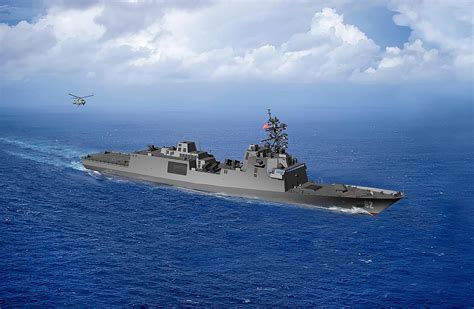
The Constellation-class frigate program illustrates what procurement instability costs the taxpayer and the industrial base. Originally selected as a carbon copy of a proven Italian frigate design, the program was intended to accelerate production by leveraging an existing platform. Successive Navy-driven design modifications, hull lengthening, propulsion reconfiguration, generator relocation, acoustic changes, and expanding displacement margins reduced design commonality from an intended 85 percent to approximately 15 percent. Physical construction commenced before key design documents were finalized, introducing rework risk, design churn, and production inefficiencies that compounded over time. The Constellation is projected to exceed its original cost estimate by more than $600 million and faces significant schedule delays relative to comparable European frigate builds completed on time using stable baseline designs.
This pattern reflects a broader acquisition dynamic: an institutional tendency to pursue incremental capability enhancements even when doing so destabilizes production timelines. Requirements creep in, personnel rotate through program offices, and each new stakeholder arrives with improvements to propose. Because profit margins on many defense contracts are regulated as a percentage of total program cost, contractors earn greater absolute revenue from larger and longer programs regardless of efficiency. Policymakers focused narrowly on limiting perceived excess profits inadvertently reward complexity over discipline.
The Same Failure, Twice
Taken together, these two cases demonstrate that the principal barriers to reindustrializing U.S. shipbuilding are structural. Funding levels alone do not explain the performance gap between U.S. and foreign shipbuilders. Procurement instability and institutional fragmentation create a self-reinforcing cycle. Delays generate cost growth; cost growth invites additional oversight and modification; modification induces further delay. Eaglen and Vela are right that the problems aren’t insurmountable. But breaking this cycle requires not merely increased appropriations, it requires structural reform that stabilizes demand, matures designs prior to contract award, and clarifies institutional accountability.
What Structural Reform Looks Like
Eaglen and Vela call for hard questions about buying foreign support ships and expanding U.S. shipyards. Before that conversation can be productive, the procurement process that has repeatedly undermined expansion efforts must be fixed. The Department of Defense should implement binding design-maturity thresholds as a precondition for contract award on all major shipbuilding programs. No construction contract should be awarded until critical design review is completed and independently validated. Program offices should maintain documented design freeze agreements, with formal change-control boards empowered to reject modifications that lack offsetting schedule or cost relief. The Constellation program is the cost of not doing this.
Eaglen and Vela rightly call for bringing autonomous and unmanned systems online faster. That goal is also a structural reform opportunity. Large surface combatants require billions in specialized capital investment, limiting participation to a small number of firms and reinforcing a bilateral monopoly in which the Navy has little leverage when costs rise or schedules slip. Deliberately opening competition in smaller vessel classes and unmanned platforms, combined with regulatory streamlining to reduce compliance burdens that currently deter innovative newcomers, could broaden the industrial base and accelerate the autonomous future they envision.
Eaglen and Vela call for a larger technical workforce to raise construction and repair rates. Part of the answer to that workforce gap lies in a region the current debate largely overlooks. The Great Lakes corridor, spanning Cleveland, Detroit, Toledo, Chicago, Milwaukee, and Duluth, retains a deep manufacturing heritage, integrated steel supply chains, and a lower cost of living than the coastal shipbuilding hubs where recruitment and retention are structurally constrained. That untapped industrial workforce is not a long-term aspiration. It is an existing asset waiting to be mobilized toward a strategic purpose.
Finally, and most fundamentally, Congress should establish multi-year block-buy contracts for both naval and commercially relevant vessel categories, frigates, auxiliary vessels, and medium landing ships. When programs are cancelled or stretched, as occurred with the Constellation-class frigate, shipyards reduce workforces, delay capital investments, and grow risk-averse. The cycle becomes self-reinforcing. By guaranteeing production volumes over guaranteed timelines, the federal government provides the planning certainty shipyards need to hire, train, and retain skilled workers at scale. Without stable demand anchored to consistent federal orders, every other reform on this list will falter.
The Commission’s Opportunity
Eaglen and Vela have traveled to three combatant commands and heard from stakeholders who see the problems and want fixes. They are right that the challenges weren’t made by any one president and require all parties to work together. But the national dialogue they are calling for must confront an uncomfortable truth: the United States cannot build the Navy it needs because it stopped building ships. That capacity is not rebuilt through budget lines alone. It is rebuilt through policy discipline, institutional commitment, and a willingness to treat the maritime industrial base as the strategic asset it has always been.
Christopher Carroll is a graduate of Pepperdine University’s Master of Public Policy program and a content creator for the Sagamore Institute.
This article was originally published by RealClearDefense and made available via RealClearWire.
