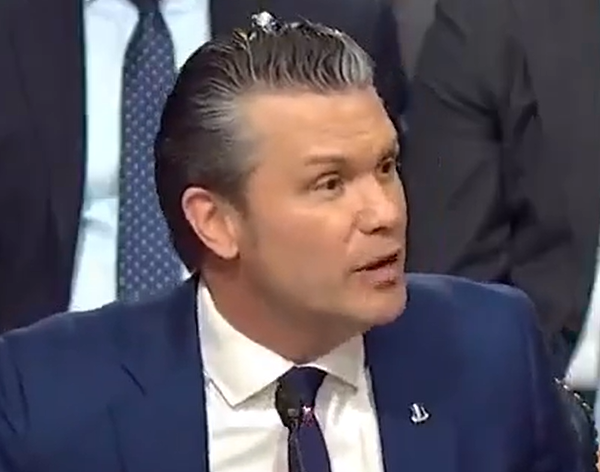
Secretary of War Pete Hegseth didn’t “nix” some sacred alliance out of spite. He hit the pause button on a creaky old joint defense board because Canada kept treating American taxpayers like their personal piggy bank while their military withered into a polite peacekeeping joke. This move sends a crystal-clear message in the Trump era: America First means no more blank checks for allies who talk tough but won’t spend the coin to back it up. The era of one-sided “partnerships” is over.
Roots in the Fires of World War II
The partnership traces back to the dark days of 1940. With Nazi U-boats prowling the Atlantic and the fall of France fresh in everyone’s mind, President Franklin Roosevelt and Canadian Prime Minister Mackenzie King met in Ogdensburg, New York. They hammered out the Ogdensburg Agreement, creating the Permanent Joint Board on Defense to coordinate continental security against threats from across the ocean.
#OTD in 1940, Canada’s Prime Minister Mackenzie King and U.S. President Roosevelt signed the Ogdensburg Agreement. It created the Permanent Joint Board on Defence, which was the foundation for #NORAD and decades of Canada-U.S. cooperation on continental security. 🇨🇦🤝🇺🇸 pic.twitter.com/JiTSHlI5vA
— Embassy of Canada US (@CanEmbUSA) August 18, 2025
This wasn’t some feel-good summit. It was raw survival math. The board handled everything from joint planning on sea, land, and air defenses to production sharing. Hyde Park followed in 1941, ramping up economic and military coordination. Canada supplied raw materials and manufacturing muscle; America brought the industrial hammer. It worked when real enemies loomed.
Fast forward to the Cold War chill. Soviet bombers posed a new nightmare for North American skies. In 1957, the two countries stood up NORAD to watch the Arctic approaches and coordinate intercepts. Formalized in 1958, NORAD became the crown jewel of binational defense: one command, shared radar nets, integrated operations out of Colorado Springs. America provided the heavy lift—fighters, missiles, satellites—while Canada chipped in bases and northern territory. Renewed and tweaked over decades, it endured through multiple threats.
For generations, this setup delivered real value. Joint exercises, intelligence sharing, Arctic patrols. But over time, the balance tilted. America carried the load while Canada coasted on proximity and polite diplomacy.
May 18, 2026
US Department of War, @USWPColby, announced it is pausing/suspending its participation in the Permanent Joint Board on Defense (PJBD), the longstanding Canada-US bilateral defense advisory body established in 1940 under the Ogdensburg Agreement.
》Canada continues… https://t.co/bUjQBPRyfi pic.twitter.com/7VmtIewr0Y
— Navy⚓Brat (@_NavyBrat) May 18, 2026
The Spending Scam That Finally Broke the Camel’s Back
Canada’s military has been in managed decline for years. Despite endless NATO summits and grand promises, their defense budget hovered pathetically low as a percentage of GDP. Trump hammered this point for a decade: allies must hit real targets or stop expecting U.S. protection on the cheap. At the 2025 Hague Summit, Canada and others pledged ramp-ups—talk of reaching five percent by 2035 sounded bold on paper.
Reality? No credible progress. Rhetoric flowed like maple syrup, but procurement lagged, readiness crumbled, and spending stayed anemic. Prime Minister Mark Carney’s globe-trotting speeches at Davos and elsewhere prioritized globalist lectures over hard power. The Pentagon noticed. On May 19, 2026, the decision dropped: pause U.S. participation in the Permanent Joint Board on Defense to reassess its value. Gaps between words and deeds had grown too wide. Canada failed to deliver on commitments while threats from China, Russia, and others mount in the Arctic and beyond.
Hegseth’s shop didn’t act in a vacuum. This fits the broader reset: pulling back from subsidized European deployments, demanding burden-sharing, and refocusing U.S. forces on actual priorities. Why pour endless resources into a board when the junior partner treats it like a social club? American warfighters and taxpayers deserve better than subsidizing a neighbor content to free-ride.
What This Really Signals
No one’s burning bridges to our northern border. NORAD operations continue because geography and mutual interest demand it. But the free pass is revoked. Hegseth and the administration are enforcing accountability: real defense spending, real capabilities, or expect adjustments. Canada can modernize its forces, invest in the Arctic frontier, and pull its weight—or watch the relationship recalibrate.
This isn’t isolationism. It’s realism. For eighty-plus years, the setup served when threats were clear and contributions roughly matched. Today, with America stretched by great-power competition, freeloading allies get the message loud and clear. Step up or step back. Hegseth’s pause on that World War II-era board is the opening salvo in a much-needed correction. Canada has a choice: become a serious partner or keep pretending while the U.S. handles the heavy lifting alone.
The voters who put Trump back in the White House expected exactly this kind of straight talk and action. No more blank checks for polite neighbors with weak militaries. Time for Canada to grow up—or enjoy the consequences of their choices.