Every September, roughly two million eighteen-year-olds do the same thing: they enroll in college. They sign the loan papers, move into the dorms, and begin four years of accumulating a credential that — depending on their major, the economy, and a fair amount of luck — may or may not lead anywhere useful. The average graduate crosses the stage holding a diploma in one hand and $40,000+ in debt in the other. Then the real education begins: how to actually find a job, manage money, and navigate a world that did not pause while they were in class.

We are not here to say college is worthless. For medicine, law, engineering, and research, a degree is the door — full stop. But for the ambitious, practical, self-directed eighteen-year-old who simply wants to build a great life on their own terms, the default path has a serious flaw: it assumes the world stands still for four years while an institution catches up with it.
It does not. The market moves. Industries transform. The skills that employers actually need — cloud security, emergency medicine, skilled trades, languages, real operational competence — have never been less dependent on a university’s ability to teach them. Curricula are designed years before students sit in the seats. They reflect what was in demand when they were written, filtered through what a department could staff, shaped by accreditation requirements that have nothing to do with the outside world. By the time you graduate, the gap between what you studied and what employers actually want can be significant — and it’s widening.
There is also the cost spiral. Tuition has outpaced inflation for four consecutive decades. The average annual cost of a four-year private college now exceeds $55,000. You can borrow your way through it — and most students do — but you will spend the opening years of your career not building wealth, not taking risks, not starting anything. You will be paying down the cost of your education at the exact moment when time and compounding are most on your side.
Which raises an uncomfortable question: what if you spent those four years differently?
What this is — and what it isn’t
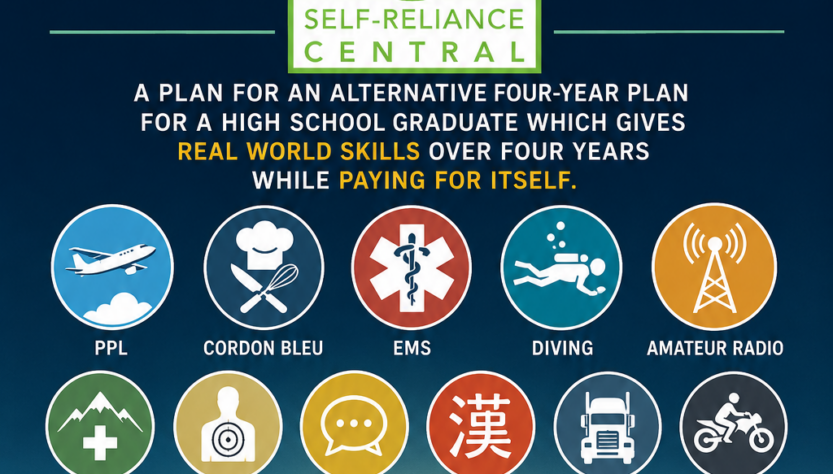
We have put together what we call the Alternative Degree: a four-year plan built around nationally recognised credentials that actually open doors, with realistic costs, honest income projections, and enough flexibility that you can shape it entirely around your own interests and strengths.
The most important thing to say up front: this is a guide, not a prescription. It is a menu, not a set meal. We have assembled what we believe is a powerful combination of credentials across healthcare, aviation, technology, culinary arts, trades, diving, languages, and firearms safety — but you do not have to take all of them, and you do not have to take them in this order.
Hate languages? Skip Spanish and Mandarin entirely and use that time to go deeper on the trades — add a second welding certification, start an electrician’s apprenticeship, or pick up a heavy equipment operator’s licence. Not interested in diving? Swap PADI for a drone pilot certificate (FAA Part 107) or a commercial kitchen management qualification. The point is the approach: be intentional, stack credentials that compound on each other, keep earning while you learn, and never pay more than you have to for something you could earn in a weekend.
Several items on this plan — the motorcycle licence, NRA firearms certifications, PADI Open Water, and the ham radio licence — cost almost nothing and take one or two weekends. They are the highest-return items on the list per hour invested. Do not overlook them.
What holds the plan together is a simple principle: every credential should either earn you money, teach you something irreplaceable, or make you interesting enough that any employer will want to know more. Preferably all three.
Year One — Age 18: Foundation and Licences (around $17,500)
Year one is about building the foundation and stacking quick wins. The EMT certification takes around four months of evening classes and puts you in an ambulance at $16–22 an hour on weekends while everything else is in progress. The CDL Class A commercial licence — often fully reimbursed by employers — means you can legally drive any commercial vehicle on the road (Some rules apply, you must be over 21 to drive intrastate but local routes are a great way to start.) Spanish tutoring runs in the background all year. Private pilot flight training starts building hours. And scattered across a handful of free weekends: a motorcycle endorsement, two NRA firearms safety certifications, and a PADI Open Water diving card.
Eight credentials. One year. And you have been earning throughout.
Credentials: EMT-Basic, CDL Class A, CompTIA A+, Spanish DELE B2, OSHA 30 + CPR, Motorcycle endorsement, NRA Basic Pistol + Rifle, PADI Open Water.
Flexibility: Don’t want the CDL? Swap it for an HVAC technician certification or a commercial drone licence. Not keen on Spanish? Double down on a second trade qualification instead.
Year Two — Age 19: Trades, Aviation, and Advanced Diving (around $17,000)
Year two is where the physical and technical worlds collide. The plumbing apprenticeship starts — and it pays you while you learn. The Private Pilot Licence wraps up, and instrument flight training begins. A few long weekends earn you your FCC Amateur Radio licence — study one week, sit both exams the same day — along with PADI Advanced Open Water and Rescue Diver certifications.
By the end of year two you are a licensed pilot, a certified welder, a rescue diver, and a ham radio operator. You are nineteen years old, debt-free, and earning.
Credentials: FAA Private Pilot Licence, AWS Welding SENSE Level 1, CompTIA Network+ and Security+, Plumbing Apprentice Year 1, FCC Amateur Radio General, PADI Advanced Open Water, PADI Rescue Diver.
Flexibility: Aviation not your thing? Those hours and dollars could go toward a Merchant Mariner credential, a structural firefighting course, or a second trade apprenticeship.
Year Three — Age 20: Paramedic, Cordon Bleu, and Cloud (around $23,500)
Year three is the most demanding — and the most rewarding. The Paramedic certification is a full 1,200-hour programme that builds directly on your EMT base. Le Cordon Bleu’s Diplôme de Cuisine runs in parallel — morning classes covering classical French technique, pastry, and kitchen management. In the evenings, self-paced AWS cloud training leads to two globally recognised certifications. One week of intensive wilderness training earns you the Wilderness First Responder certificate — the gold standard for backcountry medicine, required by every serious expedition and search-and-rescue operation.
Paramedic by day, Cordon Bleu chef in training by morning, cloud engineer by night. It sounds intense because it is. It is also genuinely extraordinary.
Credentials: NREMT Paramedic, Le Cordon Bleu Diplôme de Cuisine, AWS Cloud Practitioner, AWS Solutions Architect Associate, Wilderness First Responder.
Flexibility: Cordon Bleu not your thing? Swap it for a barbering or cosmetology licence, a heavy machinery operator certification, or a medical coding qualification.
Year Four — Age 21: Specialise and Launch (around $13,500)
Year four is about going deep and launching. The Instrument Rating finishes the aviation stack, letting you fly in conditions that ground everyone else. The Certified Ethical Hacker certification opens cybersecurity roles starting at $90,000. The plumbing apprenticeship is in its third year at full wages. One or two weekends completes the PADI Divemaster — the first professional diving rating, allowing you to guide paying divers anywhere on earth.
You are twenty-one. Your contemporaries are preparing to graduate. You already have.
Credentials: FAA Instrument Rating, Certified Ethical Hacker, Plumbing Apprentice Year 3, Mandarin HSK 3 or Portuguese B1, PADI Divemaster.
Flexibility: Don’t want cybersecurity? Use year four for a journeyman electrician qualification, commercial kitchen management diploma, or a real estate licence.
There is a serious amount of fun in this
This plan is hard work. There are no semesters off. You will be tired some evenings.
But consider what you are actually doing. You are learning to fly a light aircraft over the landscape at dawn. You are standing in a Cordon Bleu kitchen at twenty years old learning from a chef who trained in Paris. You are sixty feet underwater off a reef, weightless, more fully present than in any lecture hall. You are driving a truck across three states in the dark, earning $28+ an hour, completely free. You are sitting in a field with a hand-built radio antenna, making contact with a station in Japan on nothing but a wire and the ionosphere.
This is not deprivation. This is the texture of a life being actually lived.
The trades have their own deep satisfactions too. There is something genuinely grounding about knowing how a building’s water system works and being the person who can fix it. About running a weld bead and stepping back to look at something that will hold for fifty years. About arriving at a medical emergency as the most competent person on scene. These are not consolation prizes. They are the things that actually matter when things go wrong — and they pay accordingly.
How it compares
College graduate at 22: starting salary around $55,000, student debt around $40,000, one degree, internship experience, career options narrowed by their major.
Alternative Degree at 22: earning $65,000–90,000+, zero debt, 21 licences and certifications, four years of real work experience, seven or more independent income streams, and the ability to pivot into any one of them if the economy shifts.
Who this is really for
This plan suits the person who finds it easier to learn by doing than by being told. The person who gets restless in classrooms and energised on job sites. The person who looks at a four-year loan and feels something close to revulsion at the idea of beginning adult life already underwater.
It does not require a perfect plan. Years can be reordered. Credentials can be swapped. If you finish year one and decide that welding is the only thing you ever want to do, go deep. The framework is a scaffold, not a cage.
The only honest question to ask yourself is this: are you choosing this because you have a better plan, or because you want an easier path? This is not an easier path. It is a different path, with different rewards, that asks more of your self-direction than college ever would.
If you have that — download the free guide below and share it with someone who needs to see it.
The alternative is out there. It just needs a plan.
Download the free four-year Alternative Degree plan — full PDF and editable Word document — using the link below. https://selfreliancecentral.com/wp-content/uploads/2026/06/SRC-Alternative-Degree.pdf
