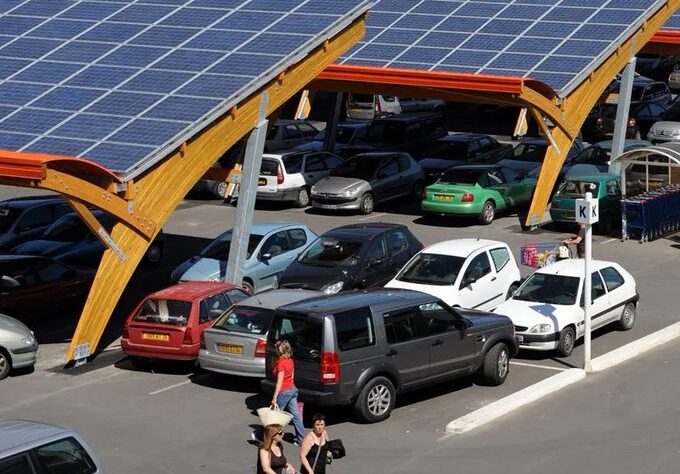
Somewhere in America right now, a Walmart parking lot is doing exactly one job: sitting there, absorbing sunlight, and radiating it back into the neighborhood as heat. Multiply that by every big-box store, mall, stadium, and shopping center in the country, and you get a genuinely staggering amount of wasted real estate. Researchers estimate the US has somewhere between 700 million and 2 billion parking spaces — engineers at UC Berkeley put the most likely figure around 800 million. Nobody actually knows for certain, because no one tracks it. That fact alone tells you something about how little we’ve thought about this land.
France thought about it.
The law
In March 2023, France passed a national mandate: any outdoor parking lot larger than 1,500 square meters — roughly the size of a soccer field — has to cover at least half its surface with solar canopies. Large lots (over 10,000 m²) have until July 2026. Smaller ones get until 2028. There are sensible carve-outs: lots with genuine technical, safety, or heritage constraints are exempt, as are lots already shaded by trees. Miss the deadline without a valid exemption, and you’re facing fines of up to €40,000 a year.
This wasn’t a symbolic gesture. The French government’s own projection is that full buildout could generate up to 11 gigawatts of solar capacity — roughly the output of ten nuclear reactors — without claiming a single new acre of land. That’s the part that should make American policymakers sit up: it sidesteps the single biggest obstacle to utility-scale solar in the US, which isn’t cost or technology, it’s land-use fights. You can’t NIMBY a parking lot that already exists.
The skeptics were wrong
Critics predicted the obvious backlash: businesses would just rip out their parking lots rather than comply, or grudgingly bolt on the cheapest possible canopies and call it done.
That’s not what happened. Carrefour, France’s largest supermarket chain, didn’t wait to be forced — it went on offense. The company partnered with the developer GreenYellow to install solar canopies across 350 stores, covering about 180,000 parking spaces, targeting roughly 450 gigawatt-hours of electricity a year — enough to cover about a fifth of Carrefour’s own store electricity needs, with the rest sold back to the grid. And Carrefour isn’t quietly complying; it’s marketing the shade as a customer perk. Nobody wants to load groceries into a car that’s been baking at 140°F. Turns out solar compliance and customer experience aren’t in tension — they’re the same project.
Why this fits America better than almost anywhere else
The US has the exact conditions this policy was built for:
- A parking surplus that dwarfs France’s. Our 700 million–plus spaces make France’s opportunity look modest by comparison.
- A land-use problem that’s strangling solar development. Rural solar farms trigger local opposition over sightlines, farmland, and property values. A Target parking lot doesn’t have neighbors who’ll show up to a zoning meeting to protect the view of the asphalt.
- A heat island problem this directly addresses. Shaded parking lots run cooler, reduce nearby cooling demand, and make retail districts more walkable in summer — a side benefit that has nothing to do with electrons.
- A grid that needs distributed generation near demand. Solar canopies sit right where the power gets used: at the stores, plants, and stadiums that need it, cutting transmission losses that come with far-off solar farms.
What it would actually take
To be honest about the mechanics: France could do this with one national law because it has one national government and one national grid regulator. The US would need to build this state by state, the way most land-use and building-code policy already works here. That’s not a fantasy — California and Colorado have already floated or passed narrower versions of exactly this idea for large commercial lots, and it’s the kind of policy that tends to spread once one state proves it doesn’t tank retail construction or scare off business investment.
It’s also worth being precise about how France is paying for this, because it’s easy to overstate. France’s Green Industry Tax Credit (worth 20–40% depending on company size and location) doesn’t subsidize retailers installing canopies — it subsidizes companies that manufacture solar panels, batteries, and heat pumps domestically. Carrefour’s canopies are being financed separately, by a private developer under a long-term energy contract, not government money. That’s arguably the more encouraging story, not less: the business case for solar canopies stood up on its own, without needing a direct subsidy to the property owner. The mandate created the demand; the market supplied the financing.
The bottom line
France took the ugliest, most wasted land use in the country — asphalt seas nobody loves — and turned it into a power source, a shade structure, and a competitive advantage, all in one stroke. The US has the same wasted land, at a much larger scale, and the same land-use gridlock that’s currently the biggest drag on getting solar built.
We don’t need a new invention. We need a law that says: if you’re already covering a soccer field’s worth of land in asphalt, cover half of it in panels too.
France passed a law requiring solar panels on every parking lot larger than 1,500 square meters.
— Give A Shit About Nature (@giveashitnature) July 5, 2026
The law took effect in July 2023. Large lots over 10,000 square meters must be 50 percent covered by solar canopies by July 2026. Smaller lots have until 2028.
Exemptions exist for… pic.twitter.com/3Dbr7XTRG2