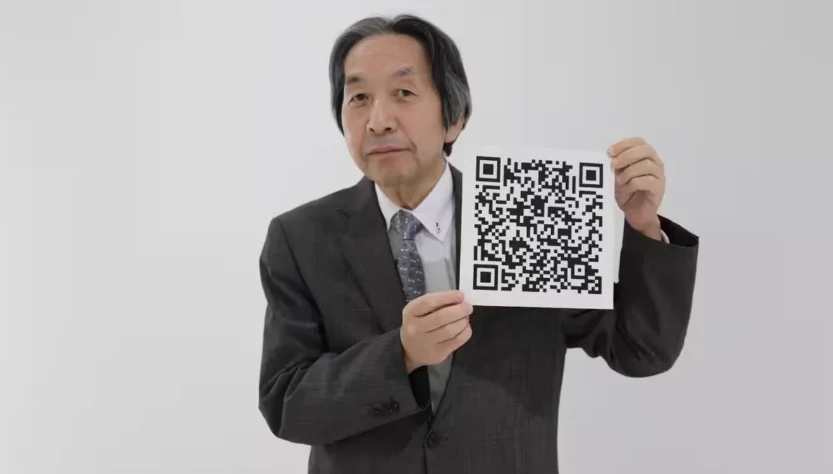
In 1994, a small team at a Japanese auto-parts supplier solved a factory floor problem so specific it barely sounds worth solving. The result is now scanned billions of times a day.
The company. Denso Wave, a maker of automotive components, was part of the Toyota Group — spun out of Toyota decades earlier as a supplier. In the early 1990s Japan’s economy was reeling from the collapse of its asset bubble, and Denso was looking for new business lines beyond car parts.
The engineer. Masahiro Hara joined Denso (then Nippon Denso) in 1980 after graduating from Hosei University. By the early 1990s he was working on barcode scanners and optical character recognition.
The problem. Car manufacturing involves parts pulled together from many suppliers and locations, and by the early 1990s that made tracking a headache. The standard barcode of the time could hold about 20 alphanumeric characters, and read in only one direction. To log everything needed about a single component, workers were affixing and scanning multiple barcodes per part — a slow, repetitive task, and one that broke down if a barcode was dirty or misaligned. In 1992, factory sites asked Hara’s group for scanners that could read faster. Hara concluded the scanner wasn’t the bottleneck — the one-dimensional barcode itself was.
The idea. Hara’s fix was to store data in two dimensions instead of one: a grid, reading across and up-and-down at once, packing far more into the same space. Denso Wave has said the visual layout was influenced by the pattern of black and white stones on a Go board — a game he played every day.
The finder pattern. For the code to scan fast, a reader has to instantly find it and tell which way it’s oriented, at any angle. Hara’s team’s solution was three square “eyes” placed in three corners of the code. For this to work reliably, that exact black-white-black pattern needed to be rare enough that scanners wouldn’t mistake ordinary printed material — packaging, magazine pages — for the code itself. Denso Wave’s team surveyed printed matter to find the least commonly occurring ratio of black to white areas, arriving at 1:1:3:1:1. That ratio still defines the corner squares of every QR code.
Error correction. The code also carries redundant copies of its own data (via Reed-Solomon error correction), so a QR code can be significantly damaged, dirty, or torn and still scan correctly — a genuine requirement on a factory floor where grease and grime were unavoidable.
The name and release. Denso Wave announced the QR Code — “QR” for Quick Response, reflecting the priority on fast reading — in 1994. Even Hara wasn’t sure at the time whether it would catch on. Denso Wave held the patent but chose not to enforce royalties on standard use of the format, publishing the specification openly. Sources place the formal decision not to enforce royalties around 1999, five years after release, once the format’s usefulness for open industrial standards became clear.
Adoption. Because it was free to use, the format spread beyond Toyota’s supply chain into ticketing, packaging, and eventually the camera-equipped smartphones that made scanning trivial. The format spent its first couple of decades as a niche industrial and marketing tool, catching on early in Japan and South Korea. It remained mostly an industrial and East Asian/Japanese market tool for roughly 25 years before the COVID-19 pandemic drove a rapid global shift to touchless menus, payments, and check-ins — the moment when most people outside Japan first noticed it and it’s use became mainstream.
Hara today. He continued at Denso Wave (a company later spun off from Denso Corporation in 2001) and has remained involved in the code’s evolution, including newer variants like rectangular and frame-style QR codes. He’s spoken publicly about being pleased the format ended up playing a role in public safety during the pandemic, and received the European Inventor Award in 2014.
Sources: Denso Wave’s official QR Code history page (qrcode.com), the Japan Patent Office’s account of the invention, and reporting including a 2020 Guardian interview with Hara.