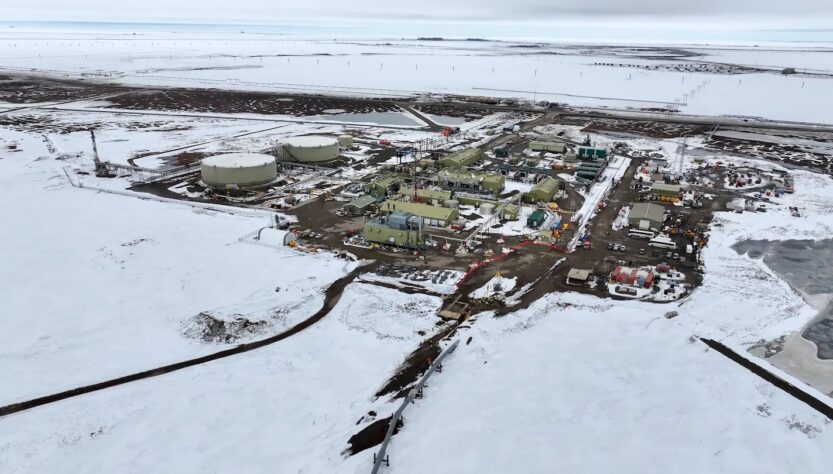
Barry McCardel, co-founder and CEO of Hex and a veteran of Palantir, recently floated an idea that deserves far more attention than it has received: build massive AI data-center capacity on Alaska’s North Slope, specifically around Prudhoe Bay, powered by the region’s stranded natural gas.
ok, hear me out: we should build a ton of AI data center capacity in northern Alaska
— Barry McCardel (@barrald) August 23, 2026
I think about this a weird amount, because I’ve actually spent time there for work (I believe I hold the record for northern-most deployment in Palantir history?)
Prudhoe Bay sits on the very… pic.twitter.com/MlBfnZ2X5u
It is a proposal rooted in first-hand experience. McCardel has worked on the Slope and claims the northernmost Palantir deployment on record. He is not theorizing from a distance. He is pointing at an existing industrial complex, already drilled, already staffed, already equipped with roads, airports, lodging, separation facilities, and gas handling systems, and asking a simple question: why are we not using it?
The Resource Sitting Idle
Prudhoe Bay remains one of the most productive oil fields in the United States, still delivering roughly 180,000 barrels of crude per day. It also produces about 8 billion cubic feet of natural gas every day. Because there is no practical way to export that gas— the Trans-Alaska Pipeline carries only crude, and ice prevents regular marine transport—operators reinject it into the reservoir.
McCardel notes that the North Slope holds roughly 40 trillion cubic feet of proven natural-gas reserves. That volume is enough, by his calculation, to generate 25 gigawatts of continuous power for three decades. The infrastructure to access it already exists. The expertise to operate large industrial facilities in extreme conditions already exists. The workforce is already there. What is missing is the decision to turn that gas into electricity on site and feed it into the most power-hungry industrial project of our time: AI compute.
Why the Location Works
Data centers are constrained by three things: power, cooling, and community opposition. The North Slope solves all three with unusual elegance.
Power is abundant and local. Cooling is essentially free for much of the year; Arctic ambient temperatures make high-density cooling far less energy-intensive than in Texas, Virginia, or Arizona. And “not in my backyard” is almost a non-issue. The landscape is industrial tundra that McCardel describes as looking “like the moon.” The permanent population near the fields is small and already oriented around oil and gas work. Adding data-center load would represent a modest incremental footprint compared with the existing oil infrastructure.
Latency* concerns are real but overstated for many workloads. McCardel’s quick math puts round-trip time from Prudhoe Bay to San Francisco at roughly 50 milliseconds over fiber—only about 15 ms worse than Texas to the Bay Area. For training runs and many batch inference jobs, that difference is immaterial. Inference that requires ultra-low latency can still sit closer to users; the heavy lifting can happen where the electrons are cheapest and most available.
A National Strategy, Not a Niche Project
McCardel is right that we are not talking about this nearly enough. The United States is racing to expand AI capacity while simultaneously struggling to site and permit new power generation in the Lower 48. Every major technology company is chasing megawatts. Grid interconnection queues stretch for years. Local opposition can kill projects. Meanwhile, a ready-made energy source sits underutilized at the edge of the continent, already connected to decades of operational know-how.
Using North Slope gas for data centers would not require the $50 billion Alaska LNG pipeline that has struggled for economic viability against cheaper Lower 48 supply. It would put the gas to work where it is, creating high-value economic activity in Alaska, strengthening the state’s long-term fiscal base, and giving the United States a geographically diversified compute backbone that is harder for adversaries to disrupt.
The environmental trade-off is also more favorable than critics might assume. The alternative is not “no data centers.” It is data centers somewhere else—often in more biologically productive landscapes, closer to population centers, and powered by whatever generation can be permitted. Concentrating additional industrial load on an already industrialized Arctic oil field is, by McCardel’s account, less disruptive to wildlife and habitat than building the same capacity almost anywhere else in the country.
Credit Where It Is Due
This is Barry McCardel’s idea, articulated with the clarity of someone who has stood on the ice and seen the infrastructure with his own eyes. He has done the public service of connecting the dots between stranded gas, existing industrial capacity, free Arctic cooling, and the voracious power appetite of modern AI. The proposal is practical, geographically shrewd, and strategically important.
Whether 25 gigawatts is built or a more modest multi-gigawatt cluster materializes first, the core insight holds: the North Slope is one of the few places in America where the hardest constraints on AI infrastructure—power availability, cooling cost, and political friction—can be dramatically relaxed at the same time.
McCardel ends his original post with a direct invitation to Elon Musk and, by extension, to anyone serious about American AI leadership. That invitation should be taken seriously. The country needs more ideas that treat existing industrial assets as national advantages rather than liabilities. This is one of the better ones to appear in a long time.
*Latency is the delay — the waiting time — between when you send a request and when you get the response back.