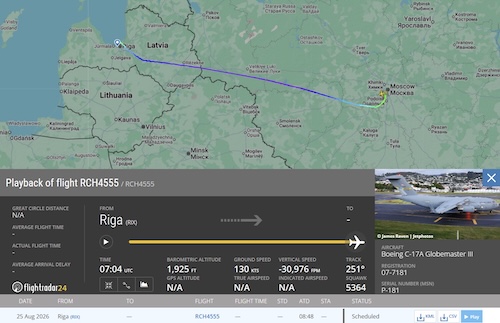
If you missed it: on August 25, 2026, the head of America’s spy agency, CIA Director John Ratcliffe, quietly flew into Moscow for a set of meetings nobody announced in advance. No press release, no heads-up — just a U.S. military plane that landed, a motorcade that drove through the city, and then confirmation, a day later, that it had actually happened.
An unusual visitor to Moscow this morning. 👀
— Flightradar24 (@flightradar24) August 25, 2026
A US Air Force C-17A Globemaster III flew from Riga to Moscow Vnukovo Airporthttps://t.co/D7vylYesDQ pic.twitter.com/jXbOSj0LXM
That’s unusual enough on its own. The last time a CIA director set foot in Moscow was November 2021 — three months before Russia invaded Ukraine. So naturally, everyone’s asking the same question: why was he there?
Nobody in Washington or Moscow has said, officially. But plenty of well-placed people have theories. Here’s a plain-language rundown of each one, plus how likely it seems based on what’s been reported so far, drawing on coverage from the New York Post, the Washington Examiner, Breitbart, UPI, and the Jerusalem Post, among others.
Video footage is circulating online showing several diplomatic vehicles with police escorts driving through the Russian capital of Moscow earlier today, following the mysterious landing of a U.S. Air Force C-17A Globemaster lll this morning at Moscow’s Vnukovo Airport. pic.twitter.com/HfJCIbElX5
— OSINTdefender (@sentdefender) August 25, 2026
How we know this happened at all
Nobody announced the trip. It was pieced together from flight-tracking data: a U.S. Air Force C-17 cargo plane — the kind normally used to haul tanks and equipment, not diplomats — left Joint Base Andrews near Washington, stopped in Latvia, and then landed at a Moscow airport. The Washington Examiner reported the C-17 was used for “high-level discussions,” and the New York Post described “mystery” swirling around the flight before Ratcliffe’s presence on it was confirmed. A U.S. diplomatic motorcade was later spotted moving through the city under escort. The Kremlin initially claimed it had no information about the plane at all — before confirming, once journalists kept pressing, that Ratcliffe had met with Russian intelligence officials. He did not meet with Putin himself, though Peskov said Putin had been personally briefed on what was discussed.
Below are the five leading theories, ranked from most to least likely based on the strength and sourcing of the reporting behind each.
- A warning about Russia planning a new military mobilization (Most likely)
This is currently the best-sourced explanation, reported by the Wall Street Journal. The idea: U.S. intelligence picked up early signs that Russia may be preparing another wave of military mobilization and could be looking to test how far NATO will let it go — possibly through “hybrid” actions like cyberattacks or deniable sabotage rather than open warfare.
There’s a timing detail that makes this theory click into place: Russia’s parliamentary elections are set for mid-September, and Ukrainian officials have said for weeks that any mobilization announcement would likely wait until after the vote, not before. A quiet, high-level warning delivered just ahead of that window would make sense.
The Kremlin has pushed back, calling talk of mobilization overblown. But of all the theories floating around, this is the one with the most specific, attributed sourcing behind it.
Why it’s plausible: It mirrors the last time this happened almost exactly. In 2021, then-CIA Director William Burns flew to Moscow to personally warn Russian officials the U.S. knew they were preparing to invade Ukraine — and to spell out consequences if they did. Analysts see this as a similar playbook.
- An attempt to restart stalled Ukraine peace talks (Plausible, but thinner evidence)
U.S.-brokered efforts to end the Russia-Ukraine war have stalled — the two sides remain far apart, with Russia reportedly still insisting Ukraine hand over territory its forces haven’t actually managed to capture. Some analysts think Ratcliffe, seen as one of the people with the most direct access to President Trump, may have been trying to find some kind of opening.
Ratcliffe isn’t the only senior U.S. figure who’s been quietly shuttling to Moscow — Trump’s Middle East envoy has made repeated trips there as part of the broader diplomatic push, which lends some credibility to the idea that intelligence channels are now part of that same effort.
Why it’s plausible, but less certain: This is a reasonable, obvious guess given the state of the war — but no source has directly tied Ratcliffe’s specific meetings to the peace process. It’s more “this would make sense” than “this is what happened.”
- Pressure over Russia’s relationship with Iran (Possible, explicitly speculative)
This theory picked up steam because of timing: Ratcliffe’s Moscow trip came just a day after the U.S. Treasury Department rolled out a new round of sanctions targeting Iran. Russia supplies Iran with military equipment, including help with satellite launches, and one national security expert said he hoped Ratcliffe used the visit to press Putin to cut that support.
Why to be cautious here: Every report connecting this trip to Iran explicitly frames it as speculation from named analysts, not something anyone with direct knowledge has confirmed. It’s a logical guess based on timing, not a leak about what was actually said in the room.
- Negotiating over Americans detained in Russia (Possible, but doesn’t fit the pattern)
The CIA has a real track record here: it played a central role in the 2024 prisoner exchange that freed journalist Evan Gershkovich, journalist Alsu Kurmasheva, and Marine veteran Paul Whelan. Ratcliffe himself is also known to have personally worked on securing the release of Ksenia Karelina, a U.S.-Russian dual national, back in 2025. So it’s not far-fetched that detainee cases came up.
Why it’s a weaker fit as the main reason: Prisoner swaps are usually finalized on neutral ground — places like Turkey or the UAE — specifically so neither side has to be seen showing up in the other’s capital. Flying the CIA director directly into Moscow on a military transport plane is a strange way to handle what’s normally quiet, third-country diplomacy. Worth noting: Russia had already unilaterally released a U.S. Marine veteran on August 11, and Breitbart reported that at least five Americans remain detained in Russia, so the topic likely wasn’t off the table entirely — it’s just an unlikely primary reason for a trip this dramatic.
- It’s the whole package, not just one thing
It’s worth saying plainly: these theories aren’t mutually exclusive. A meeting like this, between a CIA director and Russian intelligence officials, could easily have touched on all of the above — a warning here, a feeler on peace talks there, Iran and detainees mentioned along the way. Intelligence-to-intelligence channels often carry multiple messages in a single sitting, precisely because they’re rare and both sides want to make the most of them.
The bottom line
Neither the U.S. nor Russian governments have said what was actually discussed, and probably won’t anytime soon — that’s the nature of this kind of meeting. What we do know is the setting: a war that’s dragging into its fifth year, stalled peace talks, fresh warnings about Russian intentions toward NATO, and a U.S. spy chief making the kind of trip his predecessor made right before the last invasion.
That last parallel is the one giving people pause. It doesn’t mean history is about to repeat itself — but it’s exactly why this trip is getting so much attention.
This article draws on public reporting from the New York Post, the Washington Examiner, Breitbart, UPI, the Jerusalem Post, CBS News, NBC News, the Wall Street Journal, RFE/RL, and The Moscow Times, current as of August 26, 2026. Details may change as more reporting emerges.