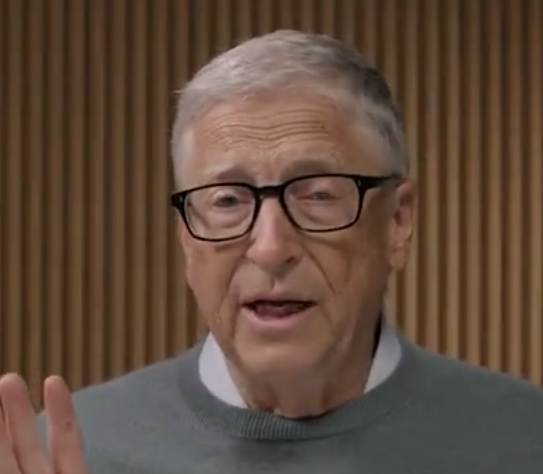
Bill Gates spent six thousand words this week telling the country to slow down artificial intelligence. He would “likely support” a credible global plan to tap the brakes. He wants taxes on AI and robots. He wants some jobs reserved for humans by law. He wants new international machinery to govern the most important technology of the century. Then he admits the thing that wrecks the sermon: it is not going to happen. Geopolitics and money will keep the race at full speed.
That last sentence is the only honest part. The rest is a rich man asking America to handicap itself while a peer competitor does no such thing.
Bill Gates: “I believe we need time to prepare for the period of social, political, and economic upheaval we are about to enter.
If someone had a credible plan for slowing down AI advances globally, I would likely support it.”
Source: https://t.co/uSRXb2YMPE pic.twitter.com/00UuYbouNg
— George Free (@RealGeorgeFree) August 27, 2026
He Knows the Race Exists. He Still Wants Us to Jog.
Gates is not calling for a hard stop. He is doing something more useful to the other side: talking as if “we” can set the pace. There is no “we.” There is the United States and there is China. Chinese models have closed a gap that used to be measured in tens of points. On major benchmarks the lead is now a few percentage points, and it has flipped back and forth. Their open models are cheaper, widely downloaded, and already running in places American labs cannot lock down. They file most of the world’s AI patents. They install industrial robots at a multiple of the American rate. Their military has already stuffed distilled models onto drones and ships.
If Washington taxes tokens, reserves jobs, and builds a global committee, Beijing will take notes and keep training. Code does not stop at customs. Weights get copied. Talent moves. Chips get smuggled or substituted. A pause that only binds the open society is not a safety policy. It is a forfeit.
Gates himself said blocking a data center here does not slow the technology because the buildings go up somewhere else. Apply that logic to the whole stack. A U.S. slowdown is a Chinese acceleration relative to us. That is not a theory. That is arithmetic.
🚨 Bill Gates warns AI risks are becoming impossible to ignore :
– Wants international controls on dangerous AI models
– Warns about biological and cyber risks.
– Says AI systems have already hacked real websites.
– Wants countries to monitor dangerous AI capabilities.
-… pic.twitter.com/et0W9Ldcbm— WTF (@wtffstories) August 27, 2026
🚨 TODAY: Bill Gates warns AI could trigger mass unemployment, cyberattacks and bioterrorism, urging global institutions to help manage the transition. pic.twitter.com/mNoU0LOIZU
— Asedin 💭🔑 (@berr57283) August 27, 2026
The Track Record Is Not Reassuring
This is the same voice that has spent decades explaining that experts should manage the future for everyone else. Population. Energy. Public health. The pattern is consistent: announce a crisis, demand central control, treat dissent as ignorance. Sometimes the models were wrong. Sometimes the cure was worse than the disease. Always the prescription was more authority for people who already have too much.
AI is not milk. If a country bans milk, it can at least try to police dairies. Intelligence software is math, data, and electricity. It crosses borders at the speed of a download. Treating it like a domestic product you can recall is the kind of mistake you make when you have not had to win a contest in a long time.
Jobs will be disrupted. Every general-purpose tool does. The last two centuries did not solve that by freezing the tool. They solved it by staying first and inventing the next layer of work. A tax designed to make American firms use slower tools than Chinese firms is not compassion. It is a plan to import the unemployment from losing.
What “International Framework” Actually Means
Gates wants domestic and international institutions to “deal with AI.” Translation: rules written by people who will not be in the room when the People’s Liberation Army fields the next targeting model. Treaties that bind the country that litigates itself and leave the country that does not. Safety theater that delays American labs while open Chinese weights spread through the rest of the world at a discount.
Cyber risk and biological risk are real. So is losing the stack that defends against both. The systems that will find the attack, write the patch, and aim the countermeasure will belong to whoever kept building. Gates talks as if the danger is speed. The danger is unilateral slowness.
Bill Gates seeks to meet Xi Jinping to discuss global AI risks and safeguards. 🤖🌍#BillGates #AI #AIRisk #China #XiJinping #AIRegulation #AIThreats #TechTrackr #TechNews pic.twitter.com/9ysMnNdU34
— TechTrackr (@TechTrackr_net) August 27, 2026
Why He Is Wrong on the Merits
He is wrong that a global slowdown is a policy rather than a wish. He is wrong that the United States can regulate its way into a shared pause. He is wrong that reserving jobs by statute will outrun a rival that is wiring the same software into factories and weapons. He is wrong that the personal-computer era is the right analogy only when it supports panic, and the wrong analogy when it supports building. He is wrong that the public is safer if the most capable models are trained under a political culture that already censors outputs, not under one that still argues in public.
America’s interest is not a seminar on turbulence. It is to stay ahead in models, chips, power, and talent so the rules of the next era are written here. Gates wants a committee. China wants a lead. Only one of those is a strategy.