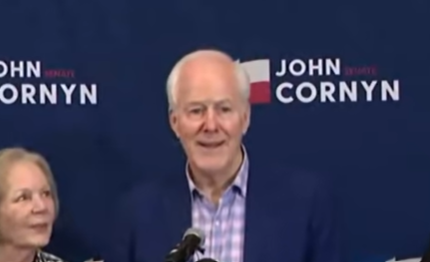
Losing an election is supposed to be the adult part of politics. You get beat, you shake hands, you get out of the way, and you let the people who actually won the argument go fight the other team. That used to be the deal. John Cornyn and Ralph Norman spent the summer proving they never signed it.
Texas Republicans and South Carolina Republicans did not fire these two men because they were bored. They fired them because both men treated the party’s voters like a rental car they could return scratched and still demand the deposit. What they have done since the ballots were counted is the tell. If you still wondered whether the primaries got it right, stop wondering.
The Texas Verdict Was Not Subtle
On March 3, Cornyn finished first in a crowded field with 42.0 percent. Ken Paxton was right behind him at 40.5 percent. Wesley Hunt took 13.5 percent. Nobody hit 50, so they went to a runoff.
On May 26, the runoff electorate rendered a verdict you could see from orbit. Paxton took 63.8 percent. Cornyn took 36.2 percent. That is 888,196 votes to 503,438. It was the first time a Republican senator from Texas lost the party’s nomination for reelection. Cornyn had been in the Senate since 2002. He had money. He had the committee gavel muscle. He had a 99 percent talking point about voting with the president. None of it mattered once the people who actually show up in a runoff decided he was not the guy.
He conceded that night and said he would support the Republican ticket. Note the wording. The ticket. Not the man who just buried him by nearly 28 points. That was the first small tell.
Then the ungrateful routine started in earnest.
— Rachel Ann Palmer Hooper (@RAPHOOPTX) August 29, 2026
The Lame Duck Discovers a Spine He Never Used When It Counted
Within weeks, Cornyn was telling anyone who would listen that the next seven months would be a “pretty bumpy ride” for the president who declined to save him. He predicted November would be a “disaster.” He said the last two years of the term would be “the most miserable.” He dropped the little suck-up project of slapping the president’s name on a Dallas-area highway because, suddenly, it was no longer a priority.
In late July he used his Judiciary Committee vote as a brick, holding up the attorney general nomination over a tax-settlement fight. This is the same John Cornyn who spent the primary twisting himself into a pretzel for an endorsement that never came. The second the voters took the office away, the institutionalist found his inner rebel. Funny how that works.
He also spent the general-election summer questioning whether Paxton could raise what he would need against James Talarico and offering the kind of half-endorsement that does more harm than a straight attack. During the runoff he was still calling Paxton an embarrassment on television. After the runoff he became the world’s most reluctant teammate.
If you wanted a picture of why Texas Republicans dumped him, there it is. Twenty-four years of go-along, get-along, and the minute the base said no, he started playing spoiler with the majority he claimed to cherish. That is not statesmanship. That is a man who thought the seat was an entitlement.
TEXAS SENATE RACE: While Epstein-pal Reid Hoffman and California Democrats pump millions into James Talarico’s campaign, the Republican Senate Leadership Fund has ZERO plans to help Ken Paxton. It’s almost as though Thune and Cornyn want to lose the Senate to the socialists. pic.twitter.com/ippDpltpOy
— @amuse (@amuse) August 31, 2026
South Carolina Did It Twice
Ralph Norman ran the same experiment with worse impulse control.
On June 9 he finished third in the Republican primary for governor with about 17 percent. That should have been the end of the statewide tour. In July, after Lindsey Graham died on July 11, Norman jumped into the special Senate primary instead. Fine. Ambition is legal.
August 11: Darline Graham led with 32.8 percent. Norman took 24.6 percent. Runoff.
August 25: Graham won 52.5 percent to 47.6 percent. Official tally: 193,486 to 175,412. Close. Not a steal. Not a mystery. A decision.
Norman conceded without a prepared speech, complained that $8 million had been spent against him, said he hated it for the state, and could not understand why the president had bothered to weigh in on a South Carolina primary. He said he would support Graham. Then, six days later, a reporter asked what he would tell an undecided voter in November.
“Vote for Ralph Norman.”
That is not a gaffe. That is a write-in advertisement delivered on camera. He followed it by refusing to say he would campaign for the nominee, complaining she had not called him, and grousing about money he labeled liberal. By September 2, after the clip had done its damage, his office said he had misheard the question and posted a statement congratulating Graham and pledging to support the nominee because beating Democrats had to come first.
RE: Ralph “Sore Loser” Norman, the one “True Conservative” who, like all the rest, now sounds exactly like John Cornyn. https://t.co/ZgpTmedLfh
— Jared A. Chambers 🇺🇲 (@C4CEO) September 1, 2026
Which version is the real one? The one he said when he thought the microphone was just another chance to stay on the ballot, or the cleanup statement two days later? Voters are allowed to notice the sequence.
I regret ever supporting Ralph Norman, pathetic behaviour that could cost us a senate seat https://t.co/tDuAQK4sE4
— Nick Perisse (@NickAuror) September 1, 2026
The president’s verdict on Norman was ugly and public: he had the look of a good congressman, not a great one, and he ruined his career when he endorsed Nikki Haley. You do not have to like the phrasing to see the political fact underneath it. Norman spent years as a hard-line House vote and still could not convince Republican primary voters in his own state that he was the Senate article. Then he treated the loss like a clerical error.
Did the Voters Get It Right?
Yes.
Not because Paxton is a choirboy. He is not. The personal wreckage, the impeachment fight, the years of ethics smoke — all of that was on the table in Texas, in public, for months, in the most expensive Senate primary anyone can remember. Republican voters looked at it, looked at Cornyn’s late-arriving loyalty act, and chose the fighter by a blowout. That is what a runoff is for.
The general election is tight, which is the part the Cornyn chorus promised would happen if the “safe” incumbent lost. A late August survey of likely Texas voters had the Democrat at 44.0 percent and Paxton at 43.4 percent. With leaners included it was 50-50. An August survey of registered voters had the Democrat at 42 percent and Paxton at 39 percent, with a large undecided block. Another June survey of likely voters had them tied at 47 percent each. Texas is not supposed to be a jump-ball Senate race. It is one now. That is a real problem.
It is not an argument for putting Cornyn back in the chair. The man who spent the primary warning that Paxton would blow the seat is now the man making the race harder by sulking, slow-walking an endorsement, and using leftover Senate power to pick fights he never picked when he needed the base. If the concern was holding Texas, the post-primary performance is a confession. He was never going to be the closer. He was going to be the guy who wanted credit for being reasonable while the other side took the state.
South Carolina is a different math problem and the same character test. That seat should not be in play. A write-in fantasy from the second-place finisher is how you turn a red seat into a science project. Norman can stand up a watchdog outfit and spend his retirement counting other people’s sins. What he does not get to do is tell Republican voters they made a clerical error and should scribble his name in anyway.
The pattern is the point. Both men ran as indispensable. Both lost to candidates the president preferred. Both discovered principle only after the returns came in. Cornyn’s principle is leverage. Norman’s principle is that the job was supposed to be his.
Primary voters in Texas and South Carolina were not confused. They were done being managed. The sore-loser tour since May and August is not evidence they panicked. It is evidence they saw these two clearly and voted accordingly. The grown-up move now is simple. Close the primary. Carry the nominee. Save the speeches for the other party.
If they cannot do that, the voters already filed the performance review. It was not close.