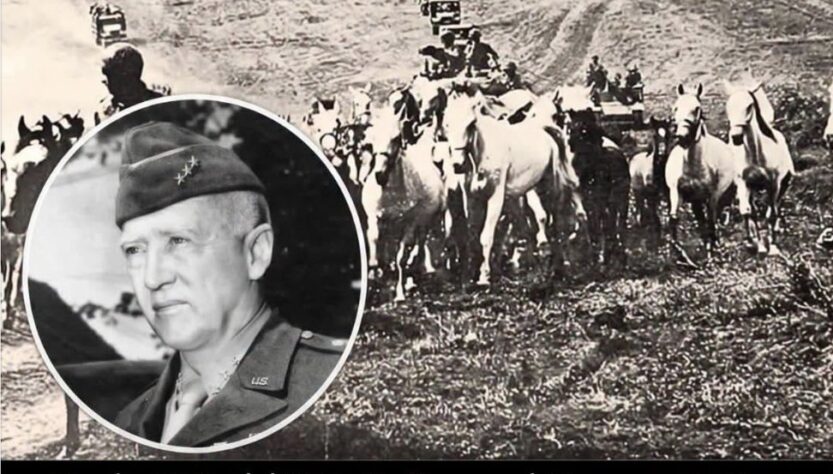
Good — the core facts check out against multiple sources (Operation Cowboy, Hostau, 375 Lipizzaners among 1,200+ horses, Wehrmacht-U.S. cooperation against the Waffen-SS, and the “one of only two” claim, the other being the Battle for Castle Itter). One small correction: Patton didn’t compete as a dedicated equestrian — he rode in the modern pentathlon (which includes a jumping event) at the 1912 Stockholm Olympics. I’ve phrased that accurately below.
Here’s your article:
The Great Horse Heist of World War II
In the war’s final, chaotic days, a bizarre alliance formed—not between armies, but against a shared enemy: time.
Deep in Nazi-occupied Czechoslovakia sat a secret prize: the Lipizzaner stallions of Vienna’s famed Spanish Riding School, along with hundreds of other rare horses. Hitler’s regime had seized them years earlier, hoping to engineer a supposed “master” horse breed through selective experimentation. By April 1945, over 1,200 animals—including 375 irreplaceable Lipizzaners with bloodlines stretching back four centuries—were trapped at a stud farm in Hostau, caught between the collapsing German front and the advancing Soviet Red Army.
The horses’ German caretakers knew what came next. Starving refugees and hungry soldiers wouldn’t spare priceless bloodlines from the stew pot. So a German colonel did the unthinkable: he drove to American lines waving a white flag—not to surrender troops, but to beg for a rescue.
The plea reached General George S. Patton, who had ridden in the equestrian jumping portion of the modern pentathlon at the 1912 Olympics and understood exactly what was at stake. He greenlit Operation Cowboy, sending a task force from the U.S. 2nd Cavalry Group deep behind enemy lines—far beyond where American troops were supposed to be.
What followed was almost unbelievable: American GIs and newly surrendered German Wehrmacht soldiers fought side by side, repelling fanatical Waffen-SS attacks meant to reclaim the farm. Together they held the line long enough to herd the horses to safety, crossing into American-held territory just hours before Soviet forces arrived.
In April 1945, during the closing days of World War II, the rare Lipizzaner horses of Austria’s historic Spanish Riding School, along with hundreds of other thoroughbreds, were trapped in Hostau, Czechoslovakia. Nazi Germany had confiscated the horses to build an experimental… pic.twitter.com/D3UzdtWsmd
— Mike Netter (@nettermike) September 4, 2026
Historians count it as one of only two known instances in the entire war when American and German troops fought as battlefield allies against the SS.
The Lipizzaners survived. The culture survived. And for two extraordinary days, enemies became rescuers together.