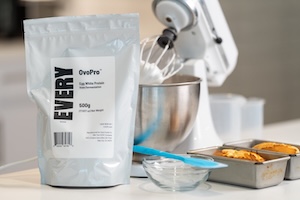
Walk down the baking aisle or grab a protein bar off the shelf, and there’s a decent chance the “egg” listed in the ingredients didn’t come from a hen. It came from a vat of genetically engineered yeast.
The ingredient is ovalbumin — the main protein in egg whites — produced through a process called precision fermentation. Companies including The Every Company (its product is called OvoPro) and Onego Bio (Bioalbumen) insert a chicken gene sequence into a yeast strain, Komagataella phaffii, then grow that yeast in large fermentation tanks. The yeast follows the inserted genetic instructions and secretes ovalbumin as a byproduct of its metabolism. The protein is then extracted, filtered, and dried into a powder that manufacturers can drop into recipes wherever they’d normally use egg whites.
No chicken cells, embryos, or animal tissue are involved. It’s closer kin to how brewer’s yeast makes beer, or how genetically engineered microbes have produced insulin since the 1980s, than to anything resembling lab-grown meat.
Where it’s showing up
Every reported a 550% jump in orders tied to a rollout into Walmart and Target, and the company is quadrupling production capacity to keep up. The powder turns up in baked goods, protein bars, pasta, sauces, and dressings — sold to food manufacturers as a bulk ingredient rather than marketed directly to shoppers, so most people encounter it without ever seeing the company name on a label.
The case for it
- Supply stability. Egg prices have spiked repeatedly due to avian flu outbreaks that wipe out laying flocks. A fermentation tank isn’t vulnerable to a virus moving through a barn.
- Functional parity. Because it’s the same protein molecule, not a substitute or mimic, it behaves like real egg white in baking and binding — no reformulation gymnastics required.
- Regulatory precedent. The process itself isn’t novel. Recombinant insulin, rennet for cheese, and various vitamins have been made by engineered microbes for decades without becoming a public health issue.
The case for caution
- “No questions” isn’t “approved.” The FDA’s response to Every’s GRAS filing was a “no questions” letter, not a formal approval. That means the agency didn’t object to the safety conclusions the company itself submitted — it’s a lighter-touch review than what’s required for drugs, based on data the manufacturer supplied rather than independent FDA testing.
- Thin track record. The ingredient is new to the commercial food supply. There’s no long-term epidemiological data on population-level effects, because there hasn’t been time to generate any. That’s not evidence of harm — it’s simply an absence of evidence either way.
- Same allergen, no opt-out. Because the protein is molecularly identical to conventional egg white, it triggers the same reactions in people with egg allergies. It must be labeled “Contains: Egg,” but if you’re not scanning ingredient panels, you won’t know it’s there until you read one.
- Opacity for the shopper. As a B2B ingredient, it’s buried in ingredient lists under a manufacturer’s own product, not marketed as “made with engineered yeast.” You have to know what OvoPro or Bioalbumen is to spot it.
The bottom line
It’s legal, it’s disclosed on the label, and it went through the same paperwork process as hundreds of other additives — but “the same process as everything else” is doing a lot of work in that sentence. A GRAS self-affirmation reviewed by the FDA with a “no questions” letter means a company graded its own homework and the agency didn’t push back on the data that company chose to submit. That’s a lower bar than most people assume when they hear “FDA cleared.” Combine that with a product that’s barely a few years old, a B2B supply chain designed so shoppers never see the manufacturer’s name, and a track record that’s still being written in real time on real stomachs — and “nothing to worry about” is not the same as “nothing worth watching.” The safest assumption is that this ingredient is exactly as well-understood as its short history allows, no more.