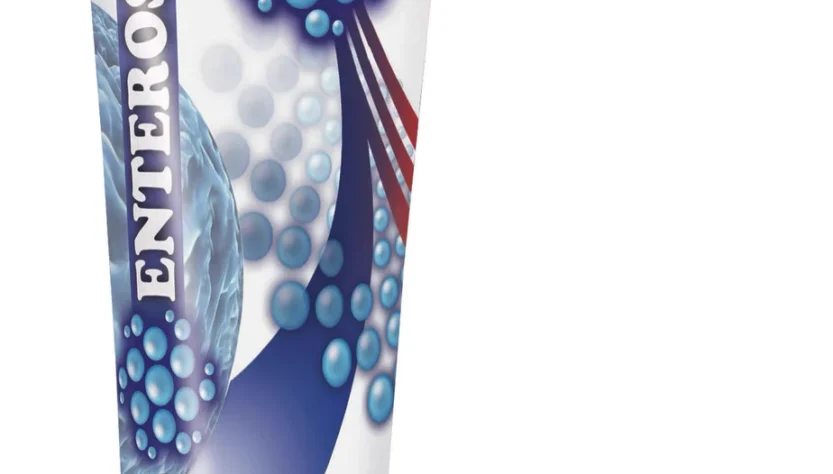
Enterosgel started life as a Soviet answer to a battlefield problem: how to pull toxins, pathogens, and poisons out of the body without anything getting absorbed into it. It was developed in Kyiv in the late 1970s, and the earliest clinical work was done in partnership with the medical service of the Kiev Military District, under Colonel Novikov and Colonel Bezlyuda. It was registered as a medicinal product in Ukraine and Russia in 1994, and today it’s sold in 40 countries.
The chemistry is the interesting part. The active ingredient is polymethylsiloxane polyhydrate — a silicone hydrogel made of tiny microglobules, roughly 50 nanometres across, that pack together into a spongy, water-filled matrix. That matrix isn’t absorbed or digested; it travels the length of the gut and comes out the other end, carrying whatever it picked up along the way.
What makes it more than just charcoal is the pore size. Its pores run from the microporous range up to about 100 nanometres, with most sitting in the 2–100nm mesopore/macropore band. That’s roomy enough to trap medium-to-large molecules — bacterial toxins, cell fragments, pathogens — while being comparatively poor at grabbing small molecules like drugs and vitamins, since its sorption capacity actually rises with the molecular weight of whatever it meets.
Lab testing has confirmed it binds bacterial endotoxin, C. difficile toxins A and B, and Shiga toxin — the toxin family behind E. coli and Shigella-driven illness.
In Russia and Ukraine, it’s used far beyond diarrhea: for poisoning (drugs, alcohol, heavy metals), acute gut infections, food and drug allergy, hepatitis, and renal failure, and — notably — it’s given prophylactically to workers with occupational chemical exposure, before symptoms appear rather than after.
Where it’s actually earned rigorous Western validation is narrower but real. A multicentre, randomised, double-blind, placebo-controlled trial of 440 people with diarrhea-predominant IBS ran an 8-week blinded phase and found meaningfully better outcomes on Enterosgel than placebo: a 37.4% vs 24.3% composite responder rate (number needed to treat: 8), 48.5% vs 32.5% improvement in stool consistency, and 53.3% vs 40.2% improvement in abdominal pain — all statistically significant, with adverse events no more frequent than placebo.
In the US, the picture is quieter. Enterosgel has no FDA drug approval and isn’t sold there as a regulated medicine or CE-marked medical device the way it is in the UK and EU. It’s available anyway — mainly through Amazon and specialty importers — but it’s marketed under dietary-supplement rules, which means the FDA hasn’t reviewed it for safety or efficacy and the labels carry the standard disclaimer that its claims “have not been evaluated by the FDA.”
So a product with a genuine double-blind RCT behind it sits, in America, in the same loosely regulated shelf as unproven joint supplements and herbal blends — not because the evidence is thinner there, but because it never went through the FDA drug-approval pathway that would let it make medical claims on a US label.
The arc is genuinely unusual: a detox gel built for a Soviet military medical service in the 1970s went on to become a CE-marked medical device sold across Europe, passed a modern Western RCT on its own terms, and yet still crosses the Atlantic as an unregulated import rather than an approved treatment.