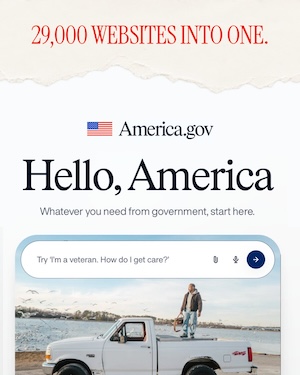
Anyone who has tried to renew a passport, sort out Medicare or track down a veterans benefit knows the drill: one agency’s website sends you to another, each with its own login, forms and jargon. President Trump says he wants to end that.
On Tuesday, President Trump signed an executive order making America.gov the single front door for federal services. The site launched the same day at an event at the Andrew W. Mellon Auditorium in Washington, according to Newsweek.
Chief Design Officer @jgebbia officially unveils https://t.co/tMEB6EUmxg, the new online home for the United States of America pic.twitter.com/Mlllz44UaQ
— Rapid Response 47 (@RapidResponse47) September 29, 2026
What the Order Does
The order puts the General Services Administration in charge of running America.gov, working with the National Design Studio and the Office of Management and Budget, according to the White House fact sheet.
It covers public-facing federal services that serve more than 100,000 people a year and can be handled online. Two big areas are excluded: IRS tax filing and national security functions.
Agencies have 90 days to identify their covered services and begin plugging them into the new site, WINK News reported. Sign-in will run through Login.gov, the government’s existing secure login system, so Americans can use one account instead of juggling several.
A lot of people looked at https://t.co/PuZtPAQNEx yesterday and immediately judged what they could see on the screen… a 3-part thread…
— Observing Consciousness (@holonabove) September 30, 2026
I heard people say… "Too simple"… "Is that it"… "Not impressed"…
That's okay, let it be simple…
What went live was the front… pic.twitter.com/pZb7csH7Xg
The order also keeps the old ways open. People will still be able to get help in person, by phone, by mail or through agency websites.
The order’s own language sums up the problem it is meant to fix. It says Americans have long been “required to navigate a system organized around the structure of Government rather than the needs of the people.”
How It Works Today
Right now, America.gov works mainly as a question-and-answer tool. Visitors can type a question about a program or benefit and get an answer with links to official sources. Newsweek reports the system runs on Google’s Gemini and Elon Musk’s Grok AI models.
In testing described by Newsweek, the site gave detailed breakdowns of VA disability benefits and handled tricky situations, such as moving between states, while separating federal responsibilities from state ones.
Later this year, the White House says, users should be able to complete tasks such as renewing a passport or enrolling in Medicare without bouncing between agency sites.
The project is led by Joe Gebbia, the Airbnb co-founder who now serves as the nation’s Chief Design Officer and heads the National Design Studio.
The Numbers Behind the Pitch
The White House fact sheet says Americans spend about 10 billion hours a year on federal paperwork. It also points to other results the administration credits to its efforts to modernize government: a 74% drop in the veterans benefits backlog, more than $260 billion in fraud uncovered by a task force since January 2025, and more than $700 million in savings on medicines through TrumpRx. Those figures come from the White House and have not been independently verified here.
Privacy Questions
Putting more of your dealings with Washington through one door raises fair questions. Privacy advocates and other experts have asked about accuracy, transparency and data privacy for AI-powered government services.
Officials say the design addresses that. Centers for Medicare and Medicaid Services Administrator Mehmet Oz described it as a “federated system” in which “individuals maintain control of their own records,” Newsweek reported. The order also calls for collecting as little data as possible and using secure authorization.
Our Take: Good Start, Now Shrink the Maze
Ten billion hours a year is a staggering tax on Americans’ time, and it doesn’t show up on any pay stub. A government that respects its citizens should be easy to deal with, especially for veterans, seniors and small business owners who can’t afford to hire someone to fight the bureaucracy for them.
Private companies figured out years ago that customers want one account and plain answers. It’s refreshing to see Washington borrow that lesson, and to bring in someone from the private sector to lead it.
But a nicer front door isn’t the same thing as a smaller house. The real win for taxpayers will come if America.gov exposes which forms, programs and offices are redundant, and Congress and the agencies then eliminate them. Streamlining should be the first step, not the last.
Privacy deserves close watching, too. Conservatives have long been wary of the government gathering more data on citizens in one place. The promises of “federated” records and minimal data collection are the right ones. Holding officials to them is the job of Congress, watchdogs and the public.
What to Watch
Look for agencies to name their covered services over the next 90 days, and for the first real transactions, such as passport renewals, to go live later this year. Whether those launches work smoothly will say more about America.gov than any signing ceremony.