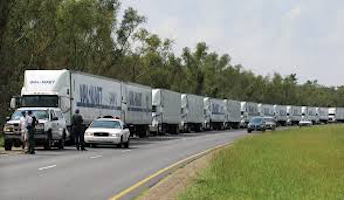
President Trump signed an executive order Monday that lets truckers and other drivers fill up on red-dyed diesel, the tax-exempt fuel normally reserved for tractors, bulldozers and other off-road equipment. The order also lets them put off paying the federal highway tax on that fuel for the rest of 2026.
“So tonight I’m going to sign a historic executive order to officially waive the off-road requirement,” Trump said, according to Fox Business. The relief runs through December 31.
Why diesel matters to everyone
Diesel moves almost everything Americans buy. It powers the trucks that haul groceries, the combines bringing in the fall harvest and the equipment that builds roads and homes. When diesel spikes, the cost shows up on store shelves.
And it has spiked. CNN reported that diesel peaked at a record $6.53 a gallon on September 22 and averaged $6.32 on the day Trump signed the order. Time reported that the price was $3.76 before the Iran conflict began, and that diesel is up 77% this year. CNN called that the largest increase since tracking began in 2000.
The White House blamed tight global supply and limited refining capacity, citing the Russia-Ukraine war and refinery closures in Democratic-run states, according to Fox Business.
What the order actually does
Red-dyed diesel is the same fuel as regular diesel. The only difference is the dye, which marks it as exempt from highway fuel taxes. Normally, running it in a truck on a public road is illegal and counts as tax evasion.
Here is what changes under the order, based on reporting from CNN, Fox Business and Time:
- Anyone can use it on the road. The off-road-only rule is waived for the rest of the year.
- The federal tax is deferred. The federal excise tax on diesel, about 24 cents a gallon, is postponed with no interest or penalties.
- The bill may be erased. The order directs the Treasury Secretary to look at eliminating the deferred tax entirely, Fox Business reported.
- Farmers come first. The Agriculture Department is told to make sure farmers can still get dyed diesel in high-demand areas during harvest.
- States are asked to join. The order encourages states to suspend their own diesel taxes and inspections for dyed fuel. State taxes and fees average about 35.5 cents a gallon, according to Time.
What it means at the pump
Time estimated that a trucker filling a 250-gallon rig would save about $60 from the federal waiver alone, and more than $100 if the trucker’s state goes along. CNN put the savings at roughly $150 per fill-up when both federal and state taxes are avoided.
North Dakota Gov. Kelly Armstrong called the order “a meaningful and timely step,” Time reported, and Farm Bureau leaders welcomed it as real help during harvest season.
Trump also predicted the measure won’t be needed for long. “We’re not going to need it long,” he said, according to CNN, adding that prices are “plummeting.”
The fine print
Not everyone is sold. GasBuddy analyst Patrick De Haan told CNN, “Just because you’re allowing something to happen, doesn’t mean it will,” pointing to the patchwork of rules across state lines. Some analysts quoted by Time warned that more demand from truckers could tighten dyed diesel supplies for farmers. Time also noted that most gas stations don’t sell dyed diesel to the public, so everyday drivers of diesel pickups may not see much change at their usual station.
Those are fair points. Waiving a tax doesn’t build a new refinery. But it does put money back into the pockets of the people doing the hauling, right now, without waiting on Congress.
The bottom line
When fuel prices soar, Washington usually reaches for one of two tools: spend more money or blame someone. This order does something different. It gets the federal government’s hand out of the fuel tank for a few months and trusts truckers, farmers and builders to keep that money and keep working.
The critics are right that a tax holiday is a short-term fix. The long-term answer is more American refining, more American drilling and fewer regulations that have pushed refineries to close. But short-term relief matters to a small trucking outfit or a family farm filling tanks every day in the middle of harvest.
Now it’s the states’ turn. Federal relief only goes so far when state diesel taxes average more than 35 cents a gallon. Governors who say they care about grocery prices can prove it by matching the president’s order.