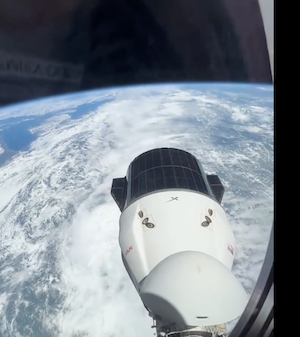
A private American spacecraft just delivered a factory’s worth of science to the International Space Station, including hardware to make artificial retinas in zero gravity.
SpaceX’s cargo Dragon docked with the station Thursday, Oct. 15, after launching from Florida two days earlier, according to NASA. It carried more than 6,300 pounds of food, supplies and experiments for the crew.
It was SpaceX’s 35th cargo run to the station under its NASA contract. That alone is a quiet American success story: a private company now flies routine supply missions to orbit like a delivery truck on a schedule.
The trip up
The Falcon 9 rocket lifted off at 6:33 a.m. Eastern on Tuesday, Oct. 13, from Space Launch Complex 40 at Cape Canaveral Space Force Station, NASA said. The launch plume lit up the dawn sky in what Interesting Engineering said observers call a “space jellyfish.”
Dragon then spent about 51 hours chasing the station, moving at roughly 17,500 mph, before docking on its own to the space-facing port of the Harmony module, the outlet reported.
Artificial retinas made in orbit
The most eye-catching cargo, literally, is equipment to manufacture artificial retinas in microgravity. NASA says the work could eventually help restore vision for patients on Earth.
Interesting Engineering described the retinas as 3D-printed. The same idea runs through much of this mission: some things simply form differently, and in some cases better, when gravity isn’t pulling on them.
Heart tissue and brain models
Dragon also carried 3D heart tissue models designed to copy key features of real human heart tissue. Researchers hope to use them to test large numbers of potential drugs. Microgravity lets cells grow in 3D shapes that look more like those inside the human body, which makes for more realistic tissue, according to Interesting Engineering.
Brain organoids, tiny 3D clusters of brain tissue, also made the trip. Scientists will study them for possible treatment targets for Alzheimer’s, Parkinson’s and multiple sclerosis, NASA said.
Another experiment will watch how a new type of glass forms without gravity in the way.
More power for the station
The flight also delivered the last set of International Space Station Roll-Out Solar Arrays. NASA said the final pair completes the station’s power upgrade, “boosting available electricity for research, operations, and the station’s safe, controlled deorbit.” Astronauts will install them on spacewalks later this fall.
The cargo list also included more practical gear: maintenance parts for the Canadarm2 robotic arm and replacement hardware for the station’s toilets, Interesting Engineering reported. Even in orbit, the plumbing has to work.
Coming home, too
Dragon has one big advantage over other cargo ships. Russia’s Progress, Japan’s HTV-X and Northrop Grumman’s Cygnus XL burn up after use, while Dragon is the only working freighter that can bring cargo back down, Space.com noted.
That matters for science. Dragon will stay at the station until mid-November, when astronauts will load it with finished experiments and send it home for a splashdown in the Pacific off California, NASA said. Researchers will get their samples back in hand instead of relying on data sent from orbit.
Why self-reliant readers should care
There is a lesson here that goes beyond space. Making something in orbit is the ultimate test of doing more with less. Every pound has to be launched, every tool has to work far from a hardware store, and every system has to be repaired by the people living with it.
That mindset, building it yourself, fixing it yourself and bringing back what you need, is what self-reliance looks like at 17,500 mph.
The bottom line
A private American company is now running regular freight to space and bringing it back, and the cargo is getting more ambitious. This load could lead to better eyesight, safer drugs and new clues for brain disease.
Watch for results when Dragon splashes down next month. If retinas built in orbit work as hoped, the next big advance in medicine may come from a factory in orbit.