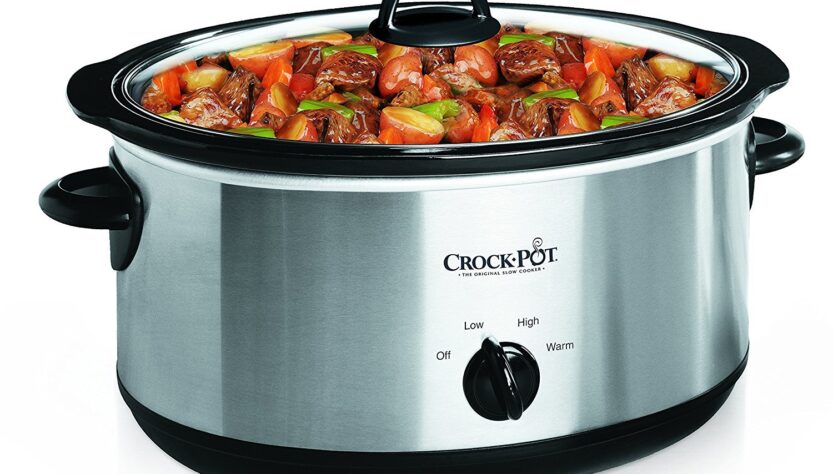
Cool mornings mean it’s slow cooker season again. Toss in a cheap cut of meat, some vegetables and broth, and come home to supper that cooked itself all day.
It’s one of the best tools a thrifty household can own. But a slow cooker works at lower heat than a stove or oven, and that means a few food-safety rules matter more than usual. Here’s what the U.S. Department of Agriculture and university extension experts say to do, and what to skip.
Why the rules matter
Slow cookers generally run between 170 and 280 degrees Fahrenheit, according to USDA guidance. That is hot enough to kill bacteria, but it can take several hours for food to get there.
The danger zone, where bacteria grow fastest, is 40 to 140 degrees, Clemson University’s Home & Garden Information Center notes. The goal is to get food through that range quickly and keep it hot.
Start cold, start clean
- Keep it in the fridge until it goes in the pot. Perishable food should stay refrigerated until you’re ready to cook, so bacteria don’t get a head start. If you prep the night before, store the cut meat and the vegetables separately in the refrigerator.
- Start with a clean cooker, clean utensils and a clean counter, and wash your hands before and during prep.
Never put frozen meat in a slow cooker
This is the big one. “Always thaw meat or poultry before putting it into a slow cooker,” the USDA guidance says. Since a slow cooker can already take hours to reach a bacteria-killing temperature, there’s no reason to make the climb longer.
The exception is a store-bought frozen slow-cooker meal. Follow the maker’s directions on the package.
Cut it down to size
Clemson recommends cutting meat into chunks or small pieces so it cooks through evenly. It advises against cooking big pieces such as whole roasts or whole chickens, which may stay in the danger zone too long. The USDA says to check your cooker’s booklet for the sizes it recommends for your model.
Load it the right way
- Fill it at least half full, but no more than two-thirds, Clemson advises.
- Vegetables go on the bottom and around the sides. They cook more slowly than meat.
- Add the meat on top, then cover with liquid such as broth, water or barbecue sauce.
- Pick high-moisture recipes. Chili, soup, stew and spaghetti sauce are ideal.
Keep the lid on
Every peek costs heat. Clemson says the temperature drops 10 to 15 degrees when the lid comes off. Lift it only to stir or check doneness.
If you can, start on high for the first hour, then switch to low or the setting your recipe calls for, the USDA says. Cooking on low the whole time is also safe, which is handy when you leave for work.
Check the temperature before you eat
A meat thermometer is the only way to know. Clemson lists these minimum internal temperatures:
- Beef and pork: 145°F
- Ground meat: 160°F
- Poultry: 165°F
- Soups, stews and sauces: 165°F
Not sure your old cooker still heats properly? Clemson suggests a simple test. Fill it with 2 quarts of water, heat on low for eight hours, then quickly check the water with an accurate thermometer. It should read 185°F.
Don’t slow-cook dry kidney beans
Raw red kidney beans contain a natural toxin that a slow cooker may not get hot enough to destroy. Kansas State University cites the FDA’s warning that as few as four or five undercooked red kidney beans can cause severe vomiting.
The FDA-based method K-State describes: soak dry beans at least five hours, drain, and boil in fresh water. The toxin is destroyed at 212°F for 10 minutes, but K-State recommends boiling for at least 30 minutes to be safe. After that, they can go in the pot. Canned beans are already cooked.
If the power goes out
Self-reliant households plan for outages, so know this rule. If you’re away and the power goes out, the USDA says to “throw away the food even if it looks done.”
If you’re home, finish cooking right away another way, such as a gas stove, an outdoor grill or a house that has power. If the food was fully cooked before the outage, it can “remain safe up to two hours” in the cooker with the power off, but only if you’re home to know when it went out.
Leftovers
Put leftovers in shallow, covered containers and refrigerate them within two hours after cooking. Don’t reheat leftovers in the slow cooker. Bring them to 165°F on the stove, in the microwave or in the oven first. Then you can hold them in a preheated slow cooker at 140°F or higher.
The bottom line
A slow cooker turns tough, inexpensive cuts into tender meals while you’re busy doing something else. Follow a few simple rules: thaw first, cut it small, fill it right, keep the lid on and check with a thermometer.
Do that, and the slow cooker will save you money all winter long.