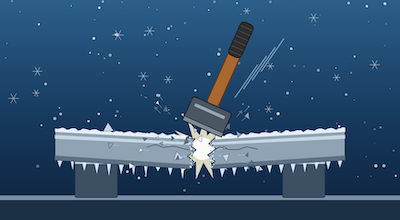
Anyone who has whacked a frozen metal part in January knows the risk: cold metal can snap instead of bend. Now an international team of engineers says it has found metals that stay tough in extreme cold.
In a study published Oct. 14 in the journal Nature, researchers led by the University of Oxford, UC Berkeley and Lawrence Berkeley National Laboratory tested two experimental alloys made mostly of niobium and titanium. At 20 kelvin, about minus 424 degrees Fahrenheit, the alloys showed no measurable shift toward brittle behavior.
“What surprised us is that these alloys remain remarkably damage tolerant even at 20 kelvin,” said Oxford’s Professor Dong Liu.
Why cold breaks metal
Metals such as iron, tungsten and chromium share a crystal structure that engineers call “body-centered cubic.” As those metals get colder, the tiny line-shaped flaws in their crystals, called dislocations, have a harder time moving. When the metal can’t shift and stretch, a crack is more likely to run straight through it.
“For decades, the ductile-to-brittle transition has been viewed as a fundamental limitation of body-centered cubic metals,” Liu said.
How the new alloys beat it
The researchers cooled samples with helium gas and pulled them apart from both ends while a neutron beam watched what happened inside. The tests ran on the Engin-X instrument at the ISIS Neutron and Muon Source in Oxfordshire, England. The team also used electron microscopes, atom-by-atom chemical mapping and computer models.
What they found was a kind of built-in backup system. When the old flaws froze up, the alloys formed tiny mirror-image regions in their crystals, a process called twinning, along with small local changes in crystal structure. Those new features piled up stress where grains meet and kicked off fresh dislocations. That let the metal keep bending instead of cracking.
“Our results suggest we should change how we think about what governs the transition to brittleness for these metals,” said lead author David Cook, who did the work at UC Berkeley and is now at the University of Cambridge.
Where it could lead
The team says the work could help designers build metals for the energy, transportation and aerospace sectors. Liu suggested this class of alloys could also suit parts that face both extreme heat and extreme cold.
This is laboratory research, not a product. The study tested two experimental alloys at one very low temperature, and the reports don’t describe any commercial use yet.
The research was funded in part by the U.S. Department of Energy’s Office of Science.
The bottom line
Breakthroughs like this don’t make the evening news, but they’re the quiet foundation of everything from power plants to aircraft. Understanding why metal fails, and how to stop it, is the kind of practical science that eventually shows up in tougher, safer equipment.
For anyone who has ever cursed a cracked part on a frozen morning, that’s welcome news, even if the payoff is still years down the road.
Sources
- University of Oxford: New study reveals metal alloys that unexpectedly resist extreme cold, staying tough
- SciTechDaily: Scientists Discover Metals That Refuse To Crack at an Astonishing -424°F