Key Takeaways
By linking a molecule between two gold tips, researchers have uncovered a new way to control motion at the smallest possible scale.
- Scientists built a tiny motor using a single screw-shaped molecule.
- An electric current makes the molecule spin.
- The spinning motion can boost the flow of electricity through the molecule.
An international team has built a motor out of one spiral-shaped molecule that spins when an electric current passes through it and reverses direction when the voltage is flipped, the University of Augsburg announced. The work was published Oct. 22 in the journal Nature.
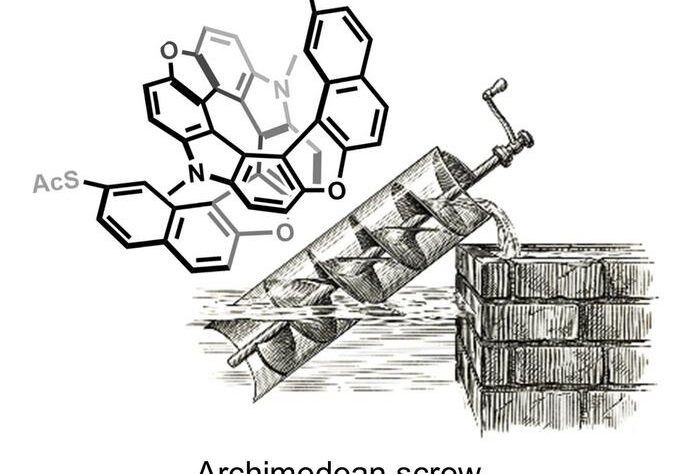
The molecule is a helicene, a corkscrew-shaped carbon compound only a few nanometers long. Chemists in Professor Michael Pittelkow’s group at the University of Copenhagen made it. Professor Oren Tal and Dr. Anil Kumar Singh at Israel’s Weizmann Institute of Science ran the experiments, and physicists led by Professor Fabian Pauly at Augsburg ran the computer simulations.
“This is a new operating principle for machines at the very limits of miniaturization,” Pauly said.
How it works
The researchers attached sulfur atoms to each end of the molecule so it would bind to gold. They then hung it between two gold tips sharpened down to the size of single atoms.
When electrons flow through the spiral, they hand off some of their rotational momentum to it, and the molecule turns. The Augsburg release compares it to wind turning a turbine. The design echoes Archimedes’ screw, the ancient spiral pump that lifts water as it turns, Interesting Engineering noted.
The team says it is the first current-driven molecular motor that is firmly attached to two metal electrodes and spins in a direction that can be controlled. Earlier electrically driven molecular motors, first shown in 2011, sat on a surface and were pushed by the tip of a scanning tunneling microscope.
The surprise: spinning helps it conduct
The simulations turned up something unexpected. As the molecule rotates, its ability to carry current rises by up to about a hundredfold, chemeurope.com reported. The positions where the molecule conducts best are ones it avoids when it sits still.
“It is only the rotation that makes these positions accessible,” said Léon Martin, a doctoral student at Augsburg.
The simulations also predict that above a certain voltage, the motor shifts from turning in steps to spinning continuously. That matters because the experiment alone can only measure current. “In the experiment, you only see the current,” said Yuta Ito, another member of the Augsburg team. The team ran its calculations on Augsburg’s LiCCA supercomputer.
What it could be used for
The researchers say the principle could lead to new molecular electronic parts, components for spintronics, and tiny pumps for microfluidic devices that move very small amounts of liquid. It also gives scientists a new way to study how motion and electricity interact at the scale of atoms.
For now, the motor works only in a lab setup that holds one molecule between precisely spaced gold tips. The published accounts do not report its speed, efficiency or lifetime, and the hundredfold boost in conductance comes from simulations. More research is needed to show whether the idea can be built into working devices.
The bottom line
People have been building machines on Archimedes’ spiral for more than 2,000 years. This team got one to run at the scale of a single molecule, powered by nothing but electric current, and found that spinning makes it a better conductor. It is early laboratory science, but it opens a new path for building machines far smaller than anything engineers can make today.
Sources
- University of Augsburg release via ScienceDaily
- chemeurope.com: molecular motor report
- Interesting Engineering: Archimedes’ screw inspires motor