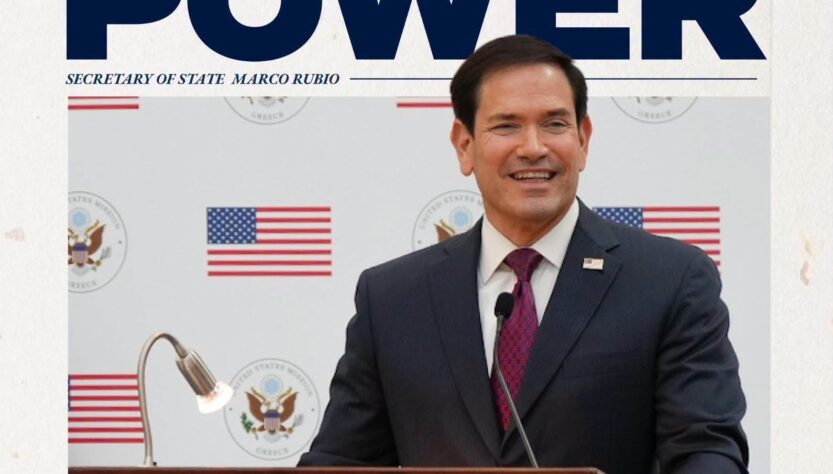
Secretary of State Marco Rubio met Venezuelan Foreign Minister Oliver Blanco at the State Department on Monday, Nov. 2, and pressed Caracas to keep freeing political prisoners and to carry out the reforms needed for free elections.
It was the first meeting between the two countries’ top diplomats since U.S. forces captured Nicolás Maduro in Caracas on Jan. 3 and flew him to New York to face drug-trafficking and torture charges. Interim President Delcy Rodríguez named Blanco to the post the week before.
What the State Department said
“Secretary Rubio reaffirmed the President’s three-phase plan for Venezuela: stabilization, economic recovery and political reconciliation, and democratic transition,” the department said in its readout.
The two men discussed “institutional reforms that lay the groundwork for free, fair, and credible elections,” the readout said. “Secretary Rubio urged the continued release of the remaining political prisoners in Venezuela.”
The Colombia-based broadcaster NTN24, citing sources in Washington, reported that Rubio told Blanco presidential elections should be held in 2027. The State Department has not announced a date.
Blanco also met Treasury Secretary Scott Bessent. According to the Treasury Department, the two discussed raising Venezuela’s energy production and bringing in investment.
Prisoners and deadlines
More than 1,000 political prisoners have been released since January. Foro Penal, a Venezuelan prisoners’ rights group, says 322 remain behind bars.
Rubio told reporters the week before that Caracas has kept its commitments so far. “We have timelines that are agreed to, and so far they’ve met every one of the timelines,” he said. Venezuela’s election machinery has to be replaced “not in 10 years, not in five years, not in two years; it needs to happen quickly under the timelines that we’ve established,” he added.
The State Department wants a new Supreme Court and a new National Electoral Council in place by mid-December. The National Assembly is scheduled to receive the names of 32 new Supreme Court justices on Dec. 11.
Rubio also explained where Washington’s leverage comes from. “To the extent they’re able to do business and operate today, it is because we are issuing waivers or general licenses that are allowing certain economic activities to happen,” he said.
Machado back home
Opposition leader María Corina Machado, the Nobel Peace Prize winner, returned to Caracas on Oct. 25 after months abroad. Rubio said the U.S. had told the interim authorities she should be allowed back without interference.
Machado thanked President Trump and Rubio. She said Rubio “has set out a sequence of events aimed at moving toward a democratic transition that makes clear the holding of presidential elections in 2027.”
In January the U.N. human rights office said the U.S. intervention violated international law.
The bottom line
Ten months ago Maduro ran Venezuela, and Machado was in hiding. Today Maduro is in a New York courtroom, Machado is holding rallies in Caracas, and more than 1,000 political prisoners are free. Those results came from American pressure backed by real economic leverage.
Rubio’s approach is to set a sequence, set deadlines and keep the regime’s business licenses on a short leash. He told reporters the process is “the only game in town” and “the closest we’ve ever been.” The December deadline for a new court and electoral council will be the real test, and so will the 322 prisoners still in custody.
If Caracas keeps meeting those deadlines, Venezuela will get the first credible election it has had in a generation, and U.S. pressure will deserve the credit.
In the Treaty Room at Foggy Bottom, Marco Rubio tells Caracas the clock is running.
They met on Monday afternoon in the Treaty Room of the State Department, the formal chamber where Washington likes to sign things. It was the first time the chief diplomats of the United States and Venezuela had sat across from each other since American forces came down on Caracas on the third of January, seized Nicolás Maduro and flew him to New York to stand trial.
On one side sat Secretary of State Marco Rubio, the Miami son of Cuban exiles, who has spent most of his political life making the case against the Chavista state. On the other sat Oliver Blanco, the new foreign minister in the government of Delcy Rodríguez. Neither man spoke to reporters afterward. Washington let a short State Department readout do the talking.
The message was not subtle. Rubio, the department said, “reaffirmed President Trump’s three-phase plan for Venezuela: stabilization, economic recovery and political reconciliation, and democratic transition.” The two men went over what the department called a Venezuelan-led reconciliation dialogue, and the institutional reforms meant to lay the groundwork for “free, fair, and credible elections.” Rubio also pressed Caracas to release the political prisoners it still holds. More than a thousand have walked out of Venezuelan jails since January. The prisoners’ rights group Foro Penal counts 322 still inside.
Behind closed doors, according to sources cited by the Colombian broadcaster NTN24, Rubio put a date on it: a presidential election in 2027, and a new parliament to go with it.
Rubio had already shown his impatience the week before. Venezuela’s election machinery had to be replaced, he told reporters, and on a short schedule: “Not in 10 years, not in five years, not in two years; it needs to happen quickly under the timelines that we’ve established.” Days later Rodríguez went on national television to promise that “there will be elections” under a “renewed” electoral authority. She did not say when.
Blanco offered his own account on X. He said the two had discussed bilateral relations, regional challenges, and cooperation on energy security. “We reaffirm our willingness to keep building spaces of understanding for the benefit of Venezuela and all Venezuelans,” he wrote. (He wrote in Spanish; the translation is ours.)
Energy is never far from the room. In September the administration announced a deal giving the United States a stake in about one-fifth of Venezuela’s oil resources.
María Corina Machado is watching from closer than she has in years. The Nobel laureate and opposition leader came home last week to organize for the vote she has waited on for so long. She thanked Trump and Rubio, and said the Secretary had “set out a sequence of events” that makes clear presidential elections will come in 2027. The question in Caracas is whether the government will keep that schedule.