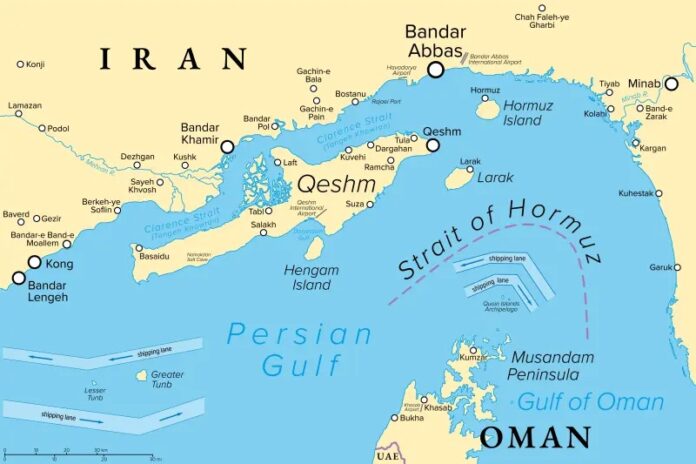
Iran’s top security official said Tuesday that Washington’s answer to Tehran’s conditions for reopening the Strait of Hormuz was “not convincing,” hours after President Trump confirmed that U.S. forces had destroyed a newly built Iranian air-defense site on Qeshm Island.
Mohsen Rezaei, secretary of Iran’s Supreme National Security Council, wrote on X that the United States “must fully and explicitly address Iran’s seven conditions and act upon them. Only in this case will the Strait of Hormuz be reopened.” Tehran’s conditions include lifting sanctions and ending the U.S. naval blockade.
U.S. officials said the Qeshm strikes followed Iranian fire at an American aircraft.
Trump on the strike
Trump described the operation to “Fox & Friends” as “just a minor attack. It wasn’t war.” “They built an anti-aircraft facility. It took them about two months. We watched it get built. As soon as it was completed, we hit it last night,” he said.
In a separate interview with the Financial Times, Trump said the United States has no immediate plan to resume strikes but is “locked and loaded” if needed. “We seem to be getting everything we want,” he said of the indirect talks. On Iran’s enriched uranium stockpile, he said, “Even though it’s under hundreds of tons of rock, I would say that I’m not happy that it will be there.”
The New York Times, citing U.S. officials, reported that Central Command has prepared plans for strikes that could begin as early as Wednesday, with three American aircraft carriers in the region. The report did not say an attack had been authorized.
Talks and attacks at sea
Qatar is carrying proposals between the two sides. Majed al-Ansari, a spokesman for Qatar’s foreign ministry, said both countries “remain committed to the negotiation process.” Vice President JD Vance said Sunday that “the president and I both feel pretty good about the prospects for potentially coming to a negotiated settlement.”
The Islamic Revolutionary Guard Corps said Wednesday that four oil tankers were destroyed by naval mines while trying to pass through a prohibited lane south of the strait, and that two other ships were detained. The British maritime agency UKMTO reported that two projectiles struck a tanker’s engine room off Oman on Tuesday, with no casualties. It is not clear whether the incidents are linked, and the IRGC claims have not been independently confirmed.
The IRGC also claimed it shot down an American MQ-9 Reaper drone over the strait early Wednesday. Iran’s supreme leader, Mojtaba Khamenei, ordered his military over the weekend to answer any threat immediately and without geographic limits, and Iranian officials have suggested European countries and undersea cables in the Gulf could be targets.
The bottom line
Iran is asking the United States to lift the blockade and the sanctions first and trust Tehran to open the strait later. That is the same regime that is laying mines in a commercial shipping lane and threatening undersea cables. The administration is right to refuse those terms.
The Qeshm strike shows the right approach. The United States watched the regime build a weapon aimed at American aircraft and destroyed it once it was finished, without starting a wider war. Trump has admitted that gasoline prices cost his party at the polls, and Tehran will read the election as a sign that Washington is in a hurry. The administration should not let that impression soften its terms.
Any deal has to reopen the strait for good and deal with the uranium buried under Iranian rock. Until Iran meets those terms, the blockade should stay, and the carriers should stay with it.