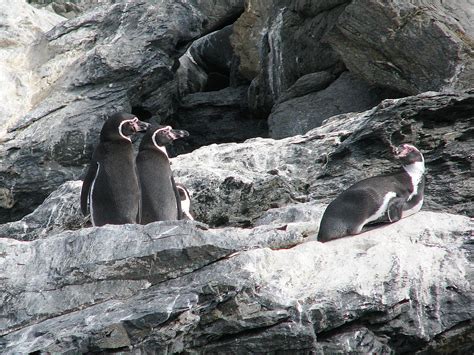
A small seabird that had fallen to a few hundred breeding pairs across its range in 1980 now has nearly 90,000 pairs nesting on a single island off northern Chile, according to a new study.
The bird is the Peruvian diving-petrel, a threatened seabird native to the Humboldt Current region along the west coast of South America. The study, led by marine biologist Marián Méndez of Universidad Católica del Norte and published in the journal Marine Ornithology, found that the population on Choros Island grew about 300-fold since 1980 and about 7.5-fold since 2013.
What changed
In 2013 the nonprofit Island Conservation and its partners removed invasive European rabbits from Choros Island. The rabbits had taken over much of the nesting colony.
Diving-petrels nest in burrows dug into the soil. The rabbits trampled those burrows and enlarged them, ruining them for the birds.
“For decades, rabbits occupied a substantial portion of the breeding colony, trampling and enlarging petrel burrows and degrading the nesting habitat,” said Nicolás Luna, a doctoral researcher at Kiel University in Germany and a co-author of the study. “Since the eradication in 2013, those degraded areas have recovered and the colony has expanded, nearly doubling in area. With more burrows available, more petrels could breed.”
The numbers
The researchers counted 11,934 breeding pairs on the island in 2013. By 2024 the count had reached nearly 90,000. The area of the colony nearly doubled over the same period, and scattered nesting patches grew together across the island.
Choros Island is now the most important breeding site for the species in Chile, the researchers said.
The island sits about 372 miles north of Santiago and is part of the Humboldt Penguin National Reserve, which is managed by CONAF, Chile’s national forestry agency. Luna said the recovery also rests on decades of protection by the agency.
The gains on Choros and elsewhere helped persuade the International Union for Conservation of Nature to move the species from Endangered to Near Threatened in 2020.
Why the method works
Islands hold a disproportionate share of the world’s unique species and are especially vulnerable to invasive animals, according to Island Conservation, which works to remove them. On Choros, taking out one invasive animal reopened nesting ground the birds had lost.
“When we remove threats, restore habitat, and help species reclaim their breeding grounds, recovery isn’t just possible, it can happen far faster than many people imagine,” said María José Vilches, a project manager for Island Conservation.
Coral Wolf, who manages the group’s conservation impact program, has seen the colony firsthand. She described it as loose earth now dotted with thousands of burrow entrances.
The researchers cautioned that the bird still breeds at relatively few locations and remains vulnerable to human-caused threats. They said the findings will help shape new management plans for the species.
Funding for the project came from the David and Lucile Packard Foundation, Bell Laboratories, Patagonia and the Mohamed bin Zayed Species Conservation Fund, along with CONAF.
A practical lesson
The Choros Island project removed one problem animal in 2013 and then left the island to recover under steady protection. In 11 years a colony of fewer than 12,000 pairs grew to nearly 90,000. Anyone who manages land, from a backyard to a ranch, knows the same principle. When the pest that is destroying the habitat is dealt with, native wildlife often returns without much more help.