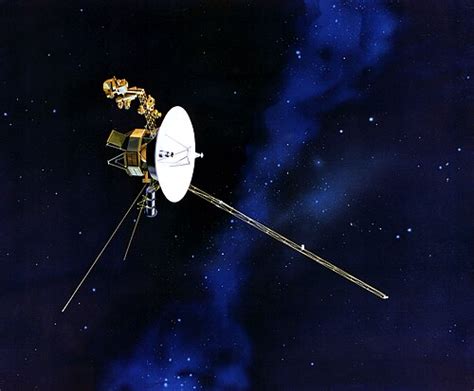
NASA’s Voyager 1 will become the first human-made object to reach one light-day from Earth on Nov. 18, about 16.09 billion miles away, NASA’s Jet Propulsion Laboratory announced. At that distance a radio signal takes 24 hours to reach the spacecraft.
“If you want to say ‘hello’ to Voyager, you send your message and then you go home,” said Suzanne Dodd, Voyager project manager at JPL, “and you wait two days before you finally get a response.”
The probe, launched 49 years ago, is traveling about 38,000 miles per hour through interstellar space. It is tracked by NASA’s Deep Space Network, the agency’s system of large radio antennas.
Keeping old hardware alive
Voyager 1 runs on radioisotope thermoelectric generators, nuclear power sources whose output drops by about 4 watts every year, NASA said, so the team has been rationing power for years. Two of the spacecraft’s 10 original science instruments have been turned off.
In early September, engineers carried out a swap they nicknamed the “Big Bang.” They turned off three heat-related devices and switched on three lower-power replacements at the same moment, so the spacecraft stayed warm enough to keep working. Voyager 2 got the same swap about six weeks earlier. Without it, NASA said, another instrument would likely have had to shut off as early as summer 2027.
A scare in October
On Oct. 18 and 19, Voyager 1 went quiet. One set of thrusters went offline, and the spacecraft’s fault-protection software switched to backups on its own. Contact was restored Oct. 20, and engineers are still investigating the cause.
“This is the first time we’ve seen the spacecraft do something like this,” said Kareem Badaruddin, the Voyager mission manager. “We’re relieved to be back in contact with Voyager 1 and are eager to understand what happened.”
As the probe nears one light-day, every command sent to fix a problem takes about a day to arrive, and the team waits another day to see whether it worked.
What it teaches
The Voyager team’s methods will sound familiar to anyone who runs a cabin on solar panels or keeps an old generator going. They know exactly how much power they have, they cut the loads they can live without, they replace parts with lower-draw versions, and they build in automatic backups so a single failure doesn’t end the mission.
Conclusion
Voyager 1 was built with 1970s parts. Careful power budgeting and steady maintenance have kept it working for nearly five decades, and on Nov. 18 it will set a distance record that may stand for a long time.