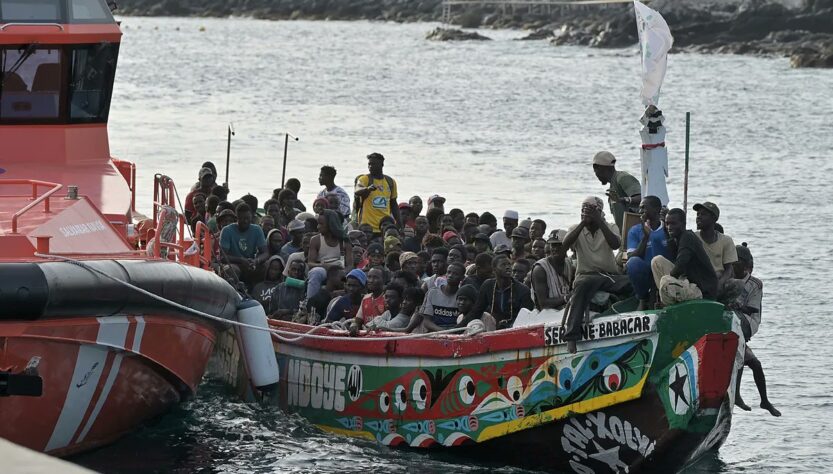
A small Spanish island off the coast of Africa is showing Europe, and America, what happens when a border is left to manage itself.
The island council of El Hierro, the westernmost of Spain’s Canary Islands, has declared a social emergency after more than 8,000 migrants arrived over the last five weeks, Euronews reported. El Hierro has about 11,400 residents, according to Al Jazeera.
El Cabildo de El Hierro declara la emergencia migratoria tras la llegada de cayucos con más de 8.000 personas en cinco semanas https://t.co/EgMghRGEmX
— EL MUNDO (@elmundoes) November 7, 2026
Between Nov. 1 and Nov. 6 alone, 49 boats carrying 4,587 migrants reached the Canary Islands, according to the regional government. Thirty-five of those boats landed on El Hierro. Spanish newspaper 20minutos counted more than 5,800 arrivals across the islands in the first eight days of November, which it said is more than Spain’s Interior Ministry recorded for the entire first half of the year. Spanish broadcaster Cadena SER reported this morning that almost 800 more people reached El Hierro in the previous 24 hours.
An island overwhelmed
“We are very concerned… by this sharp increase in arrivals,” Alpidio Armas, head of El Hierro’s governing council, told Spanish television on Saturday, according to Al Jazeera. He said conditions at the island’s hospital had become “undesirable.”
Armas told Cadena SER the island has only about 40 buses to cover school routes, tourism and migrant transfers, and that reception centers on Tenerife and Gran Canaria are full. The emergency declaration asks the regional and national governments for more personnel, rotation for exhausted rescue and medical staff, and faster transfers to larger islands. Ferries are now carrying arrivals to Tenerife.
Fernando Clavijo, president of the Canary Islands, called the situation “absolutely unsustainable,” Reuters reported, according to Al Jazeera. He said Prime Minister Pedro Sánchez agreed to convene an emergency meeting of Spain’s Interministerial Commission on Immigration on Tuesday.
“The Canary Islands cannot continue to face, practically on their own, a situation that requires the involvement of the Spanish government and Europe,” Clavijo wrote on social media, Euronews reported. “We cannot continue to act only when the situation worsens.”
The Atlantic route from West Africa is one of the deadliest crossings in the world. Two people were found dead on a boat headed for the islands this week, and five others are believed to have died during the voyage, according to AFP survivor accounts cited by Al Jazeera.
Europe’s rules on paper
The European Union has a new Migration and Asylum Pact, new return rules and emergency mechanisms. Writing in Brussels Signal on Nov. 6, Mateusz Chrzanowski noted that the European Commission reported only 28 percent of return decisions were carried out in 2025.
“A decision that cannot be executed is not an operating capability,” he wrote. “Europe is trying to patch a hole in a ship’s hull with duct tape.”
The bottom line
I feel for the people of El Hierro. They did not choose this, and their hospital, their buses and their patience are being used up by decisions made in Madrid and Brussels.
Rules mean little if they are not enforced, and deportation orders mean little if they are not carried out. When fewer than three in ten return decisions are executed, smugglers notice, and they sell that weakness to people willing to risk their lives at sea.
America learned at our own southern border that crossings follow enforcement. Some voices in the incoming Democratic majority, including Sen. Bernie Sanders, are already calling for “bringing ICE under control.” They should look at El Hierro first. When a border is not defended, arrivals climb and the smallest communities pay the price.