Winter brings ice, storms and long nights without power, and a well-stocked first aid kit is one of the simplest things you can put in place before trouble comes. The American Red Cross keeps a list of what a kit for a family of four should hold, and it is worth checking yours against it this week.
You can buy a ready-made kit at most drugstores or build your own. Either way, the Red Cross recommends keeping one at home and one in the car, carrying one with you when you can, and finding out where the kits are at your workplace.
Bandages and dressings
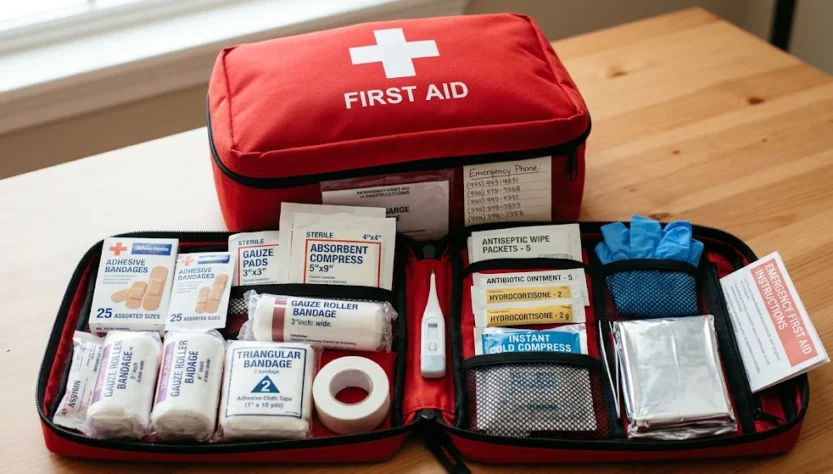
The Red Cross list starts with the basics for covering wounds. It calls for 25 adhesive bandages in assorted sizes and two absorbent compress dressings, 5 by 9 inches. It adds five sterile gauze pads 3 by 3 inches and five more at 4 by 4 inches.
For wrapping, the list includes a 3-inch gauze roller bandage, a 4-inch-wide roller bandage and two triangular bandages, which can be folded into a sling. A roll of adhesive cloth tape, 10 yards by 1 inch, holds it all in place.
Cleaning and protection
To clean and care for minor cuts and scrapes, the Red Cross suggests five antiseptic wipe packets, five antibiotic ointment packets of about 1 gram each and two hydrocortisone ointment packets of about 1 gram each.
Protecting yourself matters too. The list includes two pairs of nonlatex gloves in size large and a breathing barrier with a one-way valve for giving rescue breaths.
The rest of the list
The remaining items cover a range of situations. The Red Cross recommends an instant cold compress, an emergency blanket, an oral thermometer that is non-mercury and nonglass, a pair of tweezers and two packets of 81-milligram aspirin. It also says to include a set of emergency first aid instructions, so whoever opens the kit has guidance in hand.
The emergency blanket deserves a second look this time of year. It folds down small and is worth having in the car if you are ever stuck on a cold roadside.
Make it your own
A store-bought kit is a starting point. The Red Cross says to add any personal items your family needs, such as medications and a list of emergency phone numbers, along with anything your health care provider suggests. If someone in your home has a serious allergy or a chronic condition, talk with your doctor about what belongs in the kit for them.
Keep it ready
A kit only helps if it works when you open it. The Red Cross advises checking your kit regularly, looking at expiration dates and replacing anything used or out of date.
Make sure everyone in the house knows where the kit is kept.
Supplies are only half of being ready. Knowing how to use them is the other half, and a first aid and CPR class from the Red Cross or another recognized organization will give you the skills and confidence to act.
A simple step that pays off
Most of us will never face a true disaster, but nearly every family deals with cuts, burns, sprains and falls. Spending an evening checking your kit against the Red Cross list is a small job that can make a hard day much easier. Do it now, before the first big storm of the season, and you will be ready when it counts.