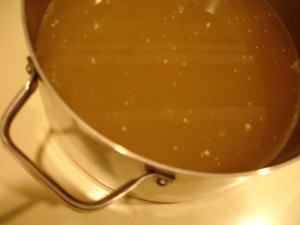
The bones left over after Thanksgiving dinner on Nov. 26 can be turned into stock and pressure-canned for the shelf, using a tested method published by the National Center for Home Food Preservation at the University of Georgia and by Penn State Extension.
Home-canned stock keeps its best quality for about a year, according to Penn State. Canned jars also keep the stock out of a freezer that is often full in late November.
Making the stock
Pull the meat off the cooked bird. Put the carcass and any pan juices in a large pot and add water to cover the bones by an inch or two. Bring it to a boil, cover and simmer for 30 to 45 minutes, until the last bits of meat fall off easily.
Strain out the bones, vegetables and herbs. Penn State suggests whole peppercorns for a clearer stock and canning salt if you plan to can it. Skip strongly flavored vegetables such as broccoli or peppers.
To cool it safely, divide the stock into small containers or set the pot in a sink of ice water and stir, so it reaches room temperature within two hours. Refrigerate it, and once it is fully chilled, skim off the hardened fat. If you are not canning, stock keeps up to three days in the refrigerator, or it can be frozen in freezer containers or wide-mouth jars with room left for expansion.
Canning it
Stock is a low-acid food, so it must be processed in a pressure canner, not a boiling-water bath.
- Bring the skimmed stock back to a boil.
- Fill hot jars, leaving 1 inch of headspace.
- Wipe the rims, put on new lids and tighten the bands fingertip-tight.
- Vent the canner with a steady stream of steam for 10 minutes before adding the weight or closing the petcock.
- Process pints for 20 minutes and quarts for 25 minutes.
At 0 to 1,000 feet, use 10 pounds of pressure on a weighted-gauge canner. Above 1,000 feet, use 15 pounds. On a dial-gauge canner, use 11 pounds up to 2,000 feet, 12 pounds from 2,001 to 4,000 feet, 13 pounds from 4,001 to 6,000 feet and 14 pounds from 6,001 to 8,000 feet.
When time is up, turn off the heat and let the pressure drop on its own. Wait 10 more minutes before opening the lid. Set the jars on a towel or rack with space between them.
Checking the seals
Test the seals after 12 to 24 hours. The center of each lid should be down and should not move when pressed. Refrigerate any jar that did not seal and use it within three days, or freeze it. Remove the bands, wash and label the jars, and store them in a cool, dark place.
Conclusion
A turkey carcass usually goes in the trash on Friday morning. With a stockpot, a pressure canner and an afternoon, it can instead become a shelf of jars ready for soups, gravy and rice through next fall.
Sources
- National Center for Home Food Preservation: Meat stock (beef, chicken or turkey)
- Penn State Extension: Preparing and preserving your own chicken or turkey stock