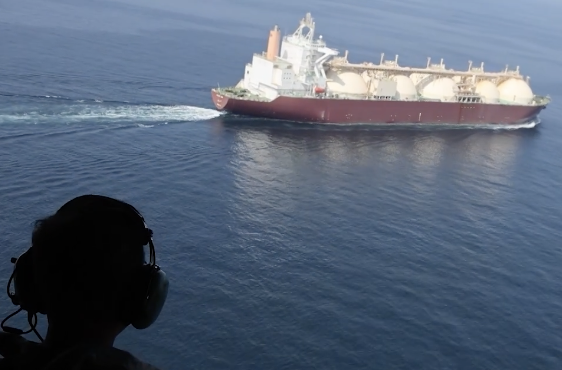
President Trump said Sunday he hopes Iran tries to run the U.S. naval blockade, saying of any ships that try, “they’ll all be at the bottom of the sea like the rest of the navy.”
Trump spoke with Fox News chief foreign correspondent Trey Yingst, Breitbart reported. Yingst said the President is inclined to order new strikes after the New Year if talks fail. The comments came a day after Trump said any deal with Tehran must be “permanent,” which this site covered Sunday.
What Trump said
Trump said Iran’s leaders are “more aggressive now than before the election.” He called Iran’s negotiators “professional tap dancers.” “They talk all the time, all they do is talk,” he said, before adding a profanity. He said Tehran’s terms remain unacceptable, though talks continue.
Later Sunday, on Truth Social, Trump wrote that Iran had launched more drones and missiles in the past week than at any time in more than a year, and that all were intercepted without damage. He wrote that Iran’s leaders see Democrats, who won both chambers of Congress on Nov. 3, as “weak, ineffective, and Country destroying.” “I won’t let that happen!” he wrote.
Trump also said the regime has killed 81,000 protesters, and he told Iranian demonstrators to “keep protesting.”
The tanker standoff
The blockade has nearly halted Iran’s crude exports. U.S. Central Command marked 130 days of the renewed blockade on Saturday. On Wednesday it widened enforcement to ships taking on Iranian cargo at sea. CENTCOM says it has redirected 150 merchant vessels and disabled five since June, Iran International reported.
Update from CENTCOM Commander: https://t.co/oipZRRCJuE
— U.S. Central Command (@CENTCOM) October 30, 2026
More than 14 tankers have gathered near Kharg Island, Iran’s main oil terminal, according to reports cited by Breitbart. Fars News Agency, which is tied to the Revolutionary Guards, has promoted a plan it calls “Operation Fereydoun” to sail a convoy to China under Iranian flags. It has threatened strikes on oil facilities in Saudi Arabia, the UAE and Qatar if U.S. forces interfere. Iranian television has discussed putting journalists, civilians and antiwar activists aboard. Tehran has not formally endorsed the plan.
Deputy Foreign Minister Kazem Gharibabadi called the blockade an “act of war” and said Iran would do what is needed to break it. He said Iran remains in contact with mediators, including Qatar, whose delegation visited Tehran on Friday, and that “enriched materials will under no circumstances leave the country.”
Treasury Secretary Scott Bessent said Friday that the regime has run through its seaborne oil supply. “The ship is sinking,” he said.
The bottom line
The blockade is doing what it was built to do. Iran’s oil exports have nearly stopped, its president has admitted the economic pressure is harder to fight than missile strikes, and regime media are now talking about putting civilians and reporters on tankers to dare the Navy to act. A government confident in its position would not plan to hide its cargo behind its own people.
The President’s warning is the right one, and it should be backed up. If Tehran sends a convoy toward Hormuz, the Navy should stop it. Letting even one convoy through would tell the regime that its threats against Saudi, Emirati and Qatari oil fields work.
Talks through Qatar can go on, but on the terms Trump has set: a permanent agreement that keeps enriched material out of the regime’s hands. Iran’s negotiators say that material will never leave the country. Until that changes, the blockade should stay in place and the pressure should keep rising.