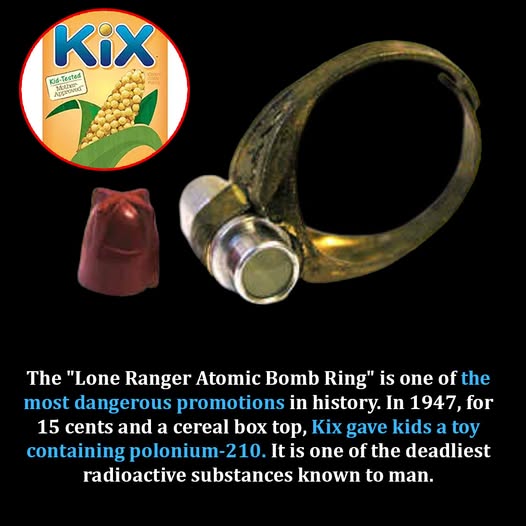
The Lone Ranger Atomic Bomb Ring was a promotional toy from Kix cereal in 1947, tapping into the era’s obsession with atomic energy and the Lone Ranger, a wildly popular radio and comic hero. Kids could get one by sending 15 cents and a Kix cereal box top to General Mills.
— Orwell & Goode (@OrwellNGoode) July 7, 2025
The ring had an adjustable gold-colored band with lightning bolts, a silver “bomb” top, and a red plastic tailfin that doubled as a secret message compartment. Its coolest feature was a built-in spinthariscope: a zinc sulfide screen paired with a tiny amount of polonium-210. In a dark room, after eyes adjusted, kids could peek through a lens to see flashes of light from alpha particles hitting the screen, billed as “atoms splitting.” This tied the Lone Ranger’s silver bullet mystique to the atomic age, making it a thrilling, futuristic gadget for kids.
The polonium-210’s 138-day half-life meant the effect faded fast, but the novelty was a smash hit, with hundreds of thousands distributed.
Kids loved it for the spy-like secrecy of the message compartment, the sci-fi allure of “atomic power,” and the Lone Ranger connection, which made them feel like heroes wielding cutting-edge tech.
It was a status symbol in schoolyards, blending adventure with the era’s atomic optimism.
Today, original rings are rare collectibles. In good condition, with the tailfin and spinthariscope intact, they can fetch $200-$500 at auction, depending on provenance and packaging. Pristine examples with original mailers or display cards have sold for $1,000 or more, driven by nostalgia and their unique place in pop culture and atomic history. Reproductions exist, so authenticity matters to collectors.