In the heart of Silicon Valley’s glittering facade lies a rotten core: the H-1B visa program, a tool for tech giants to flood the market with cheap foreign labor, sidelining U.S. graduates and perpetuating exploitation. Far from addressing a genuine talent shortage, this system suppresses wages, fosters abuse, and undermines the American dream.
The H1B problem…
Recent data exposes the hypocrisy, as thousands of domestic computer science (CS) grads languish in unemployment while corporations import workers en masse. Consider the numbers: In 2023, U.S. colleges produced 134,153 citizens or permanent residents with CS degrees. Yet, 22.6% of these graduates—roughly 30,000—were unemployed or underemployed in roles not requiring their skills.
Meanwhile, the H-1B program issued around 110,000 visas, predominantly to international tech workers, with 90-95% going to the sector. Tech behemoths like Amazon (9,200 visas), Google (5,800), Meta (4,800), Microsoft (4,700), Apple (3,800), and Tesla (1,700) alone approved more in one year than the total under/unemployed U.S. CS cohort. These figures aren’t anomalies; they’re deliberate strategy.
Critics argue the “shortage” is manufactured. Companies post sham job ads—buried in obscure corners—to feign compliance with labor laws, while aggressively recruiting from elite foreign institutions like India’s IITs. Why? Cost. H-1B workers, tethered to sponsors, endure grueling 60-100-hour weeks, subpar housing (think illegal dorms inflating rents in Austin or Seattle), and the constant threat of deportation if fired. This power imbalance depresses salaries industry-wide, benefiting executives at the expense of all workers.
The fallout is multifaceted. American grads face a barren job market, with unemployment rates for recent CS alumni hitting 6.1%—higher than many non-STEM fields. Underemployment soars to 41-52%, trapping talent in irrelevant gigs.
For visa holders, mostly from India and China, it’s indentured servitude: savings funneled home, minimal U.S. economic integration, and stereotypes that harm assimilated immigrants. Racism lurks beneath, as firms exploit global wage disparities.
So, often these workers try for PERM certification never heard of it? Neither had we.
PERM Labor Certification Explained
The Program Electronic Review Management (PERM) is a U.S. Department of Labor (DOL) process that certifies whether an employer can hire a foreign worker for permanent employment in the United States without harming U.S. workers’ opportunities, wages, or conditions. It’s the foundational step for many employment-based green cards, particularly for transitioning H-1B visa holders to permanent residency. Employers must prove there are insufficient able, willing, qualified, and available U.S. workers (citizens, permanent residents, or authorized workers) for the job in the area of intended employment, and that the foreign hire won’t negatively impact similar U.S. roles. The process involves several key steps and requirements:
Holy shit lol someone created a website to let Americans apply to the market surveys for unlisted H1B-earmarked job openings that have already been given to a foreign applicant
— Fresh Stimutacs (@fleshsimulator) August 13, 2025
If any US citizen applies to one of these, they legally can’t issue an H1B for it hahahahahahahahaha pic.twitter.com/sIsHrKd2bO
- Eligibility Determination: The employer must be a legitimate U.S. entity with a valid Federal Employer Identification Number (FEIN) and a physical U.S. location for referring workers. They define the job’s minimum requirements, duties, and classification (e.g., professional, non-professional, or special categories like college teachers or athletes under regulations like 20 CFR 656.17 or 656.18).
- Prevailing Wage Request: Before recruitment, the employer obtains a prevailing wage determination from the DOL’s National Prevailing Wage Center (NPWC) to ensure the offered salary matches or exceeds local standards for the role, preventing wage suppression.
- Pre-Filing Recruitment and Notice: This “labor market test” requires advertising the job to attract U.S. applicants. For most occupations, this includes two Sunday newspaper ads, a 30-day posting with a state workforce agency, and internal notices. For professionals, additional steps like job fairs or online postings may apply. A “Notice of Filing” must be posted at the worksite for 10 business days. If qualified U.S. applicants respond, the employer must interview them and justify rejections.
- Application Submission: If no suitable U.S. workers apply, the employer files Form ETA-9089 online via the FLAG system (after registering with Login.gov) or by mail. The DOL reviews for completeness, potentially auditing (about 30% of cases) for further proof. Approval typically takes 6-12 months, but audits extend this.
Employers must retain records for five years and pay all costs without passing them to the worker.
How PERM Requirements Are Dodged
Despite strict rules, some tech companies exploit loopholes to minimize U.S. applicant responses, ensuring PERM approval for foreign workers (often after years on H-1B visas).
These Ancestry jobs are a crazy demonstration of the sneaky ways companies hide jobs for H1Bs!
— Discover Hidden Jobs.Now! (@JobsNowPR) August 7, 2025
Go on their career site, search for "Staff Software engineer" – no post! Where could it be hiding? 🧵(1/2) https://t.co/3k1K2M5LbH pic.twitter.com/wqe4lcRCvz
Common strategies include:
- Delayed Timing: PERM isn’t required for initial H-1B hires; it’s filed 5-6 years later when sponsoring green cards. By then, the foreign worker is entrenched, making recruitment a formality.
- Obscure Advertising: Ads are placed in low-circulation print newspapers (e.g., Sunday editions), not digital platforms, reducing visibility. Many yield zero applicants, as with firms like Softrams.
- Misleading or Inaccessible Listings: Companies use virtual offices or mail-drop addresses (e.g., Sapphire Software Solutions’ non-physical site), deterring in-person applications. Ads may mismatch website postings or direct resumes to immigration lawyers, discouraging U.S. candidates.
- Lack of Genuine Effort: Managers admit ads are solely for compliance, not hiring, with no follow-up on rare applicants. This “ruse” persists despite immigration crackdowns, allowing firms to prioritize cheaper, dependent foreign labor.
These tactics suppress wages and sideline U.S. talent, often unchecked due to limited DOL oversight.
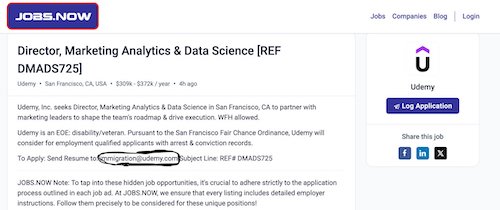
Udemy continues to advertise data science roles that ask applicants to email their resume to their immigration department
— Discover Hidden Jobs.Now! (@JobsNowPR) August 12, 2025
how has the justice department not cracked down on this blatant anti-American discrimination yet?
up to 372k year for this WFH position pic.twitter.com/27czkAVubF
Reform is urgent. We must limit visas, enforce genuine local hiring, and penalize abusers. Tools like jobs.now empower Americans to apply for PERM postings, blocking foreign retention if qualified locals exist. Ignoring this isn’t capitalism—it’s cronyism bordering on treason. Tech’s innovation thrives on fair play, not exploitation. Time to prioritize homegrown talent and dismantle this rigged game.
How Jobs.Now Works
Jobs.Now is a website designed to expose the “hidden job market” of PERM postings, which tech companies must advertise but often bury to favor H-1B workers transitioning to green cards. Its purpose is to make these exclusive opportunities accessible to U.S. citizens and residents, potentially forcing employers to hire locally if qualified Americans apply, thus delaying or blocking foreign sponsorships. The site aggregates PERM ads scraped from corporate listings, newspapers, and agencies, listing roles like software engineers at companies such as Meta, Lyft, Airbnb, and Moloco.
Features include job details (company, location—often remote—salary ranges like $157k-$306k, and posting age), searchable filters, and email subscriptions for new alerts. Users browse recent postings, review employer-specific application instructions (e.g., exact submission methods), and apply directly per those guidelines to be considered—crucial, as deviations may lead to rejection.
By applying en masse, users can demonstrate U.S. availability, aiming to promote fair hiring and counter exploitation in tech.
And it’s working!
Wow they really are complaining about Jobs Now on blind!
— Discover Hidden Jobs.Now! (@JobsNowPR) August 12, 2025
Turns out competition isn’t so fun when Americans actually get their (legally mandated) chance to apply for your jobs!
You know what to do! We have hundreds of fresh PERM jobs up on our site today! pic.twitter.com/wpB3nNRSBW
Watch this guy unfold the story
Jobs Now is back in Newsweek today explaining how big companies are asking Americans to send their resumes to their immigration department by mail!
— Discover Hidden Jobs.Now! (@JobsNowPR) August 16, 2025
It's time to end the discrimination against American citizens! pic.twitter.com/nuIuAhCmdc