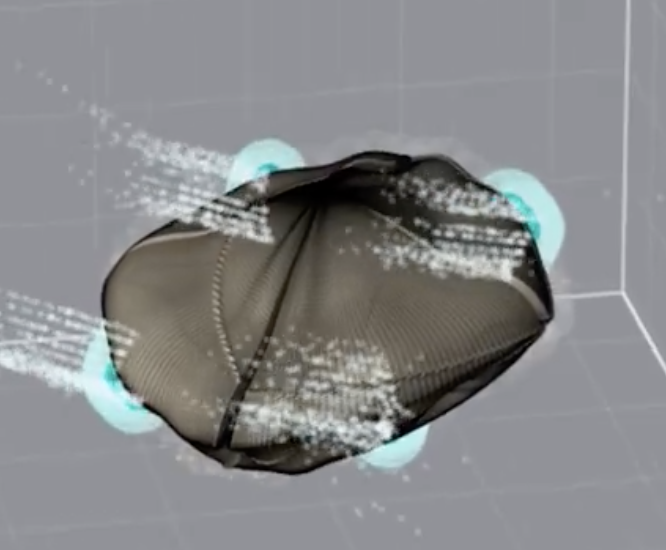
AETHRA-E is a conceptual drone design showcased in a computer simulation, created by the X user @mathelirium, who specializes in mathematics and physics animations. It represents an innovative approach to unmanned aerial vehicles (UAVs) by eliminating traditional components like rotors (propellers) or wings for lift and propulsion. Instead, the design relies on an “edge-blown monocoque” structure, where the drone’s hull itself functions as a sophisticated nozzle system.
Key Features and How It Works
- Shape and Structure: The drone has a smooth, oval or disc-like body, resembling a flattened pebble or saucer. This monocoque (single-shell) design integrates the propulsion directly into the airframe, with no external appendages.
- Propulsion Mechanism: Embedded around the edges of the hull are slot microjets—narrow slits that expel high-velocity air or gas in a continuous, sheet-like flow. This creates vectored thrust, meaning the direction and intensity of the airflow can be precisely controlled to achieve various movements:
- Lift: Symmetrical downward thrust from the slots generates upward force, allowing the drone to hover.
- Steering and Maneuvering: By adjusting the thrust asymmetrically (e.g., more flow on one side), the drone can tilt, rotate, or move laterally/forward/backward.
- Stabilization: The continuous thrust sheet helps maintain balance, countering disturbances like wind.
- Underlying Principle: This concept draws from fluid dynamics, particularly the Coandă effect, where a jet of fluid adheres to a curved surface and entrains surrounding air. Here, the hull’s shape guides the thrust sheet along its contours, effectively turning the entire body into an active aerodynamic surface. No mechanical moving parts are needed beyond internal compressors or fans to generate the airflow.
The simulation video demonstrates the drone in a 3D environment, showing it hovering stably and performing agile maneuvers by varying the blue-glowing jet emissions (visualized with white particle streams for clarity). It’s purely digital at this stage, with no known physical prototype built or tested.
Potential Advantages and Challenges
While still theoretical, this design could offer benefits over conventional drones:
- Safety: Absence of exposed rotors reduces injury risk in close-quarters operations, like indoor inspections.
- Noise Reduction: Smoother airflow might produce less turbulence and sound compared to spinning blades.
- Durability: Fewer moving parts could mean lower maintenance and greater resistance to damage.
- Efficiency: In theory, the integrated thrust could optimize energy use for certain flight profiles.
However, real-world implementation would face hurdles, such as generating sufficient thrust efficiently (requiring powerful yet lightweight compressors), managing heat from jets, and ensuring precise control in varying atmospheric conditions. It’s unclear if or when this concept might transition to hardware.
This idea gained viral attention on X starting around August 24, 2025, with the original post amassing thousands of likes and reposts. Similar rotorless drone concepts exist in R&D, like ion-thrust or electrostatic propulsion systems, but AETHRA-E stands out for its microjet-based approach.
Meet AETHRA-E…a drone without rotors or wings. Slot microjets embedded in the hull vector a continuous thrust sheet to lift, steer, and stabilize. Edge-blown monocoque: the airframe itself becomes the nozzle. Just shaped thrust. No props. No wings. pic.twitter.com/hPuTdmpH2J
— Mathelirium (@mathelirium) August 24, 2025