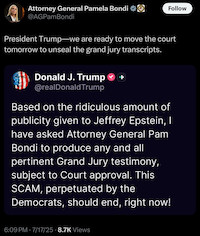
In a move that has reignited public interest in one of the most notorious scandals in recent history, President Donald Trump announced on July 17, 2025, that he had instructed Attorney General Pam Bondi to pursue the unsealing of grand jury transcripts from Jeffrey Epstein’s 2005 criminal case in Florida. This directive comes as Trump faces scrutiny over his past associations with Epstein and amid calls for greater transparency from both supporters and critics. Bondi confirmed that the Department of Justice (DOJ) would file a motion in court on July 18, 2025, to request the release of “pertinent” grand jury testimony, emphasizing their readiness to act swiftly.
As of today, July 18, reports indicate that the DOJ has indeed proceeded with the filing, marking a potential step forward in disclosing long-sealed documents related to the convicted sex offender. While the unsealing process requires court approval and may involve redactions to protect victims, legal experts note that a “clear pathway” exists under Florida’s updated laws for such releases in cases of significant public interest.
President Trump—we are ready to move the court tomorrow to unseal the grand jury transcripts. pic.twitter.com/hOXzdTcYYB
— Attorney General Pamela Bondi (@AGPamBondi) July 18, 2025
Background on the Epstein Case and the Sealed Files
Jeffrey Epstein, a financier and convicted sex offender who died in federal custody in 2019 under suspicious circumstances, was accused of operating a vast sex-trafficking network involving underage girls. His 2005 prosecution in Palm Beach County, Florida, resulted in a controversial plea deal in 2008, where Epstein served only 13 months in a work-release program despite facing serious charges. Critics, including victims’ advocates, have long decried this arrangement as unduly lenient, potentially influenced by Epstein’s connections to powerful figures across politics, business, and entertainment.
The “Epstein files” at the center of this latest development refer primarily to sealed grand jury records from that 2005 case. These include:
- Victim and Witness Testimonies: Accounts from alleged victims and investigators that could detail the scope of Epstein’s activities.
- Prosecutorial Decisions: Insights into why charges were downgraded and the plea deal was struck.
- Associated Names: While not a comprehensive “client list,” prior partial releases in January 2024 mentioned individuals like former President Bill Clinton and Prince Andrew, though no new criminal charges stemmed from those disclosures.
Earlier in 2025, the DOJ under Bondi declassified some Epstein-related files, including details on over 250 victims and a $290 million settlement with his estate. However, those releases were criticized for extensive redactions. Trump’s order builds on a 2024 Florida law allowing exceptions to grand jury secrecy, aiming to address what he called “the ridiculous amount of publicity given to Jeffrey Epstein.”
The Catalyst: Pressure and Denials
Trump’s decision follows backlash over a purported 2003 “bawdy” birthday letter from him to Epstein, published by The Wall Street Journal, which Trump has dismissed as fabricated and threatened legal action against the outlet. During his 2024 campaign, Trump promised transparency on Epstein-related matters, framing the unsealing as a way to expose alleged cover-ups by Democrats and the media. Supporters, including Rep. Anna Paulina Luna (R-FL), have described the effort as having been “quietly in the works,” while raising concerns about potential evidence destruction under the previous administration.
On social media platform X, reactions poured in rapidly. Users echoed calls for release, comparing it to the Kennedy files and suggesting implications for high-profile individuals. Others viewed it as a “bait and switch,” anticipating limited revelations initially.
Reactions from Across the Spectrum
The announcement has elicited a mix of praise and skepticism:
- Supporters’ Enthusiasm: Trump allies, including Donald Trump Jr. and Laura Loomer, praised it as a bold step toward holding pedophiles accountable. Elon Musk weighed in on X, highlighting the need for full disclosure of any “list of abusers” tied to victim settlements.
- Critics’ Doubts: Opponents question the timing, pointing to Trump’s own history with Epstein—they were acquaintances in the 1990s, though Trump claims he banned Epstein from Mar-a-Lago after learning of his behavior. Some media outlets suggest the move distracts from ongoing controversies, and legal hurdles could result in only partial releases.
- Media Coverage: Outlets like CBS News and CNN reported on the order’s immediacy, while Fox News focused on the legal feasibility. The BBC noted Trump’s threats against figures like Rupert Murdoch in related coverage.
What Happens Next?
The court motion filed today could lead to disclosures in the coming weeks, but outcomes are uncertain. Grand jury secrecy is a cornerstone of the U.S. legal system, and any release would likely prioritize victim privacy. If approved, the transcripts might reveal more about Epstein’s network, which allegedly spanned both political parties, though previous unsealed documents have not yielded major new indictments.
This development underscores ongoing debates about accountability for the powerful and the role of transparency in healing victims’ wounds. As the process unfolds, all eyes will be on the courts—and the White House—for what could be a pivotal moment in the Epstein saga.