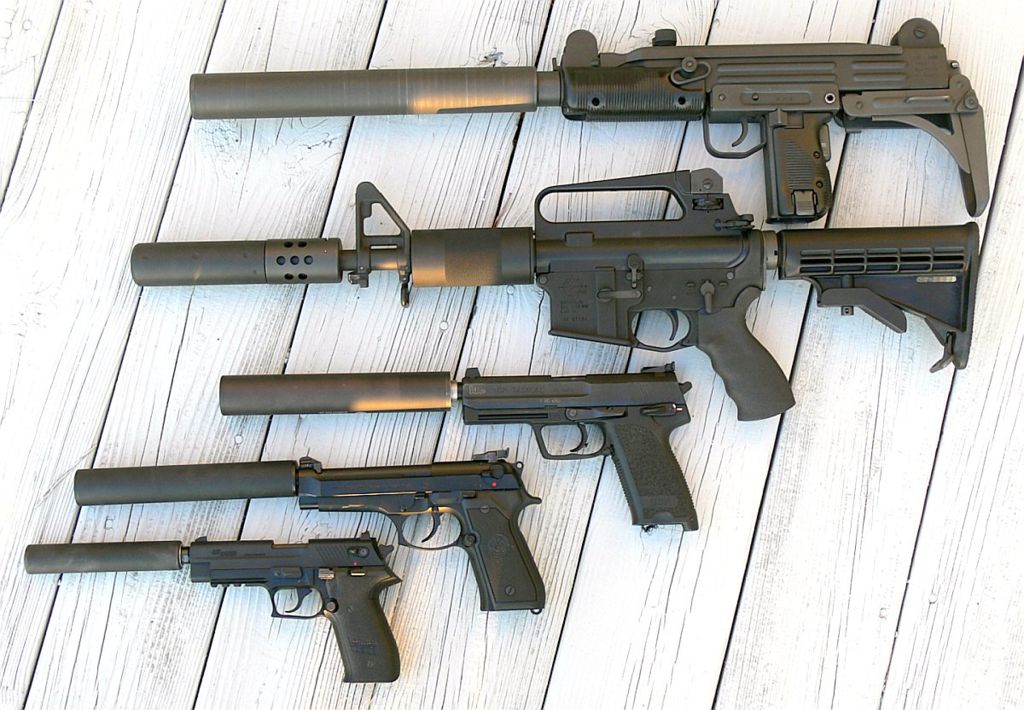
By Cassandra McBride, ammo.com
Report Highlights: Suppressors manage the sound of gunfire, reducing it to safer and more comfortable levels.
- Suppressors reduce the sound of gunfire by 20-35 decibels (dB), on average.
- An unsuppressed gunshot is roughly 155-177 dB, depending on the cartridge.
- A suppressed gunshot roughly averages 120-140 dB, depending on the cartridge.
- Suppressors do not make firearms more lethal. They only serve to dampen the intensity of the report.

Methodology
All data used in this article comes from reputable sources that follow standardized and replicable testing methods, including or equivalent to MIL-STD-1474D, the U.S. military’s standard for measuring firearm impulse noise.
Results may differ depending on environmental factors, barrel length, ammo type (e.g. subsonic vs. supersonic), and other factors. Data was cross-referenced and averaged across multiple reports where available.
How Much Does a Suppressor Reduce Noise?
On average, a suppressor reduces the noise of a gunshot by 20-35dB, depending on the firearm, environment, ammunition, and suppressor. 3, 5, 6, 7, 8, 9, 10
Smaller and/or subsonic cartridges tend to issue quieter reports than larger, higher-pressure ones. Although results vary depending on many factors, shooters can typically expect suppressors to reduce the intensity comparable to that of a jet engine taking off (150 dB depending on distance) to that of thunder (approximately 120 dB). 11
How Loud Is a Gunshot Noise?
On average, gunshots create sounds that are 155-170 dB. This is comparable to the intensity of a jet engine or fireworks, though gunfire occurs in short, high-pressure bursts rather than continuously.
Gunshot Noise Chart
*Disclaimer: Subsonic ammunition testing is included when available and classified accordingly.
| Cartridge | Barrel Length | Unsuppressed (Peak dB) |
|---|---|---|
| .22 LR (Rifle) | 16″ barrel, subsonic ammo | 145-155 dB |
| .22 LR (Pistol) | 4.5″ barrel | 140-161 dB |
| 9mm Luger (Pistol) | 4-5″ barrel, 147 gr subsonic | 157-167 dB |
| .45 ACP (Pistol) | 5″ barrel | 165-166 dB |
| 5.56x45mm / .223 Rem (Rifle) | 16″ barrel | 165-171 dB |
| .308 Win / 7.62x51mm (Rifle) | 18″ barrel | 167-173 dB |
Source: Congressional Sportsmen’s Foundation
How Loud Is a Suppressed Gunshot?
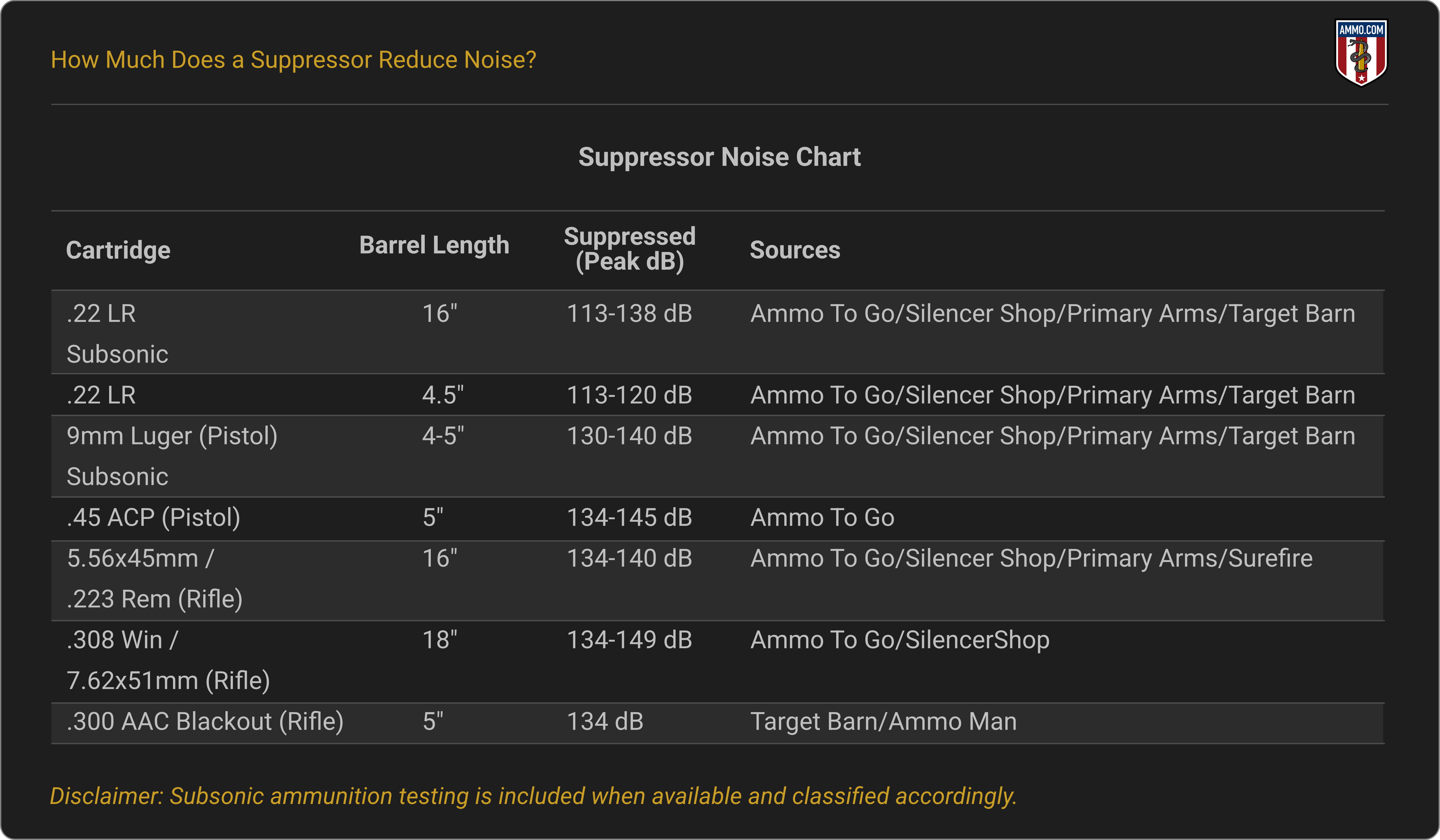
A suppressor reduces sound by an average of 20-35 dB. A suppressed gunshot is typically 120dB-140dB, still audible, but often below 140 dB. 3, 5, 6, 7, 8, 9, 10, 11
Although some suppressors still allow the emission of sound as intense as 145 dB, actual results depend on the cartridge, barrel length, suppressor quality, and type of ammo being fired.
Suppressor Decibel Reduction Chart
*Disclaimer: Subsonic ammunition testing is included when available and classified accordingly.
How Does a Suppressor Work?
A suppressor functions much like a car’s muffler. It controls the gas and pressure at the firearm’s muzzle, thus dampening the sound of propellant gases as they exit the barrel. A suppressor does not completely silence a gunshot; it merely softens the report.
To truly understand how suppressors work, we must first understand how sound works and what happens when a gun is fired.
Sound is created when our ears detect rapid changes in air pressure that cause vibrations moving through the air. Our ears detect sound because pressure changes create vibrations. When a gun is fired, ignition of the primer creates a small explosion, which in turn ignites gun powder to create a burst of high-pressure gas that propels a bullet down the barrel. When pressurized propellant gases reach the muzzle, a loud, sharp sound is produced.
A gunshot produces two (and potentially three) types of noises:
- Muzzle Blast – The loudest sound, caused by high-pressure gases escaping the barrel. This is the sound a suppressor is designed to minimize.
- Sonic Crack – If a bullet exits the muzzle at a velocity greater than the speed of sound (about 1,125 feet per second), it creates a small sonic boom. This is the sharp “crack” heard after a shot is fired.
- Mechanical Noise – The sounds made by the firearm’s moving parts, such as a slide cycling or bolt closing.
A suppressor is a device that screws into the end of a gun barrel. Inside are a series of chambers and baffles that capture and redirect the pressurized gases produced upon ignition. By slowing and cooling those gases before they reach open air, the suppressor reduces the sudden pressure change that creates most of a gunshot’s noise.
By cooling and redirecting propellant gases, a suppressor can reduce the sound of a gunshot by 20-35 dB, which in turn helps protect the shooter’s and bystanders’ hearing. The sound is still very much audible, but it isn’t as potent. Furthermore, a suppressor doesn’t affect the mechanical sounds of firearm operation, and does nothing to negate a supersonic cartridge’s sonic boom.
Do Suppressors Make Guns More Lethal?
No. Suppressors (often referred to as “silencers”) do not make guns more lethal, nor do they mask gunfire by stifling the sound completely.
Unlike Hollywood portrayals, suppressors simply reduce the intensity of the sound produced by gunfire. Their primary purpose is to protect hearing and reduce noise pollution – not to conceal shots. Even the best suppressors on the market rarely reduce sound to below 110 dB, and most firearms measure 120-140 dB when suppressed.
Wrap-Up
Suppressors are valuable tools for reducing the intensity of gunfire, protecting hearing, and improving range safety. While they don’t make firearms perfectly silent or more dangerous, they significantly lower sound levels and make shooting more comfortable for everyone nearby.
Sources
- SilencerCo – How Do Suppressors Work?
- Decibel Ratings Explained: A Guide to Understanding Suppressor Sound Reduction
- Silencer Central – Gun dB Levels Compared
- Silencer Shop – “What Does a Gunshot Sound Like?”
- SureFire – SOCOM Suppressor Technical Data (SOCOM556-RC2)
- Primary Arms – Understanding Suppressor Decibel Ratings: The Science Behind Firearm Sound Reduction
- Dead Air Armament – “Sandman L Specs and dB Reduction Data”
- Gunfire Noise Level Reference Chart (Clark & Krammer)
- Thunder Beast Arms – Ultra Suppressor Series Data Sheet
- Common Noise Levels: How Loud is Too Loud?
- Congressional Sportsmen’s Foundation
Written by Cassandra McBride. Original here.
